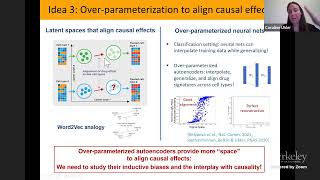
Causality and Autoencoders in Light of Drug Repurposing for COVID-19
Explore causal inference and autoencoders in drug repurposing for COVID-19, covering observational data, causality hierarchy, and predicting interventions with Caroline Uhler from MIT.
How Did Fibonacci Beat the Solitaire Army?
Explore Fibonacci's mathematical strategy to defeat the Solitaire army, featuring life-and-death mathematics, triangles of death, and captivating animations.
Dynamical Systems in Neuroscience
Explore cluster computing and OpenMind for brain and cognitive sciences, covering dynamical systems, models, and observation techniques in neuroscience research.
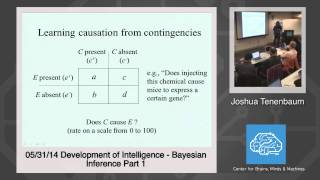
Development of Intelligence - Josh Tenenbaum: Bayesian Inference
Explore Bayesian inference and cognitive neuroscience with Josh Tenenbaum, delving into AI challenges, scene understanding, and advanced mathematical concepts for intelligence development.
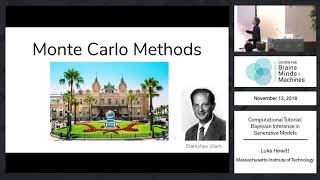
Bayesian Inference in Generative Models
Explore approximate Bayesian inference methods, including sampling-based techniques and variational inference, with hands-on exercises in implementing algorithms and using probabilistic programming languages.
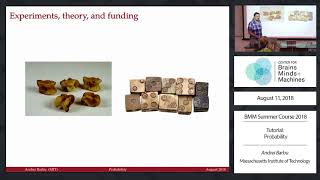
Probability Tutorial
Explore probability concepts, from uncertainty to Bayesian reasoning, with practical applications in graphical models and hidden Markov models.
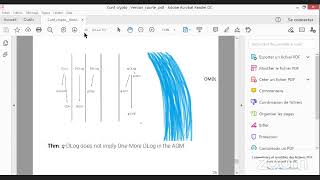
Cryptanalysis 2
Explore cryptanalysis techniques, focusing on discrete logarithm problems in finite fields. Learn about L notation, historical developments, and computational complexity.
Proofs and Arguments
Explore witness indistinguishability and boosting variable computation on encrypted data in this advanced cryptography presentation.
Lattice Cryptanalysis
Explore lattice cryptanalysis techniques, barriers, and implementations with expert insights from leading researchers in the field.
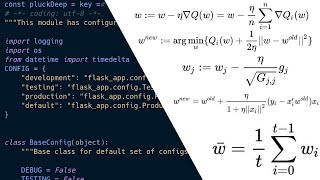
How to Read Math as a Software Engineer
Learn to interpret mathematical formulas as a software engineer, reducing anxiety and enhancing coding skills through practical examples and step-by-step guidance.
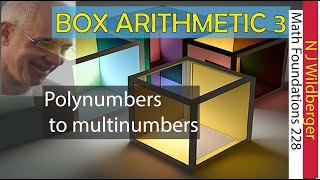
The Big Step from Polynumbers to Multinumbers - Math Foundations - N J Wildberger
Explore the transition from polynumbers to multinumbers, expanding arithmetic concepts using multisets. Learn new notations and operations for a more flexible algebraic framework.
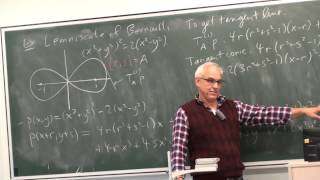
The Differential Calculus for Curves - Differential Geometry
Exploring advanced differential calculus for algebraic curves, including tangent lines, conics, and point classification. Extends to 3D surfaces, offering a comprehensive view of curve analysis.
Infinitesimal Calculus with Finite Fields - Famous Math Problems
Explore infinitesimal calculus in finite fields through the semi-cubical parabola over F_7, challenging traditional real number analysis and emphasizing polynumbers and de Casteljau Bezier curves.
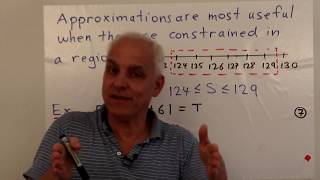
Adding Bigger Sums Using Open Numbers - Elementary Mathematics Explained
Learn a novel approach to adding larger sums using open numbers, focusing on a big end approach. Discover advantages and practice approximating sums by finding ranges for answers.
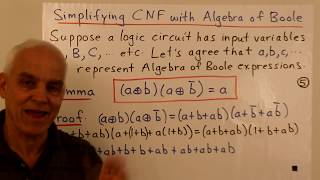
Trying to Sidestep the SAT Problem - N J Wildberger
Explores the SAT problem in Boolean algebra and logic circuits, introducing the Algebra of Boole approach as an alternative for analyzing smaller circuits and potentially addressing larger-scale issues in integrated circuit design.
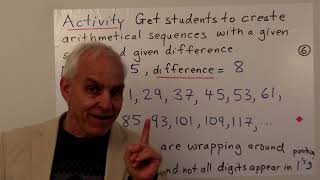
Introducing Arithmetic Sequences - Elementary Mathematics Explained
Explore arithmetic sequences, their patterns, and applications in elementary mathematics. Practice adding sequences systematically to improve number skills and solve interesting puzzles.
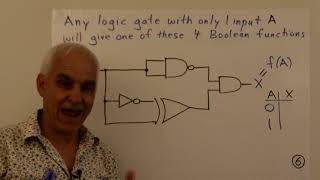
Canonical Forms for Logic Circuits - Math Foundations
Explore canonical forms for logic circuits, Boolean functions, and their geometric interpretations. Learn to express Boolean functions algebraically using Boolean algebra and Boole's original algebra.
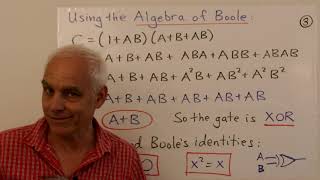
How the Algebra of Boole Simplifies Circuit Analysis - Math Foundations - N J Wildberger
Explore how the Algebra of Boole simplifies circuit analysis, comparing it with traditional Boolean algebra for encoding logic gates and solving engineering problems.
ADE Graphs and Lattices, Weights and Quarks
Explore ADE graphs, lattices, and their connections to mathematics and particle physics. Discover the Numbers game, weights, and the fascinating link between A2 diagrams and quark theory.
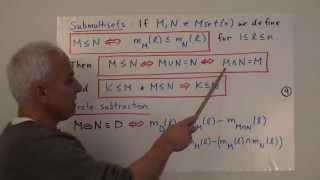
The Realm of Natural Number Multisets - Data Structures in Mathematics
Explore natural number multisets, their operations, and realm laws of arithmetic. Learn about k-msets, addition, union, and intersection in this expanded mathematical framework.
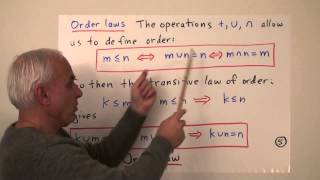
The Realm of Natural Numbers - Data Structures in Mathematics
Explore natural numbers through multisets, examining addition, union, and intersection operations. Discover unique properties, including a new distributive law that forms the basis for tropical calculus.