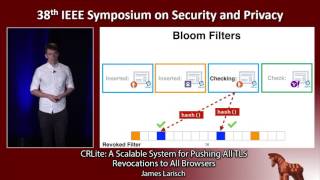
CRLite - A Scalable System for Pushing All TLS Revocations to All Browsers
Explore a scalable system for efficient TLS certificate revocation checking in browsers, reducing latency and enhancing privacy while maintaining low bandwidth costs.
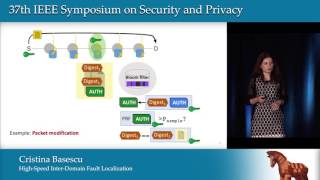
High-Speed Inter-domain Fault Localization
Secure data-plane fault localization protocol for inter-domain settings, enabling precise localization of malicious network links with high performance and low overhead.
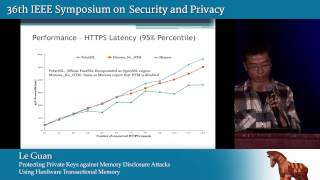
Protecting Private Keys Against Memory Disclosure Attacks Using Hardware Transactional Memory
Explore hardware transactional memory for protecting cryptographic keys against memory disclosure attacks, enhancing security in both software and physical threat scenarios.
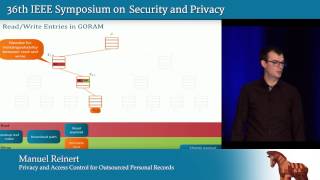
Privacy and Access Control for Outsourced Personal Records
Cryptographic system GORAM protects outsourced data secrecy, integrity, and access control while ensuring anonymity and unlinkability, addressing cloud storage security concerns for sensitive applications.
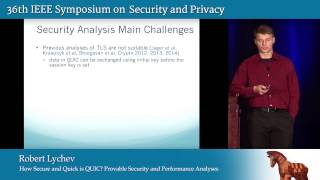
How Secure and Quick is QUIC? Provable Security and Performance Analyses
Analyzes QUIC protocol's security and performance, revealing strengths and vulnerabilities. Explores trade-offs between latency reduction and robust security in this innovative transport protocol.
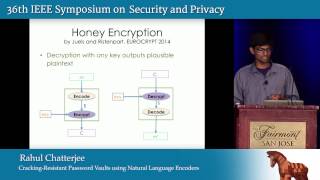
Cracking-Resistant Password Vaults Using Natural Language Encoders
Innovative password vault security using natural language encoders to generate plausible decoys, resisting offline cracking and forcing online attacks. Implements NoCrack system for enhanced protection.
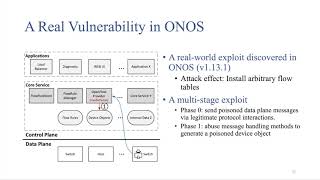
Unexpected Data Dependency Creation and Chaining - A New Attack to SDN
Explores a novel attack on Software-Defined Networking, demonstrating unexpected data dependencies and their chaining effects. Covers attack mechanics, impacts, and potential countermeasures.

Plundervolt - Software-Based Fault Injection Attacks against Intel SGX
Explore software-based fault injection attacks on Intel SGX, focusing on the Plundervolt technique that exploits voltage scaling interfaces to compromise enclave computations and cryptographic algorithms.
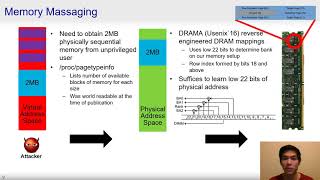
RAMBleed - Reading Bits in Memory Without Accessing Them
Explores RAMBleed, a novel Rowhammer-based side-channel attack that can read sensitive data from DRAM without accessing it, demonstrating security implications for confidentiality even with ECC memory.
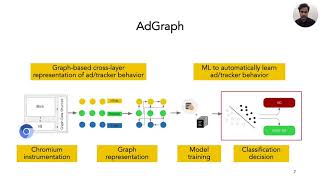
AdGraph: A Graph-Based Approach to Ad and Tracker Blocking
Innovative graph-based machine learning approach for detecting online ads and trackers, offering improved accuracy and performance compared to traditional filter list methods.
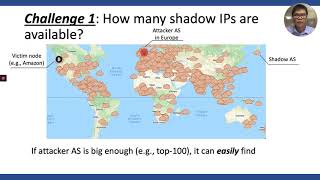
A Stealthier Partitioning Attack Against Bitcoin Peer-to-Peer Network
Explores a stealthy partitioning attack on Bitcoin's P2P network, exploiting network topology to influence node connections without routing manipulation, posing risks for cryptocurrency security.

Formal Modelling and Proof in the CHERI Design and Implementation Process
Explore rigorous engineering methods for developing secure processor architecture, focusing on CHERI's hardware capabilities for fine-grained memory protection and secure compartmentalization.
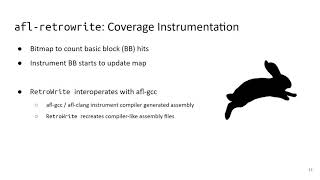
RetroWrite- Statically Instrumenting COTS Binaries for Fuzzing and Sanitization
Explore static instrumentation of COTS binaries for enhanced fuzzing and sanitization using RetroWrite, a framework for rewriting position-independent code.

Dragonblood - Analyzing the Dragonfly Handshake of WPA3 and EAP-pwd
Analyze vulnerabilities in WPA3 and EAP-pwd protocols, exploring attacks on clients and access points, information leakage, and potential solutions for Wi-Fi security.
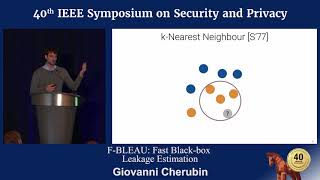
F-BLEAU - Fast Black-Box Leakage Estimation
Innovative method for estimating information leakage in black-box systems using machine learning techniques, improving efficiency and applicability to continuous output spaces.
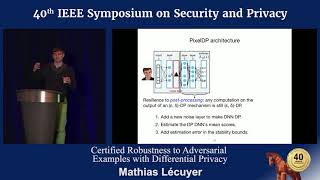
Certified Robustness to Adversarial Examples with Differential Privacy
Explore certified defense against adversarial examples using differential privacy. Scalable solution for large networks and datasets, providing robustness guarantees for various model types.

The 9 Lives of Bleichenbacher's CAT - New Cache Attacks on TLS Implementations
Explores novel cache-based attacks on TLS implementations, demonstrating vulnerabilities in popular systems and introducing a parallelization technique for padding oracle attacks against RSA.

Tracking Browser Fingerprint Evolutions - Antoine Vastel
Explore browser fingerprint tracking techniques, including FP-STALKER's rule-based and hybrid approaches, to understand long-term user identification without cookies.
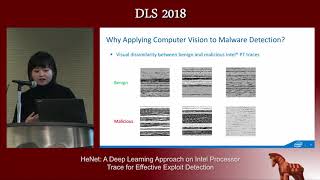
HeNet- A Deep Learning Approach on Intel Processor Trace for Effective Exploit Detection
Explore a deep learning approach using Intel Processor Trace for effective exploit detection. Learn about HeNet's hierarchical ensemble neural network for classifying hardware-generated control flow traces in malware detection.
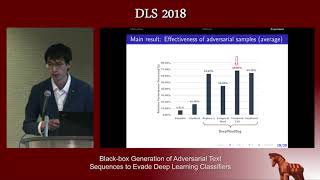
Black-Box Generation of Adversarial Text Sequences to Evade Deep Learning Classifiers
Explores techniques for generating adversarial text sequences to deceive deep learning classifiers, focusing on black-box attacks and their effectiveness in real-world scenarios.
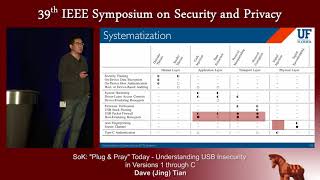
Plug & Pray Today - Understanding USB Insecurity in Versions 1 through C
Comprehensive overview of USB security vulnerabilities and defenses across multiple layers, analyzing attacks, countermeasures, and the USB Type-C Authentication protocol's limitations.