
What Does It Take to Be a Good Fisherman?
Explore statistical challenges in learning from biased data, focusing on self-selection issues in various fields and discussing recent progress in econometric modeling and auction theory.
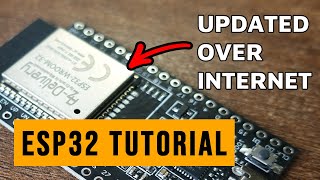
How to Fully Control ESP32 Over Internet
Learn to control ESP32 over the Internet, including firmware updates. Covers setup, coding, RTOS, variable updates, OTA, function calls, data plotting, and API usage for remote microcontroller management.

Min-Max Optimization - Part II
Explore advanced min-max optimization techniques, including convergence analysis, implicit methods, and applications to multiplayer games and polynomial-type problems.
Min-Max Optimization - Part I
Explore min-max optimization, equilibrium computation, and adversarial gradient descent in zero-sum games, connecting classical techniques to deep learning applications.

Data-Driven Control - Overview
Explore how machine learning optimization can discover models and effective controllers from data, revolutionizing control theory and engineering applications.

Pediatric Moonshot - Global, Real-Time, Privacy-Preserving Applications for Children's Medicine
Exploring innovative AI applications in pediatric medicine using privacy-preserving, decentralized edge cloud technology to improve global healthcare equity and enable real-time diagnosis and treatment.

Data Driven ED Solutions - Innovations in ED Management Course
Explore innovative strategies for optimizing emergency department operations, focusing on data-driven solutions, patient flow management, and leadership techniques to enhance overall efficiency and care quality.

The Sodium-Potassium ATPase Pump
Explore the intricate workings of the Sodium-Potassium ATPase Pump, its role in active transport, and related membrane transport mechanisms in this concise yet comprehensive video.
Embedded Nom - A Case Study of Memory Safe Parsing in Resource Constrained Environments
Explore memory-safe parsing in resource-constrained environments using Nom parser combinator framework. Learn to integrate safe parsers with existing C codebases for embedded systems.
Slow But Steady - Achieving Real Security Within Two Decades
Explore strategies for achieving real security in software systems over two decades, focusing on incremental improvements, formal verification, and well-engineered infrastructure.
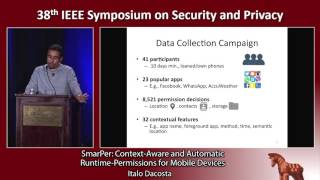
SmarPer- Context-Aware and Automatic Runtime-Permissions for Mobile Devices
Explores context-aware, automatic runtime permissions for mobile devices, using machine learning to predict user decisions and offering data obfuscation options to balance privacy and utility.
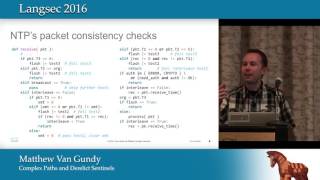
Complex Paths and Derelict Sentinels - Software Engineering Underpinnings of NTP Vulnerabilities
Explore software engineering choices behind recent NTP vulnerabilities, focusing on packet consistency checks, ephemeral associations, and spoofing in this IEEE conference talk.
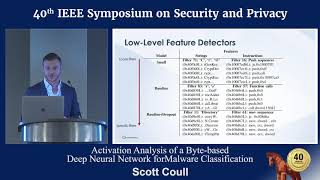
Activation Analysis of a Byte-Based Deep Neural Network for Malware Classification
Explores deep learning models for malware classification, analyzing learned features from byte-level to end-to-end, connecting activations to binary semantics, and examining impacts of training data and regularization.
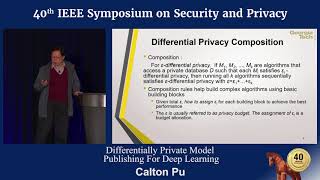
Differentially Private Model Publishing for Deep Learning
Explore techniques for publishing deep learning models with differential privacy, optimizing privacy loss and model accuracy through concentrated differential privacy and dynamic budget allocation.
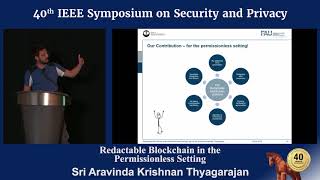
Redactable Blockchain in the Permissionless Setting
Explore innovative blockchain redaction techniques for permissionless systems, addressing data privacy concerns while maintaining security and public verifiability without additional trust assumptions.
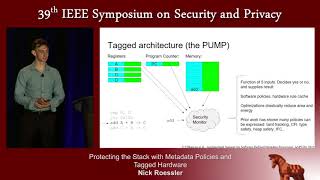
Protecting the Stack with Metadata Policies and Tagged Hardware
Explore innovative metadata-tag based stack-protection security policies for tagged architectures, focusing on efficient cacheability and performance in unsafe languages like C.
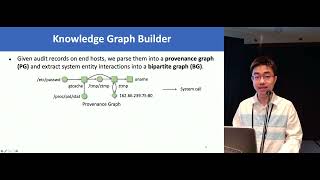
ShadeWatcher: Recommendation-Guided Cyber Threat Analysis Using System Audit Records
Explore recommendation-guided cyber threat analysis using system audit records, enhancing detection effectiveness and efficiency through innovative connectivity modeling and learning techniques.
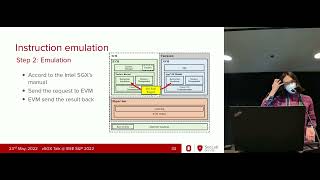
vSGX: Virtualizing SGX Enclaves on AMD SEV
Explore virtualizing Intel SGX enclaves on AMD SEV, addressing vendor lock-in and enabling software-defined trusted execution environments. Learn design goals, challenges, and performance implications.
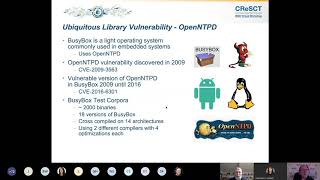
Identifying Ubiquitous Third Party Libraries in Compiled Executables Using Annotated and Translated
Explore techniques for identifying third-party libraries in compiled executables, focusing on firmware indicator translation and machine learning approaches for enhanced security analysis.

EM Fingerprints - Identifying Unauthorized Hardware Substitutions in the Supply Chain Jungle
Explore electromagnetic fingerprinting techniques to detect unauthorized hardware substitutions in supply chains, enhancing security against sophisticated attacks.
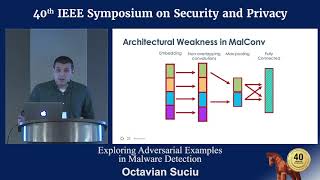
Exploring Adversarial Examples in Malware Detection
Explore adversarial examples in malware detection using CNNs, examining attack strategies, their effectiveness, and implications for model robustness in cybersecurity applications.