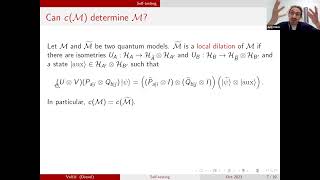
Constant-Sized Self-Tests for Maximally Entangled States and Single Projective Measurements
Explore self-testing in bipartite Bell scenarios, focusing on maximally entangled states and projective measurements. Learn about representation theory and spectral analysis in quantum systems.
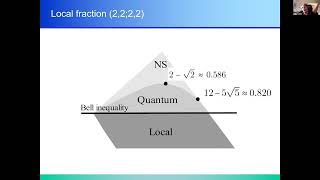
State-Independent Certification of Quantum Observables and Minimal Bipartite Full Nonlocality
Explore state-independent certification of quantum observables and minimal bipartite full nonlocality. Delve into recent findings on unique quantum observable sets and equivalences in quantum correlations.
Machine Vision vs Deep Learning in Cancer Detection
Explore machine vision and deep learning applications in cancer diagnosis, comparing their strengths and limitations. Gain insights into innovative computer-aided methods for analyzing microscopic images of breast cancer tissue.
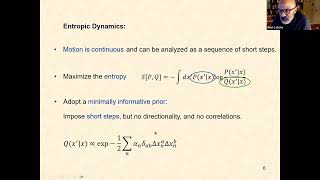
The Entropic Dynamics Approach to Quantum Mechanics
Explore the Entropic Dynamics framework for reconstructing Quantum Mechanics, focusing on ontic and epistemic variables, probability distributions, and the derivation of key quantum principles.
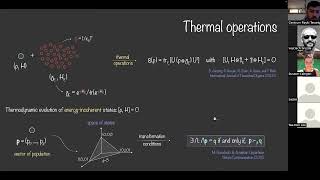
Geometric and Information-Theoretic Aspects of Quantum Thermodynamics
Explore geometric and information-theoretic aspects of quantum thermodynamics, focusing on state transformations, constraints, and practical applications of quantum catalysis in non-classical light generation.
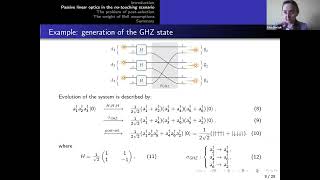
Generation of Entanglement in No-Touching Scenario: Causal Aspects and Protocols
Explore entanglement generation protocols, causal aspects, and quantum foundations. Delve into passive linear optical designs, post-selection issues, and Bell inequality violations in quantum information.
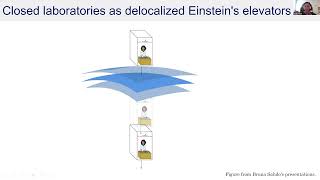
Indefinite Temporal Order on a Superposition of Spherical Shells
Explore indefinite temporal order in quantum theory through a new gravitational quantum switch protocol involving superposed spherical shells and entangled spacetime geometry.
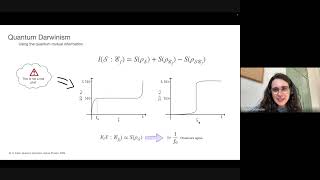
Distinguishing Between Redundancy and Consensus in Quantifying Quantum Objectivity
Explore rigorous definitions of "redundancy" and "consensus" in quantum objectivity, examining their distinct roles in the quantum-to-classical transition and implications for quantum Darwinism.

Attoscience, Nobel 2023 and Quantum Simulators
Explore attoscience, high harmonics generation, and quantum simulators. Delve into QED aspects and recent developments in the field, concluding with insights on Nobel 2023.
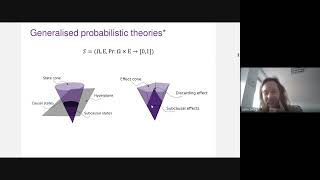
Contextuality without Incompatibility in Quantum Measurements
Explore quantum contextuality without measurement incompatibility, challenging conventional understanding. Delve into a new convex-geometric framework for generalized contextuality in quantum systems.
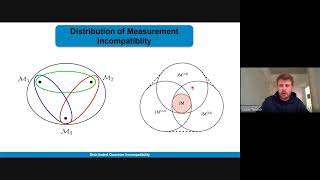
Distributed Quantum Incompatibility
Explore distributed quantum incompatibility, its enhancement through additional measurements, and its impact on nonlocality in Bell experiments. Gain insights into quantum information processing.
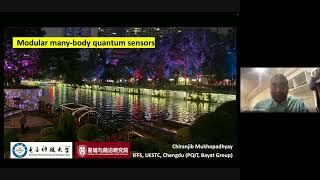
Modular Many-Body Quantum Sensors
Explore modular approaches for enhancing quantum sensing precision through multiple phase transitions in many-body systems, achieving Heisenberg scaling at phase boundaries.
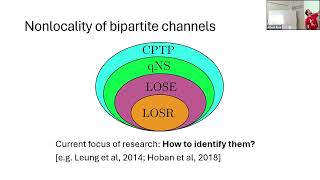
Nonlocality of Channels Under Decoherence
Explore nonlocality in quantum channels, focusing on its persistence under decoherence. Gain insights into identifying nonlocal properties of bipartite channels and their behavior in realistic setups.
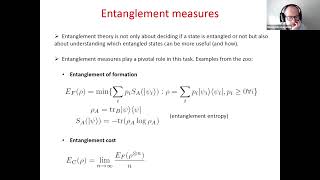
Maximally Entangled Mixed States: Do They Exist?
Explore the existence of maximally entangled mixed states in quantum information theory, examining their potential and implications for practical applications.
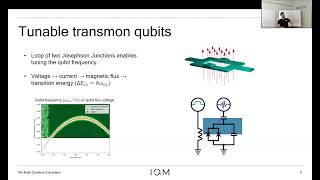
Automatic Calibration and Benchmarking of IQM Quantum Processing Units
Explore automatic calibration and benchmarking of IQM quantum processing units, focusing on superconducting qubits, architecture, and methods for reliable device optimization.
Learning and Inference with Prior Knowledge
Explore how prior knowledge influences learning and inference in intelligent systems, from human cognition to AI, with insights on improving behavioral robustness in deep networks.
Studying the Behavior of Generative AI-Based Agents in Multi-Agent Systems
Explore generative AI-based agents in multi-agent systems using Concordia library. Learn about language-mediated simulations, flexible component systems, and the Game Master concept for diverse research applications.
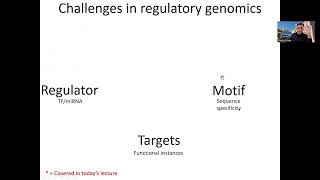
Regulatory Circuitry and Networks - Lecture 7
Explore regulatory circuitry and networks in biological systems, focusing on gene regulation mechanisms and their interconnected pathways.
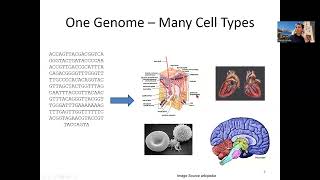
Epigenomics and Hidden Markov Models in Computational Biology - Lecture 5
Explore epigenomics, histone modifications, and DNA profiling techniques. Learn about read mapping, quality control, and Hidden Markov Models for analyzing chromatin states in computational biology.

Efficient and Reliable Wrapping of C APIs Using Modern C++ - 2024 Update
Learn efficient techniques for wrapping C APIs in modern C++. Explore adapter interface design, overhead avoidance, compile-time safety, and performance optimization. Gain insights into unit testing and C++23 features for reliable API integration.
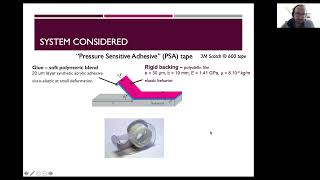
Inertial Effects on the Multi-Scale Stick-Slip Dynamics in Adhesive Tape Peeling
Explore inertial effects on multi-scale stick-slip dynamics in adhesive tape peeling, uncovering complex instabilities and energy balances through experimental studies and quantitative modeling.