Backstage is Not Your Platform - Building a Comprehensive Internal Developer Platform
Explore building an enterprise-level Internal Developer Platform by combining open-source interfaces with Platform Orchestrators for a robust backend and enhanced developer experience.
Master Prometheus on Kubernetes - Spotting Every Issue Without Alert Fatigue
Optimize Prometheus on Kubernetes: Implement best practices for effective alerting, reduce noise, and leverage key components to detect critical issues in large-scale environments.
Designing Your Internal Developer Platform Backend
Design an effective Internal Developer Platform backend for automation, standardization, and self-service. Explore options and learn how enterprises use orchestration for config setup.
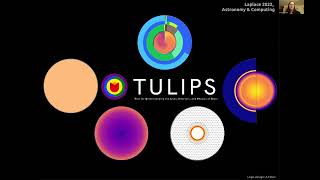
Visualizing MESA Models with TULIPS - How to Python
Learn to visualize MESA stellar evolution models using TULIPS Python package. Create plots and animations showing changes in stars over time. Enhance understanding of stellar structure and evolution.
How to Win at Monetizing Games as a Service
Learn strategies for monetizing games as a service, from data engineering to AI/ML. Explore data pipelines, warehouses, and machine learning models to optimize game monetization.
Fountain of Creativity or Pandora's Box - Large Language Models in Healthcare: From Concept to Application
Explore large language models in healthcare: from concept to application, with insights on potential benefits and risks from Stanford experts.
AI Aspirations and Healthcare Futures - August 2, 2023
Explore AI's transformative potential in healthcare with insights from Microsoft's Chief Scientific Officer on future innovations and challenges.
Leveraging AI for Equitable Mental Health Screening and Addressing Inequities in Trainee Evaluations - 18 Oct 2023
Explore AI's role in equitable mental health screening and address inequities in medical trainee evaluations for underrepresented groups.
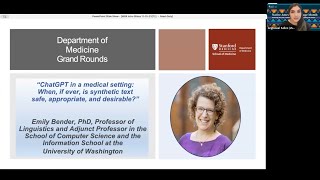
ChatGPT in a Medical Setting: Safety, Appropriateness, and Desirability - November 15, 2023
Explore the safety, appropriateness, and potential benefits of using ChatGPT in medical contexts with insights from linguistics and computer science experts.
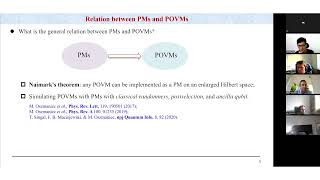
Asymptotics and Typicality of Sequential Generalized Measurements
Explore the relation between projective and generalized quantum measurements, proving how projective measurements arise from sequential generalized measurements in the asymptotic limit.
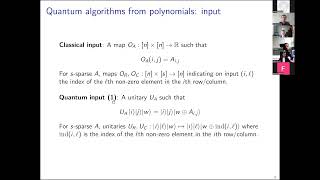
Quantum Algorithms from Polynomials: Solving Linear Systems Faster - Lecture
Explore quantum algorithms for solving linear systems using polynomial approximations. Learn about LCU and QSVT techniques, and discover constant factor improvements in quantum linear algebra.
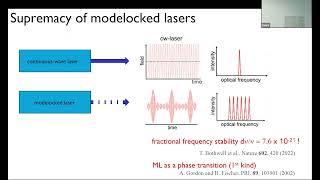
Time-Domain Approach to Quantum Optics
Explore time-domain quantum optics, focusing on subcycle sampling of vacuum states and its applications in quantum computing, communication, and sensing. Gain insights into mid-infrared technologies.
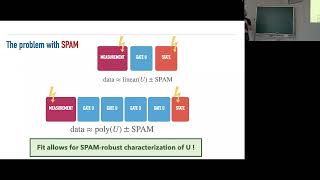
General Guarantees for Randomized Benchmarking with Random Quantum Circuits - Lecture
Explore general guarantees for randomized benchmarking using random quantum circuits, enhancing understanding of quantum information and computing concepts.
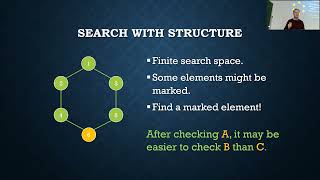
Quantum Algorithms for Search and Optimization
Explore quantum algorithms for search and optimization, including recent advancements in random walk speedups, NP-complete problem improvements, and geometric problem solutions.
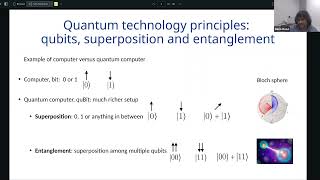
Quantum Technologies: The Case of Quantum Batteries
Explore quantum batteries as energy storage devices, their advantages over classical counterparts, and recent theoretical and experimental progress in quantum charging advantage.
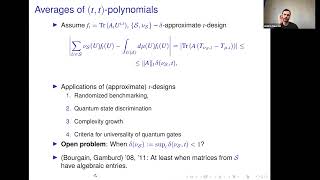
Random Approximate t-Designs in Quantum Information - Lecture
Explore approximate t-designs in quantum information, their applications, and how finite random gate-sets mimic the Haar measure in this advanced theoretical physics seminar.
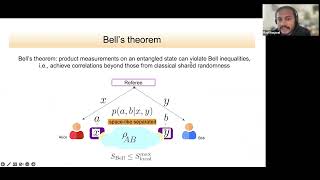
Contextuality in Composite Systems: The Role of Entanglement in the Kochen-Specker Theorem
Explore the interplay between contextuality and entanglement in composite quantum systems, examining implications for multiqubit quantum computation models with state injection.
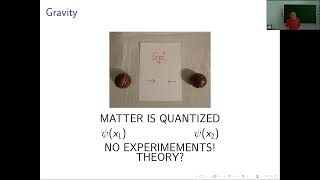
Quantum Control and Semiclassical Quantum Gravity
Explore quantum control and semiclassical quantum gravity, focusing on hybrid quantum-classical coupling and its implications for wave function collapse theory in the Newtonian limit.
Tensors versus Tensor Densities and Stokes Theorem - Lecture 12
Explore tensors, tensor densities, and Stokes theorem in electrodynamics and relativity. Gain insights into advanced theoretical physics concepts.
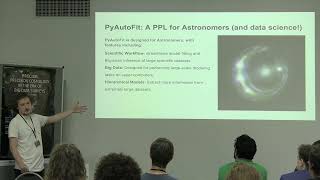
Introduction to Model Fitting - Gravitational Lensing and Graphical Modeling
Explore gravitational lensing model fitting techniques, from traditional methods to innovative graphical modeling, and learn about PyAutoFit for streamlined probabilistic programming.
Beyond Quantum Markovian Semigroups
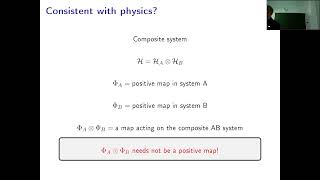
Explore open quantum systems, Markovian semigroups, and non-Markovian evolution. Gain insights into complete positivity, quantum channels, and connections to quantum stochastic processes.