Challenges in ML Engineering
Explore challenges in ML engineering, including cost-efficient inference, automation, accuracy monitoring, and anomaly detection for real-world AI applications.
New Frontiers for AI-assisted Design and Discovery in Molecular Generation
Explore AI-assisted design and discovery for generating molecules with desirable properties. Learn about overcoming challenges in combinatorial space, modeling interactions, and segregating representations for improved drug and material development.
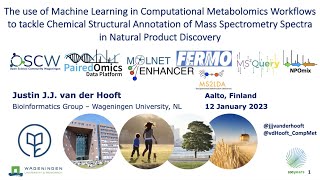
The Use of Machine Learning in Computational Metabolomics Workflows
Explore machine learning applications in computational metabolomics for metabolite structure analysis. Learn about tools like MS2LDA, MotifDB, Spec2Vec, and MS2DeepScore for improved metabolite discovery and characterization.
Hierarchical Imitation Learning with Vector Quantized Models
Learn hierarchical imitation learning techniques using vector quantized models for complex decision-making tasks, exploring subgoal identification and planning strategies to outperform expert demonstrations.
Elucidating the Design Space of Diffusion-Based Generative Models
Explore advancements in diffusion-based generative models, including improved sampling, training, and score network preconditioning. Learn about state-of-the-art results and modular design changes for enhanced efficiency and quality.
Total Variation Minimization Perspective on Trustworthy Federated Learning
Explore total variation minimization in federated learning, covering computational and statistical aspects for designing trustworthy systems across various FL flavors.
Scalable and Flexible Distributed Reinforcement Learning Systems
Explore scalable distributed reinforcement learning systems, focusing on flexible training loops, statement management, and GPU allocation. Gain insights into building efficient RLHF systems for large-scale applications.
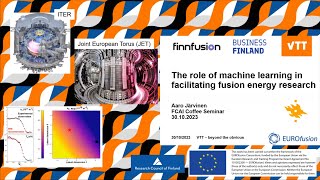
The Role of Machine Learning in Facilitating Fusion Energy Research
Explore machine learning applications in fusion energy research, including turbulence simulation speed-ups and predicting rare events. Gain insights into ML's potential to accelerate progress towards clean, abundant fusion energy.
Fast and Accurate Probabilistic Time Series Classification
Explore fast and accurate probabilistic time series classification using MINIROCKET technology, achieving near-state-of-the-art performance with significantly reduced computational costs compared to existing methods.
Automating Distributed Heterogeneous Computing for Domain Experts
Explore new approaches for enabling domain experts to program future HPC systems efficiently, focusing on compiler and runtime techniques for distributed heterogeneous computing.
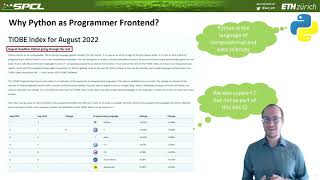
Portable High-Performance Python on CPUs, GPUs, and FPGAs
Optimize Python for high performance on CPUs, GPUs, and FPGAs. Learn HPC-oriented extensions, automatic optimizations, and portable performance techniques across architectures.
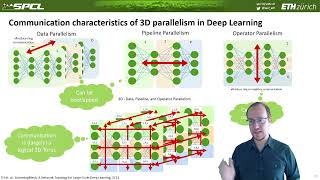
Post-Moore Spatial Computing: From Chips to Clusters
Explore spatial computing strategies for post-Moore's Law era, addressing challenges in scaling compute power from chips to clusters for AI and high-performance computing.
Self-Adjusting Networks for Optimized Datacenter Topology Design
Explore self-adjusting networks optimized for datacenter traffic, including metrics, design principles, and research challenges. Gain insights into demand-aware graphs and related optimization problems.
Next-Generation Networks for Machine Learning
Explore next-gen networks for machine learning, focusing on optical fabrics and scheduling techniques to accelerate distributed DNN training workloads and overcome datacenter network bottlenecks.
Heterogeneous Serverless Computing for High-Performance Computing and AI Workloads
Explore heterogeneous serverless computing for efficient HPC, HPDA, and AI workloads. Learn about innovative accelerator uses and flexible deployment models from edge to exascale.
Productive Performance Engineering for Weather and Climate Modeling with Python
Optimize weather and climate models using Python-embedded DSL and data-centric techniques. Improve productivity and performance through abstraction, semi-automated workflows, and transfer tuning for efficient scaling on supercomputers.
Efficient AI: From Supercomputers to Smartphones
Explore techniques for efficient AI training and inference, from data ingestion to model compression, enabling powerful models on supercomputers and smartphones.
HPC and AI/ML: A Synergistic Relationship
Explore synergies between HPC and AI/ML, focusing on scalable algorithms, efficient resource use, and data-driven models for performance optimization in large-scale computing environments.
Deinsum: Practically I/O Optimal Multi-Linear Algebra for Distributed Systems
Optimize distributed multilinear algebra computations with Deinsum framework. Automate data movement-optimal tiling and scheduling for enhanced performance in high-dimensional tensor operations.
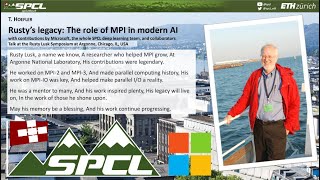
The Role of MPI in Modern AI - Rusty Lusk's Legacy
Explore MPI's crucial role in modern AI and its impact on parallel computing, honoring Rusty Lusk's contributions to the field.

From Two Strong Oxen to Billions of Fleas - The Evolution of Massively Parallel Distributed Supercomputers
Explore massively parallel distributed supercomputers, focusing on distributed-memory parallelism and RDMA through MPI. Gain insights into current designs and future challenges in high-performance computing.