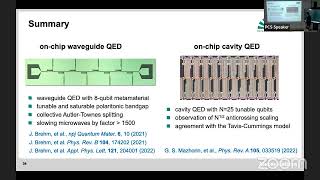
Slowing Down Microwave Photons with Superconducting Qubits
Explore superconducting qubit arrays for controlling microwave photons, demonstrating slow light and potential quantum memory applications in the microwave domain.
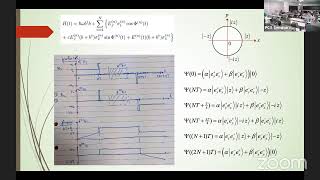
Nanomechanical Control of Superconducting Charge-Qubit Networks
Explore nanomechanical manipulation of superconducting charge-qubit networks using nanoelectromechanical setups and time-protocols for quantum information transduction and entanglement.
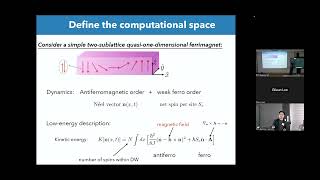
Shuttling Domain Wall Qubit on the Magnetic Racetrack
Explore a scalable quantum computing implementation using mobile domain walls on magnetic racetracks, with long-lived qubits and noise-resistant operations.
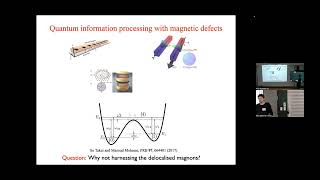
Cavity Magnonics with Domain Walls in Insulating Ferromagnetic Wires
Explore cavity magnonics with domain walls in ferromagnetic wires, uncovering quantum states, entanglement, and detection methods for potential computing applications.

Kirk Lecture: A Recent Technology for Scientific Computing - The Virtual Element Method
Explore the Virtual Element Method, a generalization of FEM for solving PDEs using polygonal/polyhedral meshes, offering improved accuracy, efficiency, and flexibility in scientific computing.
Game Programming: Ray Casting and Line Segment Intersection - Lecture 12
Explore ray casting and line segment intersection for game programming. Learn techniques for 2D visibility, lighting, and practical applications in game development.
Introduction to Artificial Intelligence: Reinforcement Learning - Lecture 13
Explore reinforcement learning fundamentals, including key concepts, problem specifications, and practical examples like Cart Pole and Mountain Car. Gain insights into policies, rewards, and the exploration-exploitation trade-off.
Intro to Artificial Intelligence - MDP and Dynamic Programming - Lecture 15
Explore Markov Decision Processes and Dynamic Programming in AI, learning algorithmic techniques for modern problem-solving in game environments.
Introduction to Artificial Intelligence: Monte Carlo Reinforcement Learning Methods - Lecture 16
Explore Monte Carlo reinforcement learning methods, including prediction and policy iteration, with applications to Blackjack and matchbox machine learning.
Game Programming: Introduction to Shaders - Lecture 21
Explore game shader fundamentals, including rendering techniques, visual effects, and performance optimization for enhanced graphics in game development.
Introduction to Artificial Intelligence: Deep Neural Networks - Lecture 19
Explore deep neural networks, edge detection, and reinforcement learning in AI, with applications to games and image processing.
Movement in Video Game AI - Lecture 4
Explore movement techniques in video games, including pathfinding, steering behaviors, and obstacle avoidance for realistic AI-controlled characters.
Grid Representations in Video Game AI - Lecture 5
Explore grid representations in video game AI, covering localization, optimization, pathfinding, and hierarchical structures for efficient game world modeling and navigation.
Grid Algorithms in Video Game AI - Lecture 7
Explore grid algorithms for game AI, including connectivity, BFS, vector fields, and distance maps. Learn techniques for efficient pathfinding and spatial analysis in video games.
Introduction to Artificial Intelligence - Game Theory - Lecture 9
Explore game theory concepts and applications in AI, focusing on advanced strategies and decision-making in multi-agent environments.
Game Programming: Collision Detection - Lecture 8
Explore collision detection techniques in game programming, covering algorithmic approaches and data structures for efficient collision handling.
Introduction to Artificial Intelligence - Connect 4 and Alpha-Beta Pruning - Lecture 11
Explore Connect 4 AI implementation, focusing on UI controls, game state management, player strategies, and evaluation functions. Learn to develop and debug an intelligent game-playing agent.
Introduction to Artificial Intelligence - Lecture 13: Assignment 4
Explore algorithmic techniques and data structures for AI problem-solving, applying learned concepts to simple games through hands-on assignments.
COMP3200 - Introduction to Artificial Intelligence - MDP and Dynamic Programming - Lecture 16
Explore Markov Decision Processes and Dynamic Programming in AI, learning algorithmic techniques for modern problem-solving in game environments.
Intro to Artificial Intelligence - RL Monte Carlo Methods - Lecture 17
Explore Monte Carlo methods in reinforcement learning, applying algorithmic techniques to solve AI problems in gaming environments.
Introduction to Artificial Intelligence: Connect 4 Assignment and AI Techniques - Lecture 12
Explore AI techniques for Connect 4, including GUI controls, game state management, player implementations, and advanced algorithms like Alpha-Beta pruning and Zobrist hashing.