
What I Learnt Fixing 50+ Broken Kubernetes Clusters
Discover key insights and strategies for troubleshooting Kubernetes clusters, gleaned from fixing over 50 intentionally broken systems in live-streamed debugging sessions.
Help! I've Created a Serverless Monolith
Discover strategies to prevent serverless applications from becoming unmaintainable monoliths. Learn about architecture, scalability, resilience, and metrics for better Azure serverless development.
Effective DevOps for Organizations
Learn effective DevOps practices to enhance organizational performance, focusing on fundamentals, cross-functional teams, customer success, and fostering a culture of psychological safety and continuous improvement.
Code Reflection in Action - Translating Java to SPIR-V
Explore Java-to-SPIR-V translation using Babylon's code reflection API for GPU execution. Learn about parallel compute workloads and graphics libraries implementation.
Project Babylon - Code Reflection Update
Project Babylon extends Java's capabilities with code reflection, enabling analysis and transformation of Java code into foreign programming models like GPU programs.
SPy: Static Python Language - Fast as C, Pythonic as Python
SPy: A statically typed Python variant aiming for C-like performance while preserving Pythonic feel. Leverages modern Python practices and typing for compile-time optimizations without sacrificing dynamic features.
Functional Error Handling in Python - Strategies for Composable Functions
Explore functional error handling in Python, moving beyond exceptions to improve function composability and code reliability. Learn strategies and tools for better error management.
Hybrid Quantum-Classical Machine Learning using Qiskit
Explore hybrid quantum-classical machine learning with Qiskit for text classification and sentiment analysis, combining quantum circuits and classical models.
Overcoming GIL with Subinterpreters and Immutability
Explore efficient data sharing between Python subinterpreters using the "memhive" framework, enabling true parallelism without serialization overhead.
Extensible Python - Robustness Through Addition
Explore extensible Python coding techniques to create robust, maintainable software. Learn patterns for composable code, event-driven architectures, and pluggable systems to extend functionality without modifying existing code.
Container Security - Strengthening the Heart of Your Operations
Explore best practices and effective steps to secure containers, safeguard the software supply chain, and protect end-users from critical security risks in production environments.
Two Examples of Thermodynamic Limits in Neuroscience
Explore thermodynamic limits in neuroscience through two examples, gaining insights into stochastic analysis and numerical probability in mathematical biology.
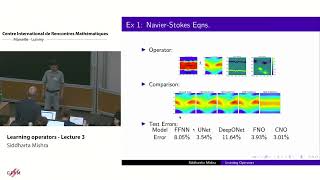
Learning Operators - Lecture 3
Explore learning operators for scientific machine learning, covering numerical experiments, generalization, and applications in inverse problems and imaging.
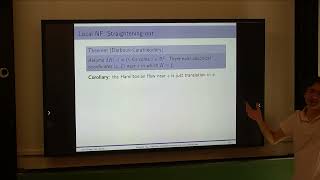
Symplectic Ak Singularities and Schrödinger Operators
Explore finite dimensional integrability in mathematical physics, focusing on symplectic Ak singularities and Schrödinger operators.
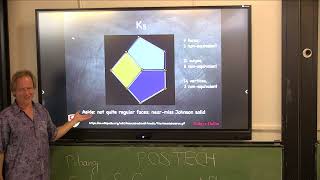
A Tale of Two Polytopes Related to Geodesic Flows on Spheres
Explore finite dimensional integrability in mathematical physics through geodesic flows on spheres, focusing on two related polytopes.
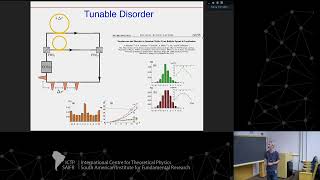
Observation of Topological Quantum Criticality in Quantum Materials
Explore topological quantum criticality through Anderson localization, quantum simulators, and optical networks. Gain insights into effective field theory and experimental observations.
Introduction and Pitfalls of Virtual Threads in Java 21
Explore Java 21's virtual threads and structured concurrency, learning implementation techniques and avoiding common pitfalls for high-throughput applications.
Respect Estimates: Recognizing and Eliminating Software Development Cults
Explore common software development pitfalls, including misguided practices in estimation, testing, and architecture. Learn to identify and eliminate ineffective "cults" in your projects.
Serverless Event-Driven Services for Spring Developers
Explore event-driven service systems using Java and annotations, focusing on Spring Boot tools for microservices and serverless functions deployment.
How to Make Your Electrons Do More in Java - Vector API and TornadoVM
Explore Vector API in Java and TornadoVM for GPU/FPGA computing. Enhance processing power and performance through advanced JVM techniques and native-code tooling.
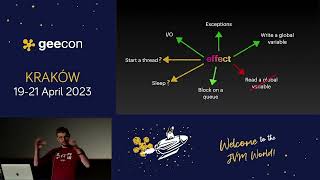
Effects: To Be or Not to Be - Exploring Effect Systems in Scala and Beyond - Lecture 1
Explore effect systems in Scala, JVM, and beyond. Analyze their necessity, differences, and tradeoffs in static typing and type system design.