Proofs, Circuits, Communication, and Lower Bounds in Complexity Theory - Robert Robere
Explore advanced concepts in complexity theory, including proofs, circuits, and communication, with a focus on lower bounds and their implications for computational limits.
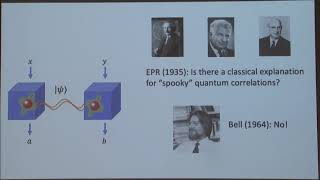
MIP* = RE - Henry Yuen
Explore quantum correlations, nonlocal games, and entanglement models in this seminar on MIP* = RE, delving into complexity theory and efficient tests for quantum phenomena.
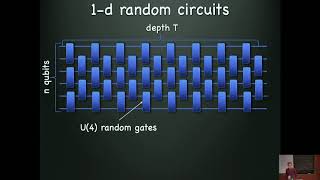
Random Quantum Circuits, Phase Transitions and Complexity - Aram Harrow
Explore quantum complexity, random circuits, and phase transitions in higher dimensions, with applications to tensor networks and simulation algorithms.

Rust Web App - Frontend - RealDOM
Learn to build a Todo app frontend using Rust and native web components. Covers setup, component creation, data handling, server requests, styling, and CRUD operations.

Rust Web App - Data Access
Learn to build a Rust web app with PostgreSQL, covering database setup, CRUD operations, SQL builder usage, and security infrastructure implementation for a Todo application.
Rust Web Development - Warp Introduction by Example
Learn Rust web development with Warp framework through hands-on examples. Build APIs, handle requests, serve static files, and implement authentication in this comprehensive tutorial.
Rust - Iterators
Explore Rust's powerful iterators, from basic usage to advanced techniques like consuming methods, chaining, and closures that capture their environment.
Rust - Generics, Traits, Lifetimes
Explore Rust's generics, traits, and lifetimes to write flexible, reusable code. Learn to create generic functions, implement traits, and understand lifetime annotations for safer memory management.
Rust - Programming a Pitfall Game
Learn to build a command-line Pitfall-like game in Rust, covering key programming concepts and applying them to game development.
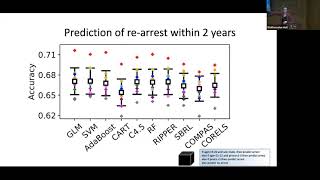
Stop Explaining Black Box Machine Learning Models for High Stakes Decisions and Use Interpretable Models Instead - Cynthia Rudin
Advocating for interpretable machine learning models in high-stakes decisions, highlighting their reliability and transparency compared to black box models with potentially misleading explanations.
Introduction to Interpretable Machine Learning II - Cynthia Rudin
Explore interpretable machine learning with a focus on decision trees, information theory, and analytical bounds. Gain insights into modern approaches and practical applications.
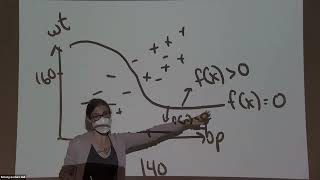
Introduction to Interpretable Machine Learning - Cynthia Rudin
Explore interpretable machine learning with Cynthia Rudin, covering classification, natural language processing, and decision trees. Gain insights into model complexity and information theory applications.
Combinatorial Invariance: A Case Study of Pure Math / Machine Learning Interaction - Geordie Williamson
Explore the intersection of pure mathematics and machine learning through the lens of combinatorial invariance, featuring insights on neural networks and their application to mathematical conjectures.
Localization Schemes - A Framework for Proving Mixing Bounds for Markov Chains
Explore a unified framework for proving mixing bounds in Markov chains, connecting Spectral Independence and Stochastic Localization techniques through the concept of localization schemes.
An Introduction to Lifted Expander Graphs - Fernando Granha Jeronimo
Explore lifted expander graphs, their construction, and applications in theoretical computer science. Learn about symmetry structures, coding theory implications, and recent advancements in this field.
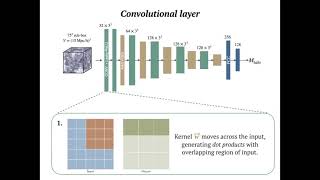
Deep Learning Insights into Cosmological Structure Formation - Luisa Lucie-Smith
Explore deep learning's insights into dark matter halo formation and cosmic structure, uncovering key features in initial conditions that predict final halo mass in N-body simulations.
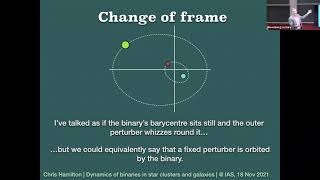
Dynamical Evolution of Binaries in Star Clusters and Galaxies - Chris Hamilton
Explore binary system evolution in star clusters and galaxies, focusing on tidal forces, Lidov-Kozai theory, and compact object mergers. Gain insights into celestial mechanics and astrophysical phenomena.
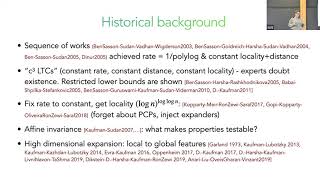
Locally Testable Codes with Constant Rate, Distance, and Locality, Part I - Irit Dinur
Explore locally testable codes with constant rate, distance, and locality. Learn about a new construction based on left-right Cayley complexes, addressing an open question in coding theory.
An Introduction to Determinantal Point Processes - John C Urschel
Explore determinantal point processes: definition, examples, and applications in random matrix theory, combinatorics, and machine learning. Survey key results and open questions.
Quantum Circuits, Cellular Automata and Tensor Networks - Ignacio Cirac
Explore quantum circuits, cellular automata, and tensor networks, focusing on their representations, entanglement properties, and generalizations to quantum channels and measurement-assisted dynamics.
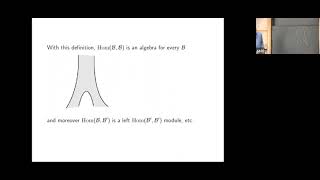
Gauge Theory and the Analytic Approach to Geometric Langlands - Edward Witten
Explore gauge theory's role in geometric Langlands correspondence, comparing categorical and analytic approaches through quantum states, operators, and gauge theory interpretations.