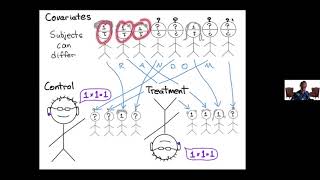
Using Discrepancy Theory to Improve the Design of Randomized Controlled Trials - Daniel Spielman
Explore discrepancy theory's application in randomized controlled trials, enhancing experimental design and statistical analysis for more accurate and efficient research outcomes.
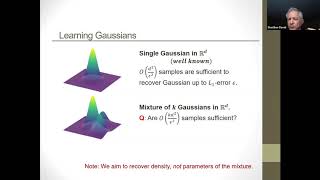
Learning Probability Distributions - What Can, What Can't Be Done - Shai Ben-David
Explore probability distribution learning, its possibilities and limitations. Shai Ben-David discusses density estimation, sample compression schemes, and challenges in statistical learning theory.
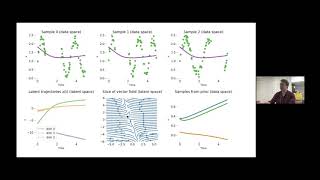
Latent Stochastic Differential Equations for Irregularly-Sampled Time Series - David Duvenaud
Explore advanced techniques for analyzing irregularly-sampled time series data using latent stochastic differential equations, with applications in predictive modeling and continuous-time machine learning.
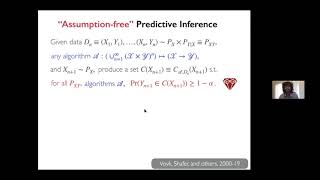
Assumption-Free Prediction Intervals for Black-Box Regression Algorithms - Aaditya Ramdas
Explore assumption-free prediction intervals for regression algorithms, covering split conformal prediction, CQR, full conformal prediction, and jackknife intervals with practical examples.
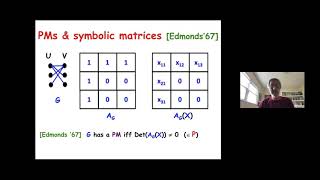
Geodesically Convex Optimization - Can We Prove P!=NP Using Gradient Descent - Avi Wigderson
Explore geodesically convex optimization and its potential to prove P≠NP using gradient descent in this advanced seminar by renowned mathematician Avi Wigderson.
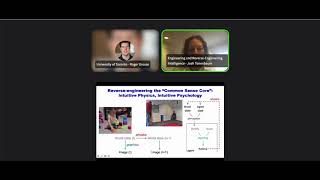
Steps Towards More Human-Like Learning in Machines - Josh Tenenbaum
Explore how machines can achieve more human-like learning through probabilistic programming, intuitive psychology, and simulation engines. Discover insights on core knowledge and one-shot learning in AI.
Tradeoffs Between Robustness and Accuracy - Percy Liang
Explore tradeoffs between robustness and accuracy in machine learning, covering topics like spurious correlations, regularization, and model complexity with Percy Liang.
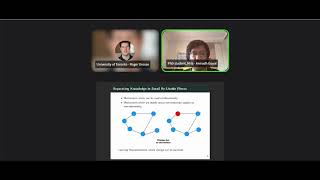
Modularity, Attention and Credit Assignment Computations - Anirudh Goyal
Explore modularity, attention, and credit assignment in computational models, focusing on complex generalization, independent mechanisms, and selective activation for improved learning and problem-solving.
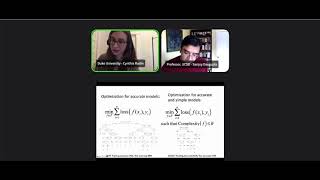
Do Simpler Models Exist and How Can We Find Them? - Cynthia Rudin
Explore simpler, interpretable machine learning models and their advantages in criminal justice and beyond. Learn about the Rashomon set, decision trees, and strategies to combat overfitting.
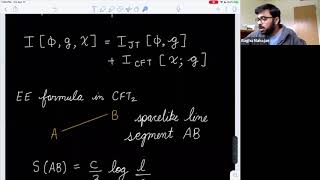
A Tutorial on Entanglement Island Computations
Explore quantum entanglement and its computational applications in this advanced seminar, covering extremal surfaces, CFTs, and non-local effects in various dimensions and temperatures.
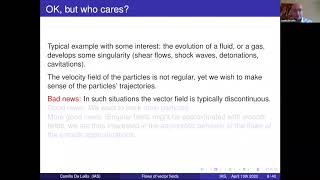
Flows of Vector Fields: Classical and Modern - Camillo DeLellis
Explore classical and modern theories of vector field flows, covering key concepts, examples, and recent developments in analysis and differential equations.
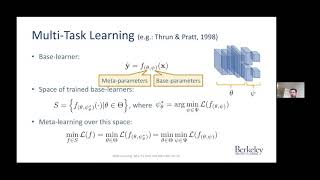
Meta-Learning - Why It’s Hard and What We Can Do - Ke Li
Explore meta-learning challenges and solutions with Ke Li, covering optimization, model selection, and program induction in this theoretical machine learning seminar.
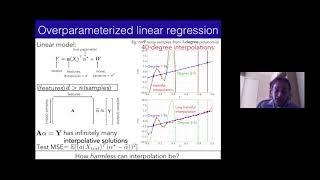
Interpolation in Learning - Steps Towards Understanding When Overparameterization Is Harmless, When It Helps, and When It Causes Harm
Explore overparameterization in machine learning, its benefits, potential harm, and the double descent phenomenon. Gain insights into interpolation regimes and matrix intuition.
Your Brain on Energy-Based Models - Applying and Scaling EBMs to Problems
Explore energy-based models in machine learning, covering applications, scaling techniques, and their impact on classification, calibration, and robustness in AI systems.
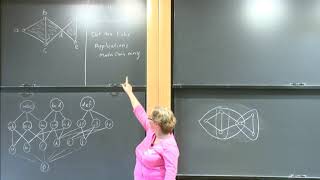
Introduction to High Dimensional Expanders - Irit Dinur
Explore high dimensional expanders with Irit Dinur, covering random walks, spectral expansion, and hypergraphs. Gain insights into this advanced topic in discrete mathematics and computer science.
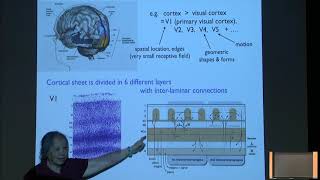
Towards a Mathematical Model of the Brain - Lai-Sang Young
Explore mathematical approaches to modeling brain dynamics, from local neural populations to complex cognitive functions, with insights on synchronization, memory, and visual processing.
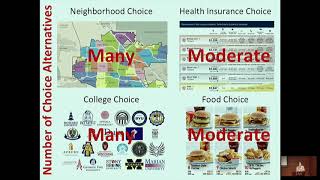
Re-Imagining the Social Sciences in the Age of AI - March 4, 2020
Explore the intersection of AI and social sciences through expert talks on mate selection decision-making and human behavior as AI's next frontier, followed by a moderated discussion and audience Q&A.

Understanding Deep Neural Networks - From Generalization to Interpretability
Explore deep neural networks, focusing on generalization and interpretability. Delve into graph convolutional networks, spectral filtering, and transferability. Examine fundamental questions and relevance mapping in machine learning.
An Introduction to Boolean Function Analysis - Dor Minzer
Explore Boolean function analysis, covering influences, PCP theory, and hypercontractive inequalities. Gain insights into fundamental concepts and advanced techniques in discrete mathematics and theoretical computer science.
Lower Bounds in Complexity Theory, Communication Complexity, and Sunflowers - Toniann Pitassi
Explore lower bounds in complexity theory, communication complexity, and sunflowers. Delve into Boolean circuits, formulas, and key lemmas with expert insights from Toniann Pitassi.
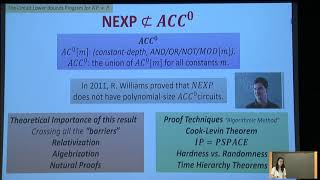
Strong Average-Case Circuit Lower Bounds from Non-trivial Derandomization - Lijie Chen
Explore advanced topics in computational complexity, including circuit lower bounds, derandomization, and their connections. Gain insights into cutting-edge research and theoretical developments in computer science.