Explaining AI to Managers
Demystifying AI for non-technical leaders: Learn to communicate the real value and potential of artificial intelligence in business contexts without delving into complex mathematics.

Understanding Numba - The Python and Numpy Compiler
Explore Numba, a JIT compiler for Python and Numpy, to accelerate numerical code. Learn implementation techniques, performance optimization, and compare with other high-performance computing options.
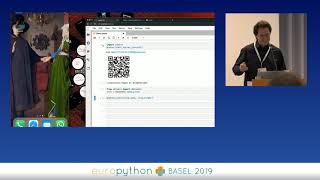
PlotVR - Walk Through Your Data
Explore 3D data visualization with PlotVR, enabling immersive VR and AR experiences. Navigate scatter plots using your phone and computer keyboard for a unique perspective on your datasets.

Introduction to Low-Level Profiling and Tracing
Explore low-level profiling and tracing tools on Linux, including ptrace, perf, SystemTap, and BCC/eBPF. Learn about their capabilities, advantages, and potential for optimizing Python performance.
Gamifying the Study of Algorithms
Explore innovative approaches to learning algorithms through gamification, enhancing problem-solving skills and making the study process engaging and enjoyable for software developers.
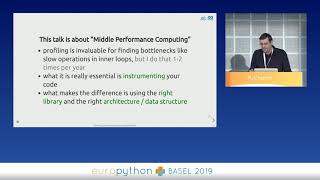
Tips for the Scientific Programmer
Practical insights for efficient scientific programming, covering parallelism, data management, memory optimization, and performance enhancement for large-scale numeric calculations.
Deep Learning with TensorFlow 2.0
Explore TensorFlow 2.0's updates, including Keras API, and learn to build machine learning models in Python. Discover new features and gain practical insights for getting started.
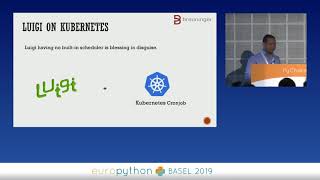
Building Data Workflows with Luigi and Kubernetes
Learn to build complex data pipelines using Luigi, package them as Docker images, and deploy on Kubernetes for scalable Big Data workflows with on-demand scaling and cost reduction.
Advanced asyncio - Solving Real-world Production Problems
Explore advanced asyncio techniques for real-world production problems, covering graceful shutdowns, exception handling, testing, debugging, and profiling in Python's asynchronous programming.
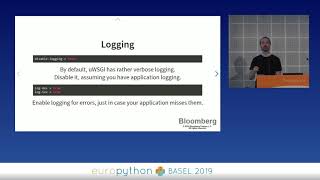
Configuring uWSGI for Production - The Defaults Are All Wrong
Optimizing uWSGI configuration for production: Learn best practices, avoid common pitfalls, and leverage powerful features to improve reliability and performance in distributed systems.
Status Quo of Virtual Environments
Explore the inner workings of Python virtual environments, their importance in dependency management, and how they function across different Python interpreters.
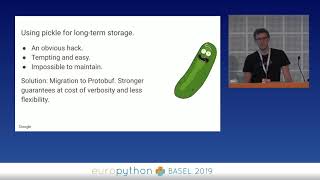
Evolving a Helper Script into a 180,000-Lines-of-Python-Code Project
Explore the evolution of a Python project from a simple script to a complex incident response framework, covering design decisions, challenges, and best practices in software development.
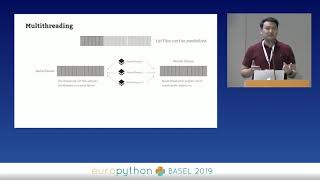
Downloading a Billion Files in Python
Explore efficient techniques for downloading massive file sets using Python, comparing multithreading, multiprocessing, and asyncio approaches with best practices and performance insights.
How We Run GraphQL APIs in Production on Our Kubernetes Cluster
Explore deploying and operating GraphQL APIs on Kubernetes, covering workflow, tools, and lessons learned from transitioning from REST APIs to containerized GraphQL services.
How We Run GraphQL APIs in Production on Our Kubernetes Cluster
Discover the workflow and tools for building, deploying, and operating GraphQL APIs on Kubernetes. Learn from Numberly's transition experience and gain insights into cluster design and developer processes.
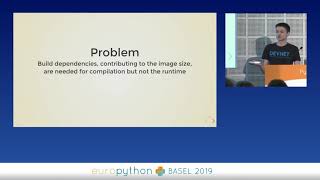
Optimizing Docker Builds for Python Applications
Discover techniques to optimize Docker builds for Python apps, focusing on speeding up the process and reducing image size for both development and production environments.
From HTTP to Kafka-based Microservices
Explore the transition from HTTP to Kafka-based microservices, discussing challenges, solutions, and benefits of asynchronous communication in Python-based systems.
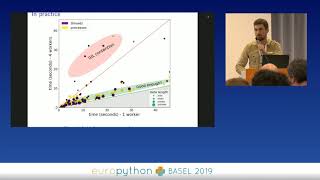
Parallel Computing in Python - Current State and Recent Advances
Explore Python's parallel computing landscape, from low-level interfaces to high-level libraries, and learn about recent advances in shared memory management and object serialization.

Astro Pi - Python on the International Space Station
Explore Python programming on the International Space Station with Astro Pi, a collaboration between Raspberry Pi Foundation and ESA, offering exciting opportunities for students to conduct space experiments.
Modern Continuous Delivery for Python Developers
Explore modern deployment techniques for Python, focusing on avoiding vendor lock-in and creating flexible, future-proof setups for seamless transitions between cloud platforms.
Go to Python
Explore combining Go and Python: learn to create Python extension modules using Go, covering data sharing, callbacks, and garbage collection. Discover the advantages of this powerful combination.