PostgreSQL and Python - A Match Made in Heaven
Explore the powerful synergy between PostgreSQL and Python for robust database solutions. Learn how these open-source technologies complement each other in real-world applications.
You Need More Security in Your Application Packaging
Explore secure application packaging methods, focusing on Python, to balance ease of installation with robust security measures for different environments and audiences.
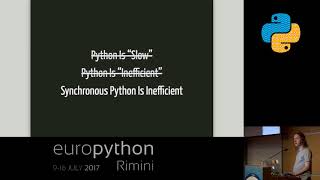
Why You Might Want to Go Async
Explore asynchronous programming in Python: its concepts, implementation, and benefits. Learn when and how to use async for improved performance in IO-bound applications.
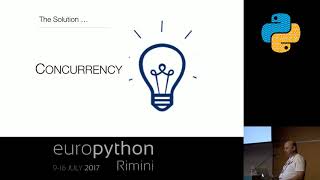
Asynchronous I/O and the Real-Time Web
Explore asynchronous web servers, concurrency for performance, real-time communication with web sockets, and challenges in async web development. Gain insights into modern web application techniques.
Making Games with Python - Mission Impossible?
Explore Python's potential in game development, comparing frameworks like Pygame and OpenGL, and discussing its role in asset pipelines, data integration, and commercial game production.
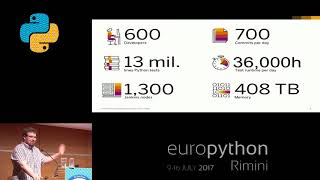
How SAP is Using Python to Test Its Database SAP HANA
Insights into SAP's large-scale Python-based testing infrastructure for SAP HANA, covering scaling challenges, optimizations, and the use of Linux Containers for improved automated testing and quality assurance.
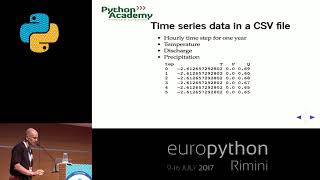
Programming in Parallel with Threads
Optimizing scientific simulations using threads for parallel processing, achieving significant speedup by leveraging IO tasks and multi-core CPUs.
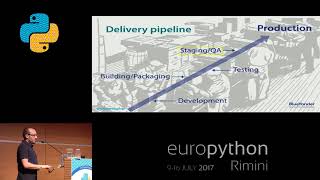
There Should Be One Obvious Way to Bring Python into Production
Explore DevOps methodologies for deploying Python applications, covering packaging, deployment, environments, and runtime options. Learn about tools and frameworks to streamline the production process.
Solid Snakes
Learn strategies to enhance software reliability, minimize manual interventions, and reduce the need for emergency fixes, ensuring more peaceful nights and stress-free vacations for developers and system administrators.
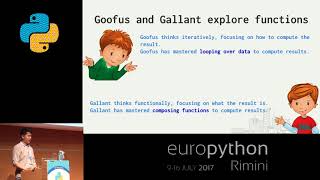
Teeing up Python - Code Golf
Explore Python code golfing techniques to write concise, readable, and Pythonic code. Learn about default values, tuples, comprehensions, functional programming, and context managers.
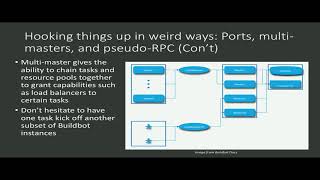
Infrastructure Design Patterns with Python, Buildbot, and Linux Containers
Explore infrastructure design patterns using Python, Buildbot, and Linux Containers for enterprise solutions beyond CI, including license management and application deployment.
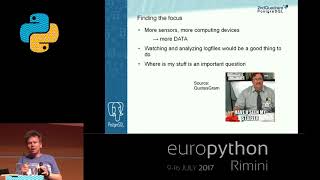
PostgreSQL - The Database for Industry 4.0 and IOT
Explore PostgreSQL's strengths for managing massive data in Industry 4.0 and IoT. Learn about its development, extensibility, and robustness, with insights on version 9.6 and 10 features.
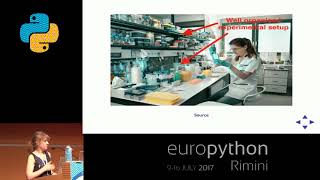
Sustainable Scientific Software Development
Explore techniques and tools for building sustainable scientific code, including testing, continuous integration, and documentation, to ensure accurate and reproducible computational research results.
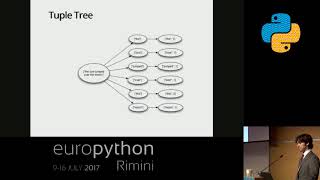
Realtime Distributed Computing at Scale - Storm and Streamparse
Explore realtime distributed computing using Apache Storm and streamparse in Python. Learn to handle high-volume data processing with low latency and high availability, suitable for large-scale production environments.
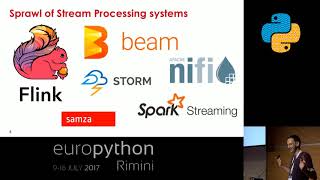
Taking the Hipster out of Streaming
Explore real-time financial data processing techniques using Python, focusing on ingesting, stitching, and analyzing vast datasets from global markets with varying formats and frequencies.
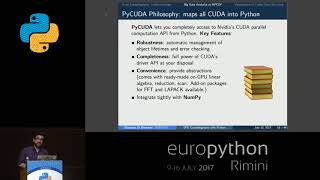
Big Data Analytics at the MPCDF - GPU Crystallography with Python
Explore GPU-accelerated Python for big data analytics in atom probe crystallography, focusing on Fourier spectral analysis, scalability across multiple GPUs, and interactive visualization techniques.
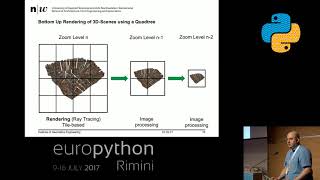
Rendering Complex 3D-Geodata Using pyRT
Explore pyRT, a Python-based ray tracer for rendering large 3D city models. Learn about processing, caching, and serving massive geospatial data for scalable 3D scene rendering in web-based solutions.
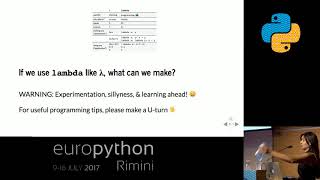
Mary Had a Little Lambda
Explore lambda calculus: from simple Python functions to powerful abstractions. Learn to create booleans, integers, operators, and data structures using only lambda functions.
Teach Your -Microservices- Speak Protocol Buffers with gRPC
Explore Protocol Buffers and gRPC for efficient microservice communication, covering schema enforcement, serialization, and API evolution with practical examples and best practices.
How CPython Parser Works, and How to Make It Work Better
Explore CPython's parsing process, its impact on performance, and potential optimizations. Learn about syntax trees, memory footprint reduction, and opportunities for improving Python's overall efficiency.
Writing Code - Evolve It Instead
Explore genetic algorithms as a biologically-inspired AI approach to code generation, discussing their potential impact on software development and the future of programming.