Compile Time Regular Expressions with a Deterministic Finite Automaton
Explore advanced C++20 techniques for compile-time regular expressions using a Deterministic Finite Automaton, optimizing performance and showcasing novel metaprogramming approaches.
Tacit DSL All the Things
Explore functional programming concepts in C++ through an extended ranges DSL, unifying various paradigms and libraries for more declarative and composable code.
The Rough Road Towards Upgrading to C++ Modules
Explores challenges in adopting C++ Modules, discussing issues with existing systems, attempts at automated modularization, and implications for code organization and compilation performance.
Parametric Expressions - A Proposed Language Feature
Proposed C++ feature: Parametric Expressions explained. Explores use cases, benefits for library authors, and potential impact on build times. Encourages audience participation in discussing this hygienic macro concept.
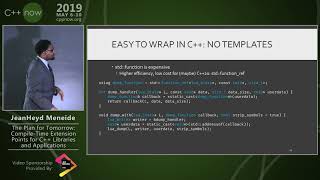
The Plan for Tomorrow - Extension Points in C++ Applications
Explore advanced C++ extension techniques beyond callbacks and virtual classes, examining libraries' non-dynamic extension points for compile-time customization and improved application flexibility.
The C++ Reflection TS
Comprehensive overview of C++ Reflection TS, explaining its features, applications, and future directions in standardization, presented by project co-author David Sankel.
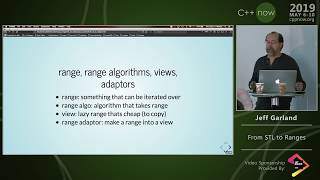
Using C++20 Ranges Effectively
Comprehensive exploration of C++20 ranges, covering concepts, algorithms, views, and practical applications. Includes code examples and exercises for effective implementation in daily programming.
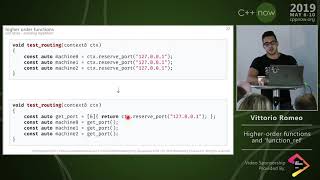
Higher-Order Functions and Function Ref
Explore higher-order functions in C++, their practical applications, and the proposed `function_ref` abstraction for C++20, enhancing code flexibility and performance.
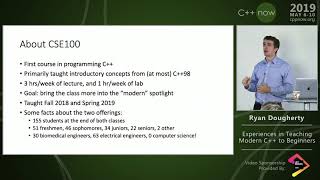
Experiences in Teaching Modern C++ to Beginners
Insights and methodologies for teaching modern C++ to beginners, focusing on C++11/14/17 concepts and best practices for educators to effectively introduce programming to freshmen.
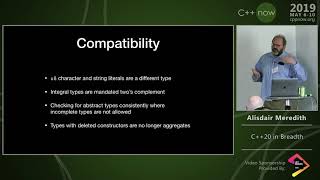
C++20 in Breadth
Comprehensive overview of C++20's major features and changes, exploring language updates, new capabilities, and their impact on C++ development and standardization.

Algorithm Intuition
Explore STL algorithms, their common uses, and how to unlock their potential through intuition and lambdas. Develop algorithm intuition to complement your data structure knowledge and enhance your C++ programming skills.
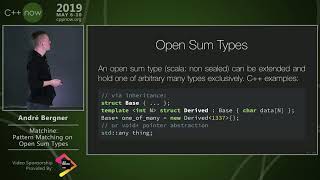
Matchine - C++ Pattern Matching for Open Sum Types
Explore advanced C++ pattern matching techniques for open sum types, focusing on efficient alternatives to RTTI and declarative dispatching methods for type hierarchies.
The Ongoing Saga of ISO-C++ Executors
Explore the evolution of ISO-C++ executors, a generic abstraction for execution. Learn about concept-driven design principles and the latest developments in concurrent programming abstractions for C++23 and beyond.
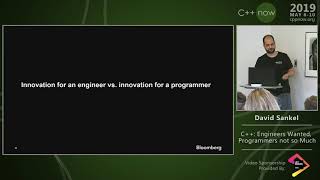
C++ - Engineers Wanted, Programmers Not so Much
Explore the shift from programming to engineering in C++, focusing on system-level thinking, business value, and mature software development practices for large-scale projects.
The C++ Rvalue Lifetime Disaster
Explores rvalue reference lifetime issues in C++, discussing const& binding and temporary lifetime extension problems, with proposed solutions for safer memory management in generic code.

A Crash Course in Unicode for C++ Developers
Comprehensive introduction to Unicode concepts and processing for C++ developers, covering encodings, normalization, and text algorithms to handle user text correctly.
How to - Colony
Dive deep into the mechanics of the colony container, exploring its implementation details, performance optimizations, and potential applications in C++ programming.
C++11/14 at Scale - What Have We Learned?
Comprehensive analysis of C++11/14 features in large-scale production, examining benefits, drawbacks, and lessons learned over 8 years of use at Bloomberg. Insights on teachability and practical implications.
Code Analysis
Explore C++ static analyzers, Core Guidelines enforcement, and "Simplify C++" trends. Discuss various code checks, from catching dangling pointers to enforcing style guidelines, and consider gamifying static analysis.
Converting a State Machine to a C++ 20 Coroutine
Explore converting state machines to C++20 coroutines, leveraging async operations and co_await. Learn to simplify complex code using modern C++ features for more readable and maintainable asynchronous programming.
Better C++ Ranges
Explore advanced C++ range concepts, including efficient stacking, self-contained adaptors, internal iteration, and optimized text formatting, enhancing code expressiveness and performance.