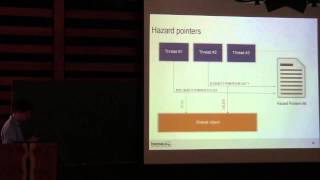
Scaling with C++11
Techniques for building hyperscalable software: design principles, multithreading patterns, memory management, and asynchronous I/O in C++11 for maximizing parallel execution and reducing inter-thread dependencies.
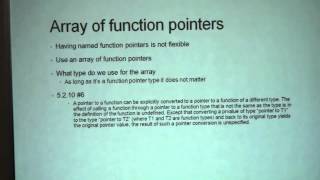
Easy Binary Compatible C++ Interfaces Across Compilers
Explore techniques for creating binary-compatible C++ interfaces across compilers, leveraging C++11 features for easy-to-define, implement, and use interfaces without external tools or extensions.
HPX - A C++ Runtime System for Parallel and Distributed Computing
Explore HPX, a C++ runtime system for parallel and distributed computing. Learn about its innovative approach to multi-core processing, asynchronous task execution, and scalable addressing for high-performance applications.
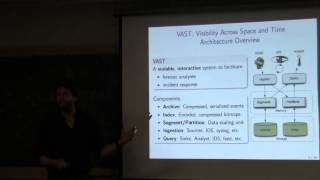
Libcppa - Designing an Actor Semantic for C++11
Explore libcppa, an open-source library combining the actor model with C++11 for efficient concurrent and distributed programming. Learn about its design, implementation, and benefits for building reliable systems.
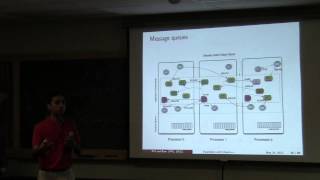
Parallel Programming Using Charm++ - C++Now
Explore Charm++, a C++-based parallel programming framework for high-performance computing across shared and distributed memory systems, using object-oriented principles for efficient and scalable software development.
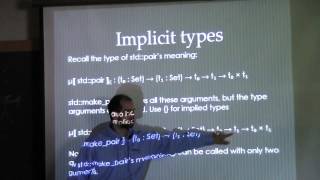
The Intellectual Ascent to Agda
Explore denotative design and its application in C++ programming, using Agda's syntax to derive powerful, composable libraries from domain-specific mathematical entities.
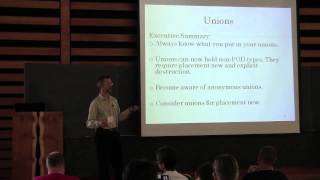
Sweating the Small Stuff - Brace Initialization, Unions and Enums
Explore C++11's less-discussed features: brace initialization, unions, and enums. Learn practical applications and benefits for beginner to intermediate C++ developers.
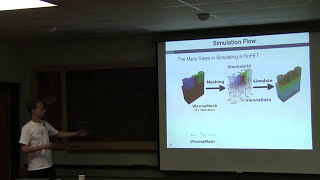
A Discussion of Selected Vienna-Libraries for Computational Science
Explore Vienna-Libraries for computational science: ViennaCL, ViennaGrid, ViennaData, ViennaMath, and ViennaFEM. Learn how C++ can better meet scientific computing needs.
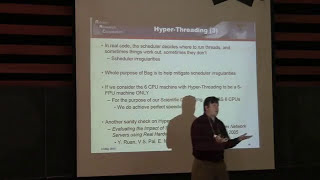
Thread-Safe and Thread-Neutral Bags
Explores implementing thread-safe and thread-neutral bags in C++, introducing drawer and cupboard abstractions using C++11 multi-threading features for efficient concurrent data access.
A System for Resource Deadlock Prevention Using Intrusive Dynamic Analysis
Explore a framework for preventing resource deadlocks in multithreaded programs using intrusive dynamic analysis. Learn implementation, integration, and potential future developments.
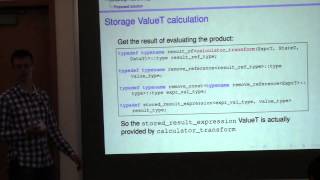
Building Finite-Element Matrix Expressions with Boost Proto and the Eigen Library
Learn to integrate Eigen with Boost Proto for finite-element matrix expressions, including user-defined functions and external libraries in domain-specific languages.
Solving World Problems with Fusion
Explore Boost.Fusion's power in simplifying interfaces, providing declarative experiences, and efficient type handling. Learn practical usage patterns for integrating this versatile library into your C++ projects.
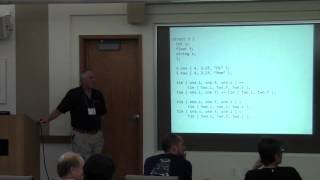
Fun with Tuples
Explore std::tuple's versatility in C++, from basic usage to advanced techniques. Learn about compile-time and run-time applications, comparisons with structs, and integration with template meta-programming.
Look Ma, Update DB to HTML5 Using C++ - No Hands
Explore seamless data transport from SQL databases to HTML5 interfaces using WebSocket and POCO framework, enhancing performance and enabling real-time updates without polling.

Boost.Asio and Boost.Serialization - Design Patterns for Object Transmission
Explore C++ network programming using Boost.Asio and Boost.Serialization for efficient object transmission, covering complex data structures, serialization techniques, and asynchronous communication patterns.
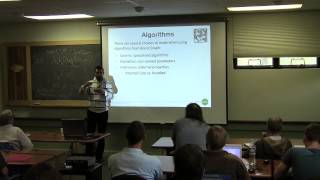
Boost.Graph for Beginners
Learn to use Boost.Graph library's algorithms for graph operations, with examples of input/output parameters and function calls to simplify implementation in C++ projects.

Multi-Threading with C++11 and Boost
Explore C++11 and Boost for multi-threading through practical examples, including thread-safe queues, parallel tasks, and task interruption. Learn about threads, mutexes, and condition variables.
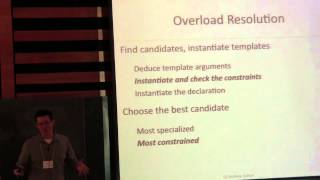
Concepts Lite - Constraining Templates with Predicates
Introduction to template constraints in C++14, improving template declarations and error handling. Learn to use constraints with algorithms, data structures, and class templates for better code organization and readability.
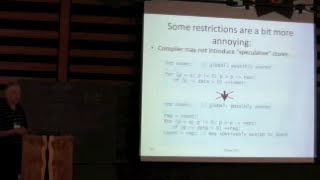
Threads and Shared Variables in C++0x
Explores C++0x's introduction of threads and shared variable semantics, focusing on the memory model, atomic operations, and challenges in designing meaningful multithreaded programs with sequential consistency.
Distributed Parametric Optimization with the Geneva Library
Explore Geneva, an open-source library for distributed optimization algorithms, leveraging Boost libraries to solve large-scale parametric problems on multi-core systems, clusters, and cloud environments.
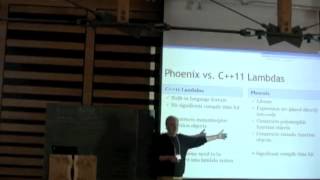
Phoenix V3 - An Overview
Overview of Phoenix V3, a next-gen library for creating unnamed, inlined polymorphic function objects. Combines Boost.Bind and Boost.Lambda functionality, focusing on functional programming in C++ and its applications.