
What C and C++ Developers Can Learn from Rust
Explore how Rust's ownership model, memory safety features, and modern practices can enhance C/C++ development, improving code reliability and efficiency.
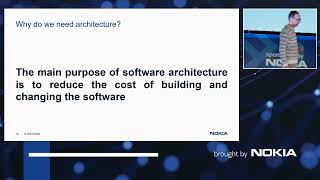
From Developer to SW Architect
Explore the journey from developer to software architect, covering essential skills, responsibilities, and challenges in this insightful talk by an experienced professional in the telecom industry.
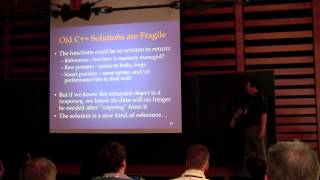
A Whirlwind Overview of C++11
Comprehensive overview of C++11 features, covering lambdas, uniform initialization, auto, rvalue references, multithreading, smart pointers, and new STL containers for improved code clarity and performance.

Now What? A Vignette in Three Parts
Exploring C++11's potential for beautiful, efficient code, addressing performance challenges, and adapting to the evolving landscape of networked devices and ubiquitous data access.

C++11 - High-Level Threading
Explore C++11's high-level threading capabilities, including locks, mutexes, and futures. Learn to solve common threadsafe programming challenges using these components.
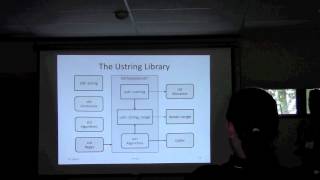
Ustring - A Modern Alternative to std::string
Explore Ustring, a modern C++11 alternative to std::string, addressing limitations and offering enhanced Unicode support and flexibility for efficient string handling.
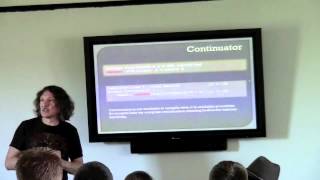
Compile-Time - Run-Time Functional Programming in C++
Explore advanced C++ programming techniques at the compile-time/run-time boundary, including functional concepts like monads and continuations, with a focus on practical applications.
Type to String Conversions, and Vice-Versa
Explore options for type-to-string conversions in C++, from traditional methods to modern solutions like std::stoi and boost::lexical_cast. Introduces boost::coerce, highlighting its speed and extensibility.
Compile-time Reparsing - C++Now 2012
Explore compile-time parsing techniques in C++ for creating embedded domain-specific languages, including runtime expressions, compile-time strings, and angle-bracket expressions.
Robust and Efficient Multi Precision Algorithms Design
Exploring design principles for complex numeric algorithms, balancing usability, extensibility, efficiency, and robustness. Insights from Boost.Polygon.Voronoi library implementation.
Value Semantics and Concepts-based Polymorphism
Explore value semantics and concepts-based polymorphism in C++, learning advanced techniques to improve code efficiency, maintainability, and performance in modern software development.
Metaprogramming Applied to Numerical Problems
Explore advanced Template Metaprogramming techniques for implementing efficient Runge-Kutta schemes to solve ordinary differential equations in various scientific fields.
HPX - A C++11 Parallel Runtime System
Explore HPX, a C++11 parallel runtime system offering an alternative to MPI for computational science applications, featuring lightweight user-threads and Active Global Address Space.
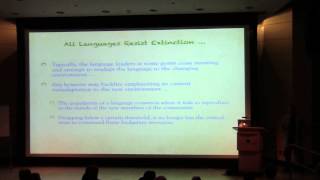
Yet Another Paradigm Shift - A Meta4 Model of Concurrency
Explore language evolution, C++ history, and a new paradigm shift in programming, using biological metaphors to propose innovative approaches to concurrency and language design.
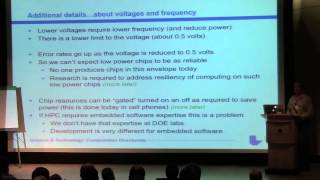
C++ Use in High Performance Computing Within DOE - Past and Future
Exploration of C++'s role in high-performance computing at the Department of Energy, examining historical applications and future prospects in scientific and technical computing.
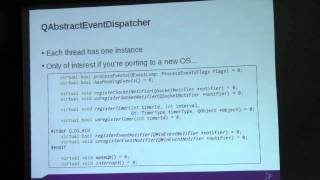
Qt Event Loop, Networking and I/O API
Explore Qt's event loop, networking, and I/O API. Learn about asynchronous mechanisms, TCP/UDP handling, and HTTP/FTP support. Gain insights for both application and library developers.
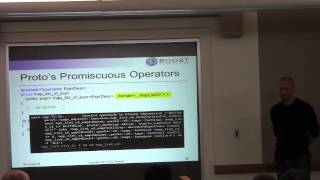
A First Look at Proto-0x
Explore Proto-0x, a C++11 library for building Embedded Domain-Specific Languages. Learn about EDSL design, grammars, semantic actions, and how C++11 features enhance library development.
Boosting MPL with Haskell Elements
Explore advanced C++ template metaprogramming techniques inspired by Haskell, including let expressions, monads, list comprehension, and error handling, to enhance Boost.MPL and improve code readability and organization.
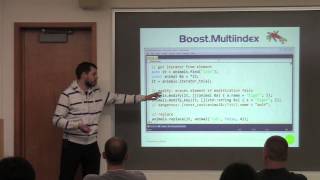
Containers in Boost
Explore advanced container libraries in Boost, including Multiindex, Bimap, CircularBuffer, and more. Learn to leverage these powerful tools to enhance your C++ projects with specialized data structures.
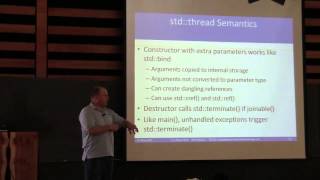
Survey of Multi-Threaded Programming Support in C++11 and Boost
Comprehensive overview of C++11 and Boost tools for multi-threaded programming, covering threads, async operations, mutexes, condition variables, and atomics.
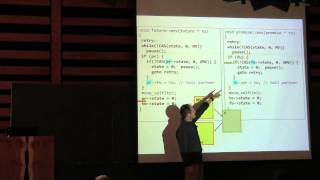
Non-Allocating std - future - promise
Explore lock-free techniques for implementing std::future/promise without allocation, addressing challenges of shared state and object lifetime in C++. Interactive session for hands-on learning.