Taming Dynamic Memory - An Introduction to Custom Allocators
Explore custom allocators for improved performance and reliability in C++. Learn pooling, monotonic allocation, alignment challenges, and integrating popular allocator implementations in modern codebases.

Fighting Git Workflows
Honest case study on transitioning from SVN to Git in a medium-sized team. Explores workflows, challenges, and DevOps considerations for CI/CD pipelines, offering practical insights and workarounds.
Going Multiplatform with Kotlin
Explore Kotlin's multiplatform capabilities for code reuse across Android and iOS. Learn about Kotlin/Native, coroutines, and efficient architecture for shared core components.

The Cell as a Computer - Turing Complete and Massively Parallel
Explore biological computing: cells as Turing-complete devices, biocomputers, and parallels between cellular processes and computer components. Gain insights into nature's 4-billion-year-old computing paradigm.

Here's My Number; Call Me, Maybe - Callbacks in a Multithreaded World
Explore techniques for managing callbacks in multithreaded applications, focusing on clarity, object lifetime management, and preventing dangling references in C++ programming.

Optimising a Small Real-World C++ Application
Hands-on demonstration of optimizing a real-world C++ application using measurement tools to find hotspots, avoid common pitfalls, and improve performance through different algorithms and libraries.

An Adventure in Race Conditions
Explore high-level abstractions for concurrent programming, avoiding common traps with locks and atomics. Learn strategies to prevent and detect race conditions in C++ development.
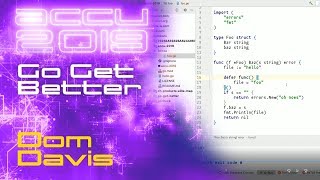
Go Get Better - Go Programming Language
Comprehensive introduction to Go programming, covering basics, concurrency, Docker integration, and common pitfalls. Ideal for beginners and intermediate developers seeking to enhance their Go skills.

Navigating the Development and Evolution of a Library
Comprehensive guide on library development, covering code quality, testing, documentation, release management, and user engagement. Insights from Boost and libc++ experiences.

What Are Hash Trees and Why You Should Care
Explore hash trees and their applications in building efficient authenticated data structures. Learn about one-way hash functions and how hash trees enable data integrity verification.
Nim - First Natively Compiled Language with Hot Code-Reloading at Runtime
Explore Nim's powerful metaprogramming and runtime hot code-reloading capabilities. Learn about its native compilation, REPL support, and potential applications in systems programming and scientific computing.

Higher-Order Functions and Function_Ref
Explore higher-order functions in C++, including lambda expressions and function_ref, to enhance code flexibility, safety, and reduce repetition. Learn practical applications and optimization techniques.

Elsewhere Memory - C++20 Abstract Machine and Virtual Memory
Explores C++20 object and memory model limitations, discussing challenges with external memory allocation and proposing solutions for future hardware compatibility and improved language design.

Ranges for Distributed and Asynchronous Systems
Explore Functional Reactive Programming for asynchronous systems using range-inspired transformations. Learn to implement concurrent code with improved clarity and reduced shared state issues.

M-PIN Authentication in Vehicle Tracking
Explore Apache Milagro for secure IoT authentication in vehicle tracking. Learn about post-PKI internet, stronger security, and independence from third-party trust authorities through a C++14 fleet management example.
A Modern, Scalable Risk System Architecture
Explore modern, scalable risk system architecture for banks, addressing technical debt and leveraging cloud technology. Learn architectural principles, prototypes, and solutions for financial risk platforms.

Delivering Software That Is Secure and Usable - Whose Job Is It?
Explore the intersection of security and usability in software development with insights from a leading expert in human-centered security and privacy solutions.
Better Embedded Library Interfaces with Modern C++
Explore modern C++ features to create safer, user-friendly embedded library interfaces without sacrificing efficiency. Learn to apply namespaces, enums, overloading, and templates in embedded systems.
More GDB Wizardry and 8 Other Essential Linux Application Debugging Tools
Practical demonstration of advanced GDB features and essential Linux debugging tools, enhancing programming effectiveness through live demos of powerful techniques and utilities.

Hashing - Hashing Values
Comprehensive exploration of hashing techniques for efficient associative containers, covering hash functions, byte sequences, and considerations for user-defined types. Emphasizes best practices and common pitfalls.
Impact on Maintainability and Refactoring for Higher-Level Design Features
Explores strategies for refactoring C++ code at various abstraction levels, discussing the impact on maintainability and the challenges of evolving interfaces in complex systems.