Structure and Matrices in Julia Programming - Lecture 3
Explore matrices, sparse structures, and SVD for image compression and computational thinking in Julia, with practical applications in machine learning and linear algebra.
Seam Carving: Live Coding Session - MIT 18.S191 Fall 2020 - Week 2
Live coding session demonstrating seam carving algorithm implementation in Julia, covering energy calculation, seam generation, and image manipulation techniques for content-aware image resizing.
Seam Carving and Dynamic Programming - Week 2 - MIT Fall 2020
Explore seam carving algorithm for intelligent image resizing, covering edge detection with gradients and optimal path finding using dynamic programming.
Convolutions in Image Processing - MIT 18.S191 Fall 2020 - Week 1
Explore image processing convolutions, from basic blurs to edge detection, using Julia. Learn about kernels, computational complexity, and connections to Fourier transforms.
State of Julia - JuliaCon 2020
Comprehensive overview of Julia's progress, highlighting key developments in multithreading, infrastructure, ecosystem, and future plans, with insights on challenges and upcoming features.
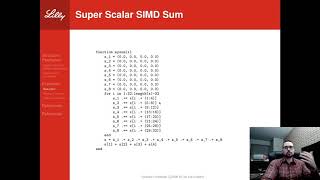
Loop Analysis and Vectorization in Julia - JuliaCon 2020
Explore LoopVectorization.jl for efficient loop representation, cost modeling, and vectorization strategies in Julia, enhancing performance through intra-core parallelism and SIMD operations.

Natural Dams - Inherent Risk Factors
Explore impacts of natural dam failures through case studies, 3D visualizations, and risk assessments. Learn about prehistoric events, climate change effects, and recent disasters like the 2021 Uttarakhand tragedy.
Next Generation 2D Hydraulic Modelling
Explore advancements in 2D hydraulic modeling, comparing 1D and 2D approaches through case studies and discussing pros and cons for enhanced reliability and efficiency in open channel simulations.
HEC-RAS 6.0, What You Need to Know - Part Two
Explore new sediment-related features in HEC-RAS 6.0, including mud and debris modeling, 2D and 1D sediment transport, with expert insights from USACE Hydrologic Engineering Center specialists.
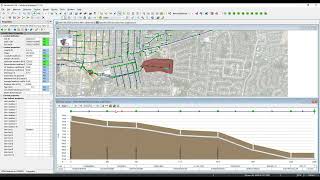
SWMM Model Management in ICM
Discover how InfoWorks ICM enhances SWMM modeling with database tracking, SQL benefits, and efficient simulation management, saving time and reducing data loss for storm, sewer, and flood modeling professionals.

BinaryBuilder.jl - The Subtle Art of Binaries That Just Work
Explore BinaryBuilder.jl for compiling binary libraries across Julia platforms. Learn to create build recipes, use the wizard, and contribute to Yggdrasil. Hands-on experience included.
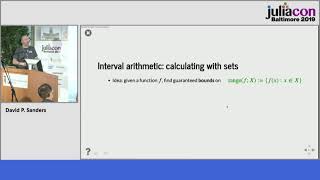
Interval Methods for Scientific Computing in Julia
Explore interval methods for scientific computing in Julia, focusing on constraint propagation, global optimization, and root finding using IntervalConstraintProgramming.jl and IntervalArithmetic.jl packages.
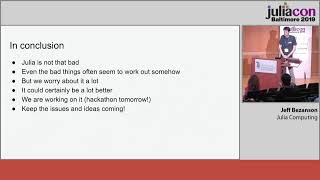
What's Bad About Julia - Addressing Fundamental Issues
Julia co-creator Jeff Bezanson discusses fundamental issues in the language, focusing on modularity, types, and method specificity rules, offering insights into potential solutions for a better programming experience.
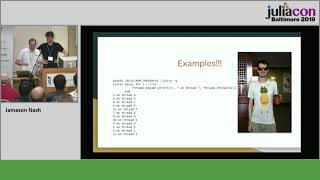
Multi-threading in Julia with PARTR - JuliaCon 2019
Explore multi-threading in Julia with PARTR, covering old and new features, future developments, and practical examples. Includes performance comparisons and Q&A on threading models and implementation details.
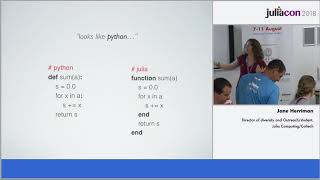
An Introduction to Julia for Beginners
Comprehensive introduction to Julia programming, covering basics to advanced topics. Ideal for beginners with technical computing needs and experience in other languages.
Flux - The Elegant Machine Learning Library for Julia
Explore Flux, an intuitive machine learning library for Julia, featuring state-of-the-art performance, automatic differentiation, and innovative compiler technology for efficient and flexible ML development.
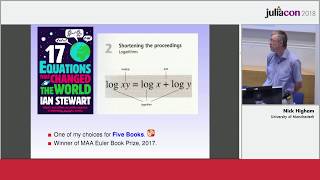
Tricks and Tips in Numerical Computing - Keynote
Explore advanced numerical computing techniques, from complex differentiation to low-precision arithmetic, with insights on error analysis, matrix operations, and IEEE standards for improved computational accuracy and efficiency.
Shared Memory Parallelism in Julia with Multi-Threading - Parallel Depth-First Scheduling
Explore efficient shared memory parallelism in Julia using multi-threading, focusing on nested parallelism and the parallel depth-first scheduling approach for improved performance.
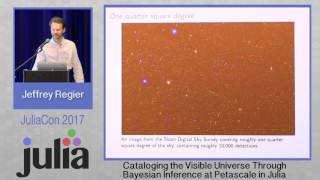
Celeste.jl - Petascale Computing in Julia
Explore Celeste.jl, a Julia-based project for petascale astronomical image analysis using Bayesian inference, showcasing Julia's power in high-performance computing and data science on supercomputers.
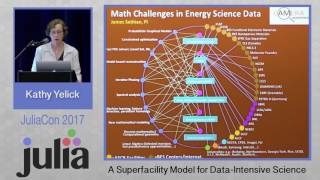
A Superfacility Model for Data-Intensive Science
Explore data-intensive science challenges, high-performance computing, and the role of programming languages like Julia in addressing big data and computational demands in scientific research.
Applied Hydrodynamic Modelling
Explore hydrodynamic modeling applications in environmental planning and structural design through case studies of the Coorong estuary and Brisbane River, highlighting unique approaches and key lessons learned.