Tomographic Image Reconstruction with Julia
Explore Julia's capabilities for tomographic image reconstruction, focusing on large-scale inverse problems and matrix-free methods. Learn about package ecosystems for different imaging techniques.

Dictionaries.jl - Improved Productivity and Performance in Julia
Explore Dictionaries.jl for enhanced Julia productivity: alternative interface, data manipulation tools, implementation insights, and applications in tabular data with keys.
Agents.jl and the Next Chapter in Agent-Based Modelling
Explore Agents.jl for complex system modeling: learn its philosophy, simplicity, performance, interactivity, and integration with Julia ecosystem. Discover the future of agent-based modeling.
Introduction to Metaprogramming in Julia - JuliaCon 2021 Workshop
Comprehensive workshop on Julia metaprogramming, covering expressions, macros, and code generation. Ideal for intermediate users seeking to enhance their programming skills and create domain-specific languages.
Package Development: Improving Engineering Quality and Latency - JuliaCon 2021 Workshop
Aprenda a melhorar a qualidade e reduzir a latência no desenvolvimento de pacotes Julia, usando ferramentas avançadas para detectar e corrigir problemas de desempenho e robustez.
GPU Programming in Julia - Workshop
Comprehensive workshop on GPU programming in Julia, covering CUDA, AMDGPU, and oneAPI packages. Explores array operations, kernel programming, profiling, and real-world applications across different GPU architectures.
User-Defined Functions in Julia - Week 2 Lesson 3
Learn to create and use custom functions in Julia, enhancing your programming skills with practical examples and essential debugging techniques.
Discrete and Continuous Mathematics - MIT Computational Thinking Spring 2021 - Lecture 14
Explore discrete and continuous mathematics, bridging concepts through indexing, function evaluation, area calculation, and random walks in computational thinking.
Random Walks II - Lecture 13
Explore random walks, Pascal's triangle, and probability distributions using Julia programming. Learn to implement time evolution of probabilities and understand cumulative sums in computational thinking.
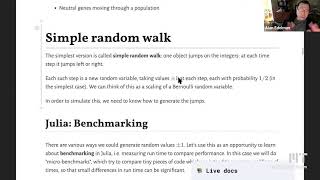
Random Walks in Computational Thinking - Lecture 12
Explore random walks in computational thinking, covering visualization, Julia concepts, benchmarking, and advanced topics like mutable structs and type parameters.
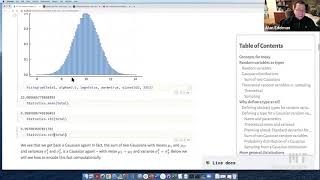
Random Variables as Types - Lecture 11
Explore random variables as types in Julia programming, covering Gaussian distributions, sampling, abstract types, and generic programming for probability distributions.
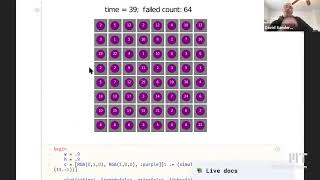
Modeling with Stochastic Simulation - Lecture 10
Explore stochastic simulation modeling using Julia, covering individual-based models, failure visualization, string interpolation, Bernoulli variables, and running simulations with practical examples.
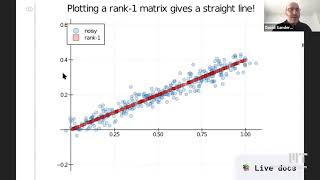
Principal Component Analysis - Lecture 8
Explore Principal Component Analysis: from matrix rank to SVD. Learn to measure data cloud size, understand correlated data, and navigate high-dimensional spaces using statistical techniques.
Transformations - Composability and Linearity in Computational Thinking - Lecture 4
Explore composability and linearity in transformations, focusing on image processing applications and advanced Julia programming techniques for vector-valued functions and linear/nonlinear transformations.
Transformations and Automatic Differentiation in Computational Thinking - Lecture 3
Explore transformations and automatic differentiation in Julia, covering linear and non-linear transformations, function types, and applications in machine learning, with practical examples and visualizations.
Transforming Images and Image Processing Techniques - Lecture 2
Explore image transformation techniques using Julia, including downsampling, linear combinations, convolutions, and filters. Learn about complexity, GPUs, and data structures in computational thinking.
Introduction to Arrays and Images in Computational Thinking - Lecture 1
Explore computational thinking through image manipulation and array operations in Julia, with hands-on examples and an introduction to abstraction concepts.

Understanding the Discrete Fourier Transform - Week 14
Explore Discrete Fourier Transform using Julia, from basic concepts to implementation. Compare DFT with Fast Fourier Transform, analyze sounds, and understand computational complexity.
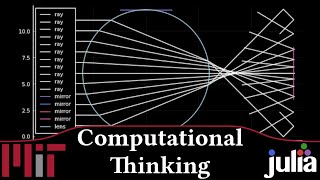
Raytracing in 2D - Week 8 - MIT Fall 2020
Explore 2D raytracing, covering light behavior, reflection, refraction, and Snell's law. Learn to implement these concepts in code using Julia, with practical examples like mirrors and lenses.
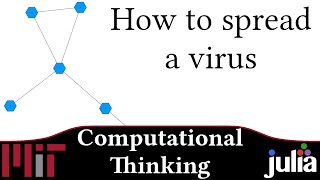
Graphs, Trees, and Spreading Disease - MIT 18.S191 Fall 2020 Week 5
Explore graph theory, tree traversal, and epidemic modeling using Julia programming, with hands-on demonstrations and practical applications in network analysis and disease spread simulation.
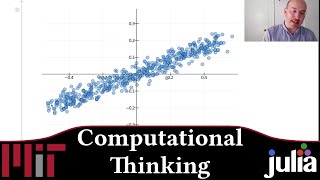
Understanding Structure in Data - Week 3
Explore data structure analysis using Julia, covering matrix rank, data visualization, PCA, and building a simple recommendation engine. Gain practical insights into advanced data science concepts.