Mitigating LangSec Problems With Capabilities
Explore how capability-based systems like Sandstorm mitigate language-based security vulnerabilities through robust isolation and authorization mechanisms, enhancing web application security.
Verifiable ASICs
Explore verifiable computation for untrusted ASICs, enabling high-assurance execution without compromising performance. Learn about the Zebra system's implementation and its potential to match trusted platform performance.
Prepose - Privacy, Security, and Reliability for Gesture-Based Programming
Explore a novel language and system for secure, private gesture recognition in sensor-based interfaces, addressing privacy concerns and security threats while ensuring fast performance.
A Practical Oblivious Map Data Structure with Secure Deletion and History Independence
Introduces a novel oblivious RAM supporting variable-sized blocks and a history-independent data structure, offering enhanced privacy and efficiency for key/value map operations.
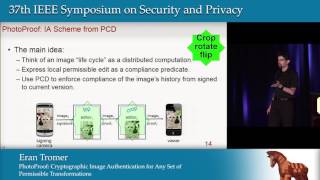
PhotoProof - Cryptographic Image Authentication for Any Set of Permissible Transformations
Cryptographic method for authenticating images while allowing permissible transformations. Enables verification of image integrity and authenticity without revealing sensitive information.
Multi-Architecture Container Images - Why Bother, and How To
Explore multi-architecture container images: their importance, how registries handle them, and techniques for building cross-platform containers to ensure software compatibility across diverse CPU architectures.
Creating a Distributed Round Robin Scheduler with Etcd
Explore the challenges and insights of building a distributed round-robin scheduler using etcd for persistence and consensus in this developer-focused journey.

The Container Operator's Manual
Practical insights on container adoption in production environments, exploring advantages, challenges, and tradeoffs for engineers and organizations considering containerization at scale.
GitOps - An Elegant Tool for Hybrid Cloud Kubernetes
Explore GitOps for consistent application management across multiple Kubernetes clusters. Learn deployment, management, and migration techniques through live demonstrations.

The Map Is Not the Territory - How SLOs Lead Us Astray, and What We Can Do about It
Explore SLO limitations in complex services, understand failure modes, and learn best practices for robust SLO construction to improve reliability and decision-making in modern systems.
Zero-Downtime Rebalancing and Data Migration of a Mature Multi-Shard Platform
Explore zero-downtime techniques for rebalancing and migrating data in multi-shard platforms, focusing on MySQL binlog-based tools for load distribution and tenant isolation.
Latency SLOs Done Right
Explore effective methods for implementing Latency Service Level Objectives (SLOs), addressing common pitfalls in latency measurement and aggregation for improved service quality tracking.
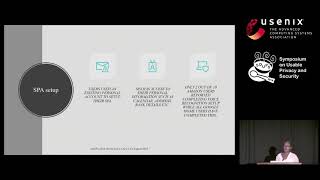
More than Smart Speakers - Security and Privacy Perceptions of Smart Home Personal Assistants
Explores users' perceptions of security and privacy in smart home assistants, revealing incomplete mental models and limited understanding of data handling, leading to inadequate threat models and coping strategies.
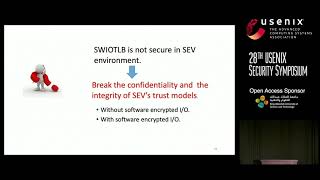
Exploiting Unprotected I/O Operations in AMD's Secure Encrypted Virtualization
Explores vulnerabilities in AMD's Secure Encrypted Virtualization, demonstrating attacks on I/O operations and constructing primitives to breach VM memory encryption, highlighting security risks in emerging technology.
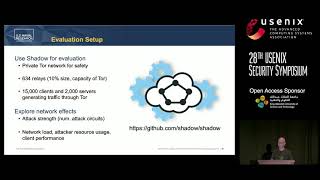
Point Break - A Study of Bandwidth Denial-of-Service Attacks against Tor
Explores bandwidth denial-of-service attacks against Tor, demonstrating feasibility and impact on network performance through experimentation and simulation. Analyzes costs and effects of various attack strategies.
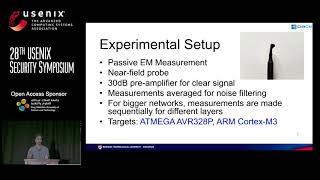
CSI NN - Reverse Engineering of Neural Network Architectures Through Electromagnetic Side Channel
Reverse engineering neural networks through electromagnetic side channels, revealing architecture details like activation functions, layers, neurons, and weights using non-invasive techniques on ARM Cortex-M3 microcontrollers.
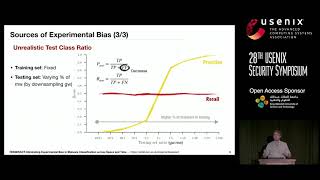
TESSERACT - Eliminating Experimental Bias in Malware Classification Across Space and Time
Unveils TESSERACT framework to eliminate spatial and temporal biases in Android malware classification, improving real-world robustness and revealing counterintuitive performance insights.
Data Domain Cloud Tier - Backup Here, Backup There, Deduplicated Everywhere!
Innovative cloud tier for Data Domain appliances, enabling cost-effective deduplication in the cloud. Focuses on space estimation, efficient data transfer, and file management between on-premises and cloud storage.
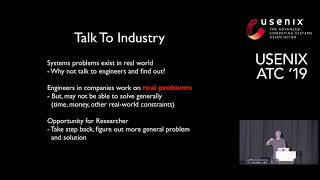
Measure, Then Build
Explore an empirically-driven approach to systems research, focusing on analyzing existing systems before designing new solutions. Learn from two decades of research examples at UW-Madison.
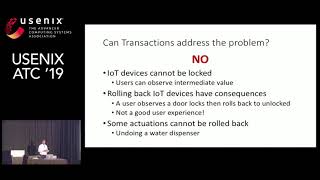
Transactuations - Where Transactions Meet the Physical World
Exploring transactuations: a novel abstraction for building reliable IoT applications, addressing inconsistencies in smart home environments caused by failures and unwanted interleaving.
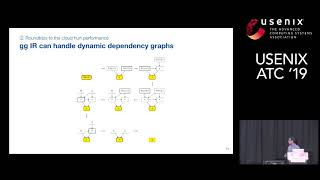
From Laptop to Lambda - Outsourcing Everyday Jobs to Thousands of Transient Functional Containers
Explore gg, a framework enabling near-interactive execution of everyday tasks using thousands of parallel cloud functions, revolutionizing how we approach resource-intensive computing jobs.