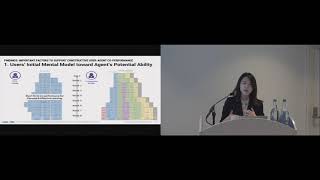
Co-Performing Agent - Design for Building User-Agent Partnership in Learning and Adaptive Services
Explores design strategies for intelligent agents that collaborate with users, enhancing personalized experiences through partnership-building and cooperative learning in adaptive services.
Explaining Decision-Making Algorithms through UI - Strategies to Help Non-Expert Stakeholders
Strategies for explaining decision-making algorithms through UI to non-experts, focusing on improving comprehension and transparency while exploring the impact on trust and user experience.
Wicked Problems and Collective Intelligence
Experts discuss wicked problems and collective intelligence, exploring innovative approaches to global challenges through conservation, ant behavior, organizational design, and supply chain management.

An Overview of the Andrew System
Overview of Andrew System: distributed computing environment for academic users. Explores file system, toolkit, messaging, and UI. Developed at Carnegie Mellon's Information Technology Center, used campus-wide by students, faculty, and staff.

Bringing Emotional Intelligence to Technology During Covid-19
Explore how AI with emotional intelligence can enhance human connection during the pandemic, improving technology's ability to understand and respond to our emotions.
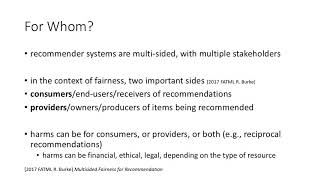
Building User Trust in Recommendations via Fairness and Explanations
Explore techniques to enhance user trust in recommender systems through fairness and explanations, addressing ethical concerns and promoting transparency in AI-driven decision-making.

Community, Art and the Vernacular in Technological Ecosystems
Exploring AI's impact on race, gender, and aging through art, emphasizing inclusive tech ecosystems and community-driven approaches to shape ethical AI and robotics for a more equitable future.
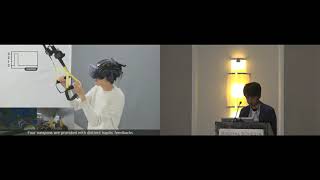
Pull-Ups - Enhancing Suspension Activities in Virtual Reality with Body-Scale Kinesthetic Force Feedback
Enhancing virtual reality experiences with body-scale kinesthetic force feedback using a suspension kit for activities like kitesurfing and paragliding, improving realism and reducing motion sickness.
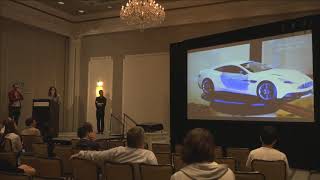
Photo-Chromeleon - Re-Programmable Multi-Color Textures Using Photochromic Dyes
Innovative method for creating re-programmable multi-color textures using photochromic dyes, enabling single-material fabrication techniques to produce high-resolution, customizable designs on physical objects.
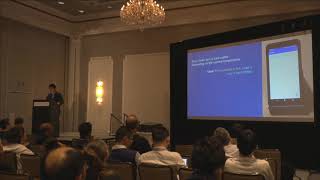
PUMICE - A Multi-Modal Agent that Learns Concepts and Conditionals from Natural Language and Demonstrations
Explore PUMICE, a multi-modal agent that combines natural language and demonstrations to learn concepts and conditionals, enabling end users to teach new tasks effectively.

Minecraft as AI Playground and Laboratory
Explore Minecraft as an AI research platform, focusing on Project Malmo and the MineRL competition to advance sample-efficient reinforcement learning and tackle complex decision-making challenges.
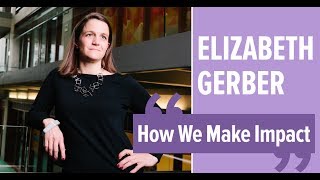
How We Make Impact
Exploring diverse design approaches beyond technology to create impactful solutions for societal challenges, emphasizing broader perspectives in problem-solving and innovation.
Homo Cyberneticus - The Era of Human-AI Integration
Explore the future of human-AI integration, discussing neural networks, symbiosis, and the potential consequences and benefits of AI augmentation for humanity.

Gesture Recognition - Key Insights and Future Directions
Explore key insights and future directions in gesture recognition, focusing on increasing accuracy, robust recognition systems, and ecological validity in evaluations. Learn from decades of research and challenges.
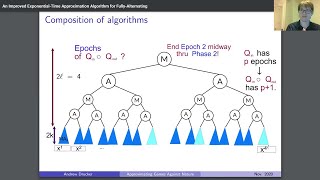
An Improved Exponential-Time Approximation Algorithm for Fully-Alternating Games Against Nature
Explore improved exponential-time approximation algorithms for fully-alternating games against nature, covering adversarial versions, MA formulas, and steepener algorithms.

Computation in the Brain Tutorial - Part 2
Explore neural computation models, focusing on assembly calculus and its applications in language processing, with insights from leading researchers in computational neuroscience.
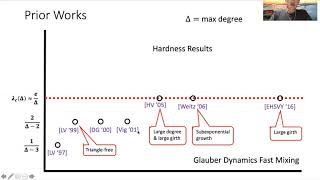
Spectral Independence in High-Dimensional Expanders and Applications to the Hardcore Model
Explore spectral independence in high-dimensional expanders and its application to the hardcore model, focusing on Glauber dynamics, complexity phase transitions, and future research directions.
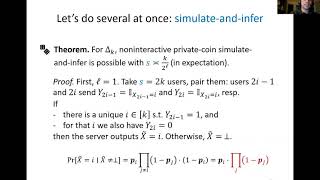
Cookbook - Lower Bounds for Statistical Inference in Distributed and Constrained Settings - Part 4
Explore statistical inference in distributed and constrained settings, focusing on lower bounds, simulation techniques, and non-interactive inference methods.
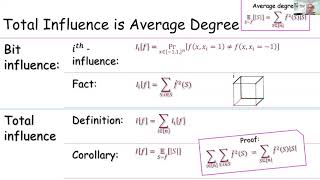
Towards a Proof of the Fourier Entropy Conjecture
Explore the Fourier Entropy Conjecture through concentration, entropies, and influence, with insights from leading researchers in mathematical analysis and theoretical computer science.
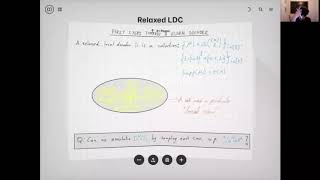
Relaxed Locally Decodable Codes
Explore advanced concepts in coding theory, focusing on relaxed locally decodable codes and their applications in data storage and transmission.
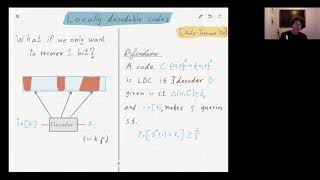
Relaxed Locally Decodable Codes - Part 1
Explore coding theory, locally decodable codes, and their relaxed variants, focusing on applications, logical polynomials, and synthesis techniques in this IEEE presentation.