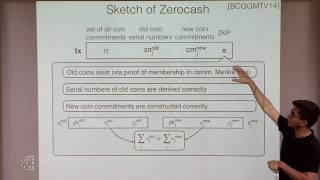
Zexe- Enabling Decentralized Private Computation
Explore decentralized private computation with ZEXE, addressing scalability and privacy in blockchain systems for digital asset trading and custom access control.
Blockchain and Economics - Progress and Open Questions
Explore economic design in blockchain, focusing on performance incentives, market institutions, and governance in decentralized systems. Learn about applications and open questions in this emerging field.
Mind Over Data - The One Thing You Know and Machines Don't
Explore the intersection of human intuition and machine learning in causal reasoning, examining Bayesian networks, confounding factors, and real-world applications in AI and data analysis.
Recent Algorithmic Primitives - Linear Combination of Unitaries and Quantum Signal Processing
Explore advanced quantum computing techniques like Linear Combination of Unitaries and Quantum Signal Processing, focusing on their applications in algorithmic development and Hamiltonian simulation.
Quantum Computing and Simulation with Trapped Ions
Explore trapped ion quantum computing, from individual qubits to scalable systems, with insights on algorithms, dynamics, and future challenges in building modular quantum computers.

Quantum Supremacy - Checking a Quantum Computer with a Classical Supercomputer
Explore quantum supremacy, error rates, and hardware challenges in quantum computing. Learn about recent advancements and the race to achieve computational superiority over classical systems.
Recent Advances in Quantum Simulation
Explore recent advancements in quantum simulation, focusing on dynamical simulation, unitary access, and applications in quantum chemistry and physics.

Classical Simulation of Quantum Many-body Systems with Tensor Networks
Explore tensor networks for simulating quantum many-body systems, focusing on matrix product states and branching mirror techniques in quantum computation challenges.

Backpropagation and Deep Learning in the Brain
Explore deep learning in the brain, backpropagation, and credit assignment algorithms. Discover neuroscience evidence and new models of neurons in this computational brain theory talk.

The Information Bottleneck Theory of Deep Neural Networks
Explore the Information Bottleneck Theory's application to deep neural networks, examining statistical learning, information theory, and stochastic gradient descent in brain data analysis.
Explaining Landscape Connectivity of Low-Cost Solutions for Multilayer Nets
Explore landscape connectivity in multilayer networks, focusing on low-cost solutions, equivalent local minima, overparameterization, and dropout stability. Gain insights into non-convex optimization and deep neural networks.
From Classical Statistics to Modern Machine Learning
Explore the evolution from classical statistics to modern machine learning, examining key concepts like generalization, interpolation, and the "double descent" phenomenon in supervised learning.
Disentangling Influence: Using Disentangled Representations to Audit Model Predictions
Explore disentangled representations to audit model predictions, examining direct and indirect influence, independent factors, and experimental results in fairness research.
Generative Models
Explore generative models in deep learning, covering theoretical perspectives, hacker models, information flow, and provable algorithms for learning classifiers and phylogenetic reconstruction.
Implicit Regularization I
Explore implicit regularization in deep learning, covering boosting, complexity control, optimization landscapes, and stochastic gradient descent for effective model training.
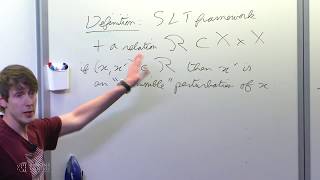
Adversarial Examples
Explore the intriguing world of adversarial examples in deep learning, their implications, and theoretical frameworks with expert Sébastien Bubeck from Microsoft Research.
Recent Developments in Over-parametrized Neural Networks, Part I
Explore recent developments in over-parametrized neural networks, focusing on optimization challenges, theoretical problems, and strategies for achieving optimal results in deep learning.
Generalization II
Explore advanced concepts in deep learning, including random averages, losses, and network architectures, with experts from UC Berkeley and MIT.

Classical Zero Knowledge Arguments for Quantum Computing
Explore zero-knowledge arguments in quantum computing, covering delegation protocols, quantum NP, and classical commitment to quantum states.
Federated Heavy Hitters Discovery with Differential Privacy
Explore federated learning, differential privacy, and heavy hitters discovery in this talk by Peter Kairouz. Learn about multiparty computation, open research, and practical applications in data analysis.
Can Non-Convex Optimization Be Robust?
Explore non-convex optimization's robustness, examining locally optimizable functions, perturbed objectives, and matrix completion. Insights on empirical vs. population risk and semi-random adversaries.