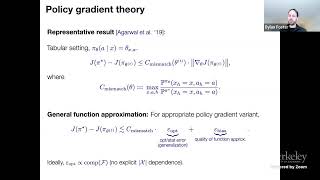
Reinforcement Learning - Part I
Explore reinforcement learning fundamentals, including credit assignment, dynamic programming, and exploration algorithms. Gain insights into algorithm design and sample complexity in this comprehensive introduction.
Introduction to Causal Graphical Models - Graphs, D-Separation, Do-Calculus
Explore causal graphical models, d-separation, and do-calculus. Learn about graphs, Bayesian networks, and instrumental variables for understanding causality in complex systems.
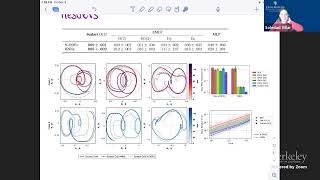
Equivariant Machine Learning Structured Like Classical Physics
Explore equivariant machine learning and its connection to classical physics, focusing on graph neural networks, spectral methods, and symmetry in optimization problems.
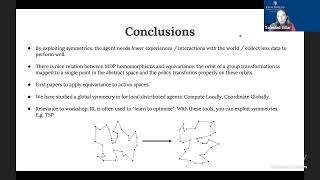
Equivariant RL
Explore equivariant reinforcement learning, its advantages, and applications in graph neural networks with Max Welling from the University of Amsterdam.
Optimal Gradient-Based Algorithms for Non-Concave Bandit Optimization
Explore optimal gradient-based algorithms for non-concave bandit optimization, covering stochastic problems, low-rank linear rewards, and high-order polynomials with applications to reinforcement learning.

Optimization Crash Course
Explore geometric methods in optimization and sampling, covering key topics like convexity, optimality, and gradient descent with expert insights from MIT's Ashia Wilson.
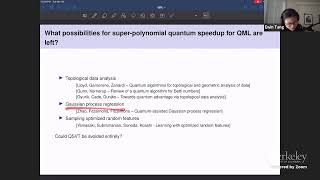
On Quantum Linear Algebra for Machine Learning - Quantum Colloquium
Explore quantum singular value transformation for machine learning, its applications, barriers to quantum speedups, and connections to classical algorithms.

Dreamcoder- Bootstrapping Inductive Program Synthesis With Wake-Sleep Library Learning
Explore program induction and library learning in AI, focusing on DreamCoder's approach to synthesizing models and systems through neural-guided Bayesian inference and abstraction refinement.

Towards Practical Quantum Advantage - Quantum Colloquium
Explore quantum computing's potential for practical advantage, focusing on small data problems with superquadratic speedups. Discusses progress in quantum algorithms for chemistry and simulation challenges.
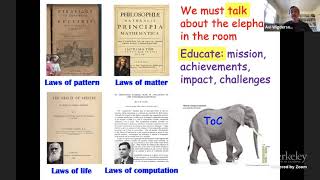
Are We Aging Well?
Explore the evolution and impact of Satisfiability (SAT) in computing theory over 50 years, including recent breakthroughs, algorithms, and its central role in computational complexity.
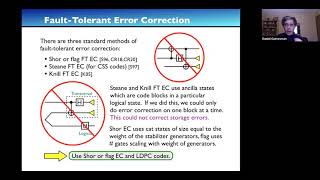
Fault Tolerance with LDPC Codes - Quantum Colloquium
Explore fault tolerance in quantum computing using LDPC codes, examining their potential to reduce overhead compared to surface codes and discussing recent progress in the field.

Hybrid Classical-Quantum Algorithms
Explore hybrid algorithms combining quantum and classical computing for optimization and inference, leveraging strengths of both platforms to solve complex problems efficiently.
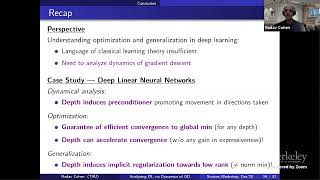
Analyzing Optimization and Generalization in Deep Learning via Dynamics of Gradient Descent
Explore deep learning optimization and generalization through gradient descent dynamics, focusing on implicit preconditioning and its impact on matrix completion problems.
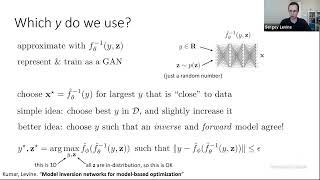
Offline Reinforcement Learning and Model-Based Optimization
Explore offline reinforcement learning and model-based optimization techniques, focusing on data-driven approaches, Q-function lower bounds, and model inversion networks for automated decision-making.

Beyond Worst-Case: Instance-Dependent Optimality in Reinforcement Learning
Explore instance-dependent optimality in reinforcement learning, focusing on policy evaluation and TD learning. Gain insights into achieving optimal algorithms and useful bounds.

What Are the Statistical Limits of Offline Reinforcement Learning With Function Approximation?
Explore statistical limitations in offline reinforcement learning with function approximation, covering realizability, coverage, policy evaluation, and practical considerations.
Model-Based Reinforcement Learning with Value-Targeted Regression
Explore model-based reinforcement learning with value-targeted regression, covering episodic RL, UCRL, deterministic systems, and the MatrixRL algorithm.
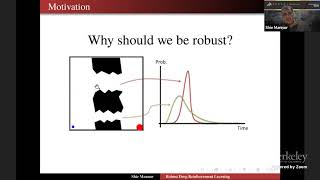
Deep Robust Reinforcement Learning and Regularization
Explore robust reinforcement learning, addressing uncertainties in deep RL through regularization techniques. Gain insights into robust MDPs, policy evaluation, and uncertainty-aware Bellman equations.
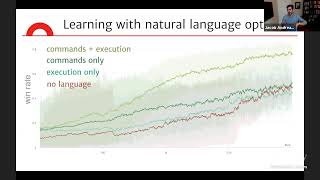
Language as a Scaffold for Reinforcement Learning
Explore how natural language can enhance reinforcement learning, covering topics like instructions as observations, task decomposition, and learning from demonstrations.
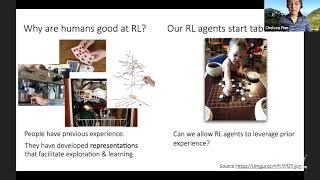
Learning Exploration Strategies with Meta-Reinforcement Learning
Discover meta-reinforcement learning strategies for efficient exploration in complex environments, focusing on posterior sampling and task-relevant information.

Discussion - Offline Reinforcement Learning
Explore offline reinforcement learning, covering data sets, optimism under uncertainty, state coverage, and policy evaluation. Gain insights into pragmatic and conceptual approaches.