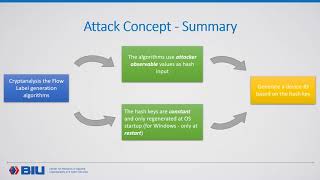
Exploiting IPv6 Flow Label
Uncovers security vulnerabilities in IPv6 flow label implementation, demonstrating how it can be exploited for device tracking across networks, VPNs, and browsers on Windows, Linux, and Android systems.

Intriguing Properties of Adversarial ML Attacks in the Problem Space
Explores novel formalization of adversarial ML evasion attacks in problem-space, focusing on real-world implications. Proposes a new attack on Android malware, demonstrating the feasibility of "adversarial-malware as a service".
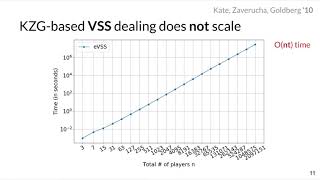
Towards Scalable Threshold Cryptosystems
Explore techniques to scale threshold cryptosystems for large-scale distributed systems, focusing on improving efficiency in signature aggregation, verifiable secret sharing, and distributed key generation.
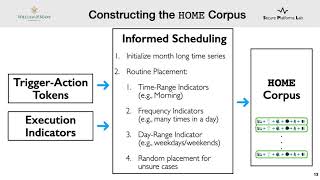
Towards a Natural Perspective of Smart Homes for Practical Security and Safety Analyses
Explore smart home security through natural automation patterns, leveraging user-created routines to generate realistic scenarios for practical safety analyses and policy development.
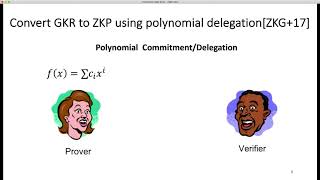
Transparent Polynomial Delegation and Its Applications to Zero Knowledge Proof
Explore transparent polynomial delegation for zero-knowledge proofs, including constructions, applications to verifiable secret sharing, and comparisons with other ZKP systems.
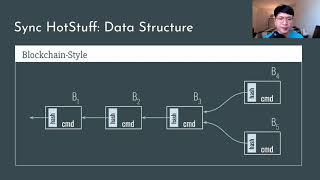
Sync HotStuff: Simple and Practical Synchronous State Machine Replication
Explore a simple, efficient synchronous Byzantine Fault Tolerance solution for state machine replication, offering improved fault tolerance and optimistic responsiveness in distributed systems.
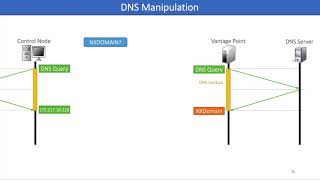
ICLab - A Global, Longitudinal Internet Censorship Measurement Platform
Explore global internet censorship through ICLab, a comprehensive measurement platform. Gain insights into blocking techniques, political impacts, and network interference across 60 countries.
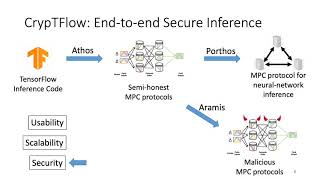
CrypTFlow - Secure TensorFlow Inference
Secure TensorFlow inference system converting code to MPC protocols. Enables privacy-preserving machine learning on real-world neural networks with improved performance and security guarantees.
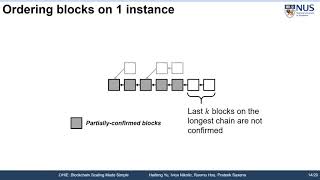
OHIE - Blockchain Scaling Made Simple
OHIE: A simple, scalable blockchain protocol that achieves high throughput by running parallel instances of Bitcoin's backbone, offering improved decentralization and linear scaling with available bandwidth.
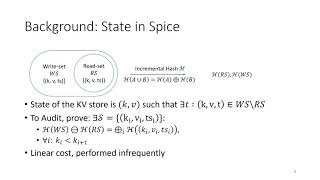
Replicated State Machines Without Replicated Execution
Innovative approach to reduce costs in replicated systems using cryptographic proofs for state transitions, enhancing efficiency in large-scale Byzantine fault-tolerant environments.

Alpaca & LLaMA - Can it Compete with ChatGPT?
Explore Stanford Alpaca's capabilities, learn inference techniques, and compare its performance to ChatGPT in this step-by-step tutorial on setting up and optimizing the model.

Navigating the MLOps Landscape
Expert panel discusses MLOps challenges, best practices, and innovations. Gain insights on operationalizing machine learning, leveraging open-source tools, and addressing security concerns in large-scale ML systems.

Industry Shocking Text-To-Music AI Model by Facebook Audiocraft - Full Tutorial - Better Than MusicLM
Learn to use Facebook's Audiocraft AI model for text-to-music generation. Install, run, and experiment with this powerful tool on your computer or Google Colab to create amazing AI-generated music.
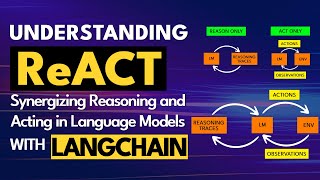
Understanding ReACT with LangChain
Explore ReACT framework implementation using LangChain, covering its principles, manual application, and integration for enhanced AI reasoning and task-solving capabilities.

PCPs and Global Hyper-contractivity - Lecture 1
Explore advanced concepts in theoretical computer science, focusing on Probabilistically Checkable Proofs and global hyper-contractivity with expert Dor Minzer.

Log-concave Polynomials and Spectral Independence - Part 3
Explore advanced concepts in log-concave polynomials and spectral independence, delving into their applications in analysis and theoretical computer science.
Accelerating Application Delivery and Operations Across Kubernetes Environments
Explore ZeroOps solutions for Kubernetes to accelerate application delivery, simplify DevOps, and enhance developer productivity. Learn about open-source tools and managed services for efficient, modern app development.
Structural Transfer Learning- Exploring Neural Models and Language Structure Through
Explore neural models and language structure through innovative transfer learning techniques, uncovering insights into communication patterns across species.
Individual Discrimination of Bottlenose Dolphin Signature Whistles Using Deep Learning
Explore deep learning techniques for identifying individual bottlenose dolphins through their unique signature whistles, advancing our understanding of cetacean communication and behavior.

Multigroup Fairness - Polylogues
Explore key themes of multigroup fairness in algorithmic systems with Stanford's Omer Reingold, discussing statistical judgment validity and societal implications of AI decision-making.
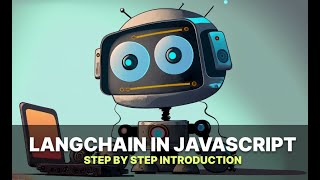
Langchain in JavaScript - Step by Step Introduction
Step-by-step guide to implementing Langchain in JavaScript, covering API calls, prompt templates, agents, memory, streaming, and component integration for advanced AI applications.