
CoSMeDis - A Distributed Social Media Platform with Formally Verified Confidentiality Guarantees
Explore a distributed social media platform with formal confidentiality guarantees. Learn about design, implementation, and verification of information flow security in a multi-node system.
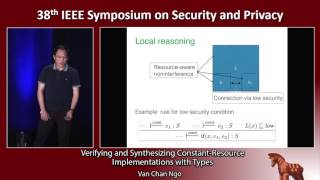
Verifying and Synthesizing Constant-Resource Implementations with Types
Explores a type system for verifying constant-resource implementations, enhancing security against side-channel attacks while allowing natural programming models. Introduces resource-aware noninterference and automated repair techniques.
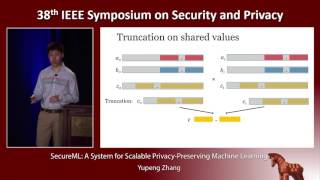
SecureML - A System for Scalable Privacy-Preserving Machine Learning
Explores scalable privacy-preserving machine learning techniques for linear regression, logistic regression, and neural networks using secure two-party computation, with efficient protocols and MPC-friendly alternatives to nonlinear functions.
On the Practicality of Cryptographically Enforcing Dynamic Access Control Policies in the Cloud
Explores the practical challenges of implementing cryptographic access control for cloud data, highlighting computational costs and bottlenecks in dynamic scenarios.
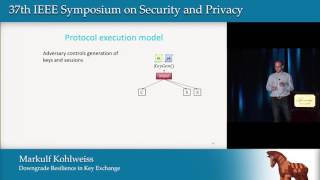
Downgrade Resilience in Key-Exchange Protocols
Explore downgrade attacks in key-exchange protocols, their causes, and strategies for achieving downgrade security. Learn about vulnerabilities and protective measures in widely-used protocols like TLS.
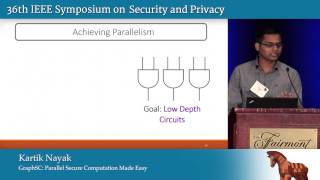
GraphSC: Parallel Secure Computation Made Easy
Parallel secure computation framework for efficient, oblivious execution of graph-based algorithms on large datasets, enabling practical big data analysis with minimal privacy leakage.
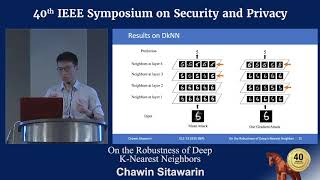
On the Robustness of Deep K-Nearest Neighbors
Explore the robustness of Deep k-Nearest Neighbors against adversarial attacks, proposing a heuristic method to find vulnerabilities in this defense mechanism for deep learning models.
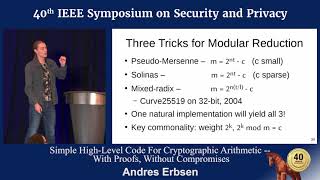
Simple High-Level Code for Cryptographic Arithmetic - With Proofs, Without Compromises
Innovative approach to implementing cryptographic arithmetic using high-level code with machine-checked proofs, achieving competitive performance across multiple CPU architectures and prime fields.
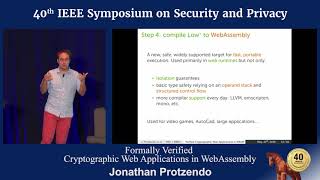
Formally Verified Cryptographic Web Applications in WebAssembly
Explore formal verification of cryptographic web apps in WebAssembly, focusing on compiling Low* to WebAssembly for compact, auditable code. Includes case studies on WHACL* and LibSignal*.
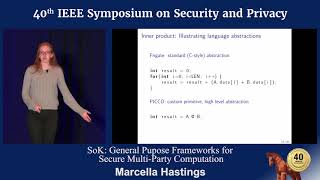
SoK - General Purpose Frameworks for Secure Multi-Party Computation
Explore secure multi-party computation frameworks, their capabilities, and challenges. Learn about high-level abstractions for executing MPC protocols on arbitrary functions across various systems.
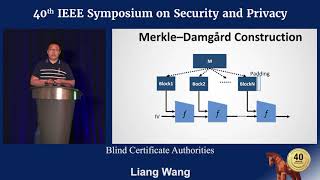
Blind Certificate Authorities
Explore building blind certificate authorities for anonymous systems, focusing on binding email addresses to public keys without revealing identities. Introduces secure channel injection protocols and demonstrates practical implementation.
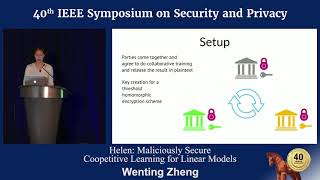
Helen - Maliciously Secure Coopetitive Learning for Linear Models
Explore secure collaborative machine learning with Helen, a system enabling multiple parties to train linear models without revealing sensitive data, addressing privacy concerns in competitive environments.
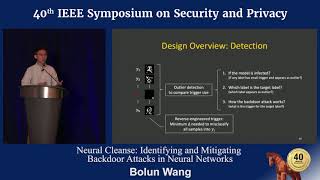
Neural Cleanse: Identifying and Mitigating Backdoor Attacks in Neural Networks
Explore techniques to detect and mitigate backdoor attacks in neural networks, focusing on identifying hidden triggers and developing robust defense mechanisms for enhanced security in AI applications.
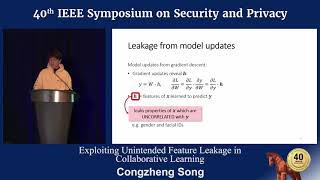
Exploiting Unintended Feature Leakage in Collaborative Learning - Congzheng Song
Explores security vulnerabilities in collaborative machine learning, demonstrating how model updates can leak sensitive information about training data and proposing inference attacks to exploit these weaknesses.
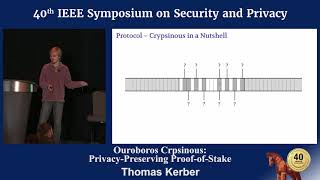
Ouroboros Crypsinous Privacy Preserving Proof of Stake
Explore privacy-preserving proof-of-stake blockchain protocol, focusing on adaptive security and novel cryptographic techniques for enhanced privacy in decentralized systems.
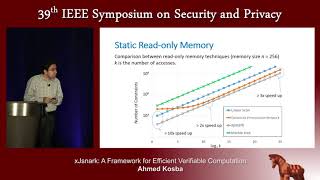
XJsnark - A Framework for Efficient Verifiable Computation
Explore efficient verifiable computation with xJsnark framework. Learn circuit-friendly algorithms, optimizations for integer arithmetic, and techniques to minimize redundant computations in cloud and cryptocurrency applications.
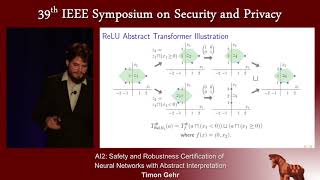
AI2- Safety and Robustness Certification of Neural Networks
Explore AI2, a groundbreaking analyzer for neural networks that uses abstract interpretation to prove safety properties and robustness, offering faster and more scalable verification than existing methods.

EverCrypt - A Fast, Verified, Cross-Platform Cryptographic Provider
Comprehensive, verified cryptographic provider offering high-performance functionalities with agility and multiplexing. Demonstrates effective composition of C and assembly, outperforming unverified implementations in various algorithms.

HopSkipJumpAttack - A Query-Efficient Decision-Based Attack
Explore a query-efficient decision-based adversarial attack algorithm for generating adversarial examples, analyzing its theoretical foundations and performance against defense mechanisms.
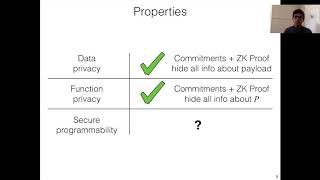
ZEXE - Enabling Decentralized Private Computation
Explore ZEXE, a system enabling private, efficient decentralized computation on ledgers. Learn about its innovative approach to transaction validation and privacy preservation in blockchain applications.
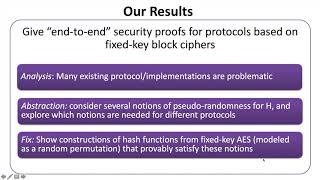
Efficient and Secure Multiparty Computation from Fixed-Key Block Ciphers
Explores secure multiparty computation using fixed-key block ciphers, providing end-to-end security proofs and improving performance for implementations of secure-computation protocols.