Beyond Worst-Case Analysis - Panel Discussion
Experts discuss advanced algorithmic analysis, exploring beyond worst-case scenarios to improve efficiency and understanding in computer science and machine learning applications.
Continuous Algorithms - Sampling and Optimization in High Dimension
Explore high-dimensional sampling and optimization techniques, including cutting plane methods, interior-point algorithms, and Riemannian Hamiltonian Monte Carlo, with insights on complexity and open problems.
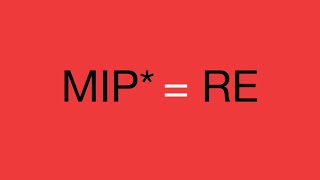
MIP* = RE
Explore the intersection of physics, mathematics, and computer science through a two-player game, delving into quantum mechanics, operator algebras, and interactive proofs.
What Is the Statistical Complexity of Reinforcement Learning?
Explore statistical complexity in reinforcement learning, covering supervised learning, linear models, evaluation challenges, and realizability conditions.
Fully Homomorphic Encryption, 10 Years Later - Definitions and Open Problems
Explore fully homomorphic encryption's evolution, definitions, and challenges in this talk by Daniele Micciancio, covering lattice-based cryptography, bootstrapping techniques, and composability.
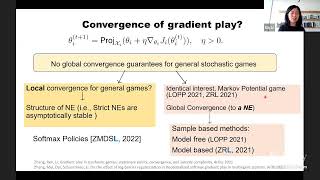
Learning Decentralized Policies in Multiagent Systems - How to Learn Efficiently
Explore decentralized policy learning in multiagent systems, focusing on scalable actor-critic methods, network structures, and performance characterization using stochastic game frameworks.
What Does Machine Learning Offer Game Theory - And Vice Versa
Explore the intersection of machine learning and game theory, focusing on simplifying complex scenarios and building cooperative AI agents for real-world applications.
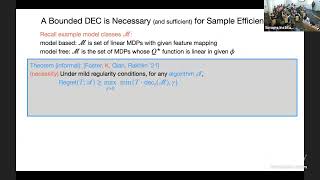
What Is the Statistical Complexity of Reinforcement Learning?
Explore statistical complexity in reinforcement learning, focusing on conditions for generalization and sample-efficient learning. Introduces the Decision-Estimation Coefficient as a key complexity measure.
V-Learning - Simple, Efficient, Decentralized Algorithm for Multiagent RL
Explore efficient decentralized algorithms for multiagent reinforcement learning, focusing on V-learning's ability to overcome challenges in joint action spaces and achieve Nash equilibria.
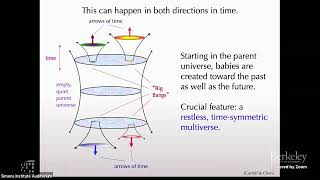
The Arrow of Time in Causal Networks
Explore the macroscopic arrow of time, causal networks, and their relation to fundamental physics. Delve into entropy, complexity, and the nature of causality in our universe.
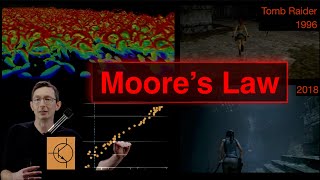
Moore's Law, Exponential Growth, and Extrapolation!
Explore Moore's Law, exponential growth in computing, and its impact on AI, scientific computing, and future technologies. Understand the implications for technological advancement.

Overview of Deep Reinforcement Learning Methods
Comprehensive exploration of deep reinforcement learning techniques, including Q-learning, actor-critic methods, policy networks, and gradient optimization for advanced AI decision-making and control systems.
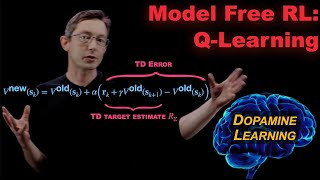
Q-Learning - Model Free Reinforcement Learning and Temporal Difference Learning
Explore Q-learning and temporal difference algorithms in reinforcement learning, including SARSA and connections to biological learning through dopamine. Covers key concepts for deep reinforcement learning.
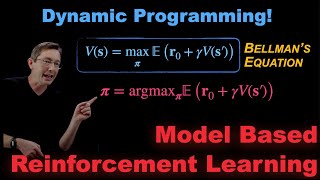
Model Based Reinforcement Learning - Policy Iteration, Value Iteration, and Dynamic Programming
Explore dynamic programming in model-based reinforcement learning, covering policy iteration, value iteration, and Q-learning for effective decision-making strategies.
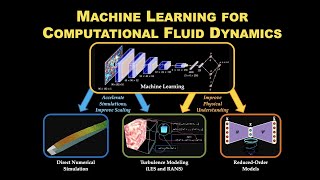
Machine Learning for Computational Fluid Dynamics
Explore machine learning's potential to enhance computational fluid dynamics, covering applications in simulations, turbulence modeling, and reduced-order models while emphasizing physics-informed approaches.

Deep Learning to Discover Coordinates for Dynamics - Autoencoders & Physics Informed Machine Learning
Explore deep learning techniques for discovering effective coordinate systems in dynamical systems, enabling simpler models and physical law discovery. Focus on autoencoders and physics-informed machine learning.
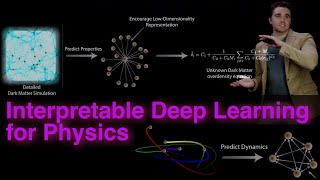
Interpretable Deep Learning for New Physics Discovery
Explore a novel method combining deep learning and symbolic regression to uncover physical laws from data, with applications in physics and cosmology.
Deep Learning for Turbulence Closure Modeling
Explore how deep learning revolutionizes turbulence modeling in fluid dynamics, focusing on RANS equations and large eddy simulations for advanced computational techniques.

Deep Reinforcement Learning - Neural Networks for Learning Control Laws
Explore neural networks in deep reinforcement learning for control systems, from game-playing AI to robotics. Learn about key algorithms and groundbreaking applications.
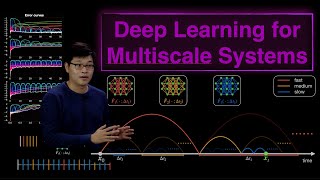
Deep Learning of Hierarchical Multiscale Differential Equation Time Steppers
Learn to integrate multiscale differential equations efficiently using a novel deep learning architecture, with benchmarks on illustrative dynamical systems.
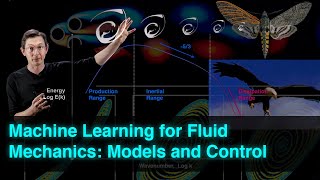
Machine Learning for Fluid Dynamics: Models and Control
Explore machine learning applications in fluid dynamics modeling and control, covering patterns, complexity, RANS closure models, SINDY, and deep MPC for flow control.