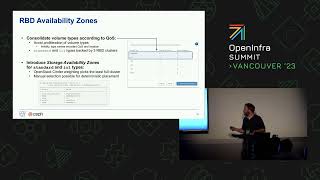
Improving Business Continuity for Large-Scale Ceph Infrastructure
Discover strategies for enhancing high availability and disaster recovery in large-scale Ceph infrastructures, including RBD backups, multisite replication, and CephFS backup solutions to S3.
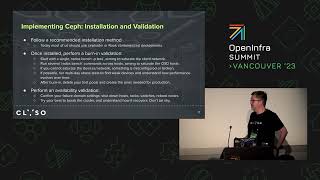
Lessons Learned in Ceph Operations for Science at CERN - From 3PB to 100PB
Discover how CERN scaled Ceph from 3PB to 100PB across data centers, exploring operational challenges, performance improvements, and essential lessons for large-scale storage implementation.
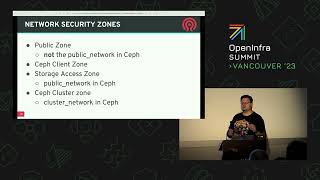
Data Security and Storage Hardening in Rook and Ceph
Explore comprehensive security strategies for Ceph storage systems, from threat modeling and encryption to access controls, focusing on practical hardening techniques for robust data protection.
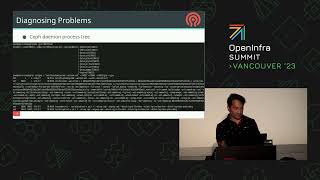
Ceph Troubleshooting in a Containerized Environment
Master essential techniques for troubleshooting Ceph in containerized environments, from diagnosing issues and analyzing logs to resolving daemon problems and memory leaks.
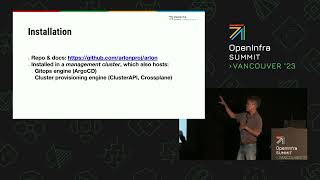
Arlon: Unified and Scalable Deployment of Kubernetes Clusters, Configurations and Applications
Discover how Arlon unifies Kubernetes cluster deployment, configurations, and applications through a single declarative API, enabling efficient large-scale management and standardized production-ready environments.
Data Platform for End-to-End AI Democratization
Explore how data platforms enable AI democratization through unified processing and training architectures, improving efficiency for recommender systems and deep learning workloads.
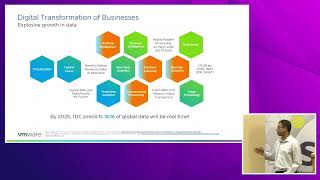
Addressing Capacity and Cost Challenges for Oracle Workloads Using VMware Software Memory Tier
Discover how VMware Software Memory Tiering optimizes Oracle workloads, addressing capacity challenges through memory disaggregation and efficient infrastructure management for enhanced performance and cost savings.
Next-Generation Storage Using DPUs Instead of CPUs
Discover how DPUs revolutionize data center storage systems, offering 3-10x better performance than CPU-based solutions while exploring architectural advantages, implementation examples, and the future of storage technology.

Green Computing with Computational Storage Devices - Energy Efficiency in Data Centers
Discover how computational storage devices revolutionize data center efficiency through Samsung Smart SSD technology, focusing on power reduction and database acceleration through CPU-to-SSD computation offloading.
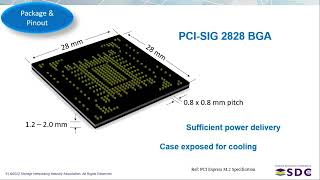
Automotive SSD Specification Update - Next Generation Vehicle Storage Solutions
Discover how next-gen automobiles leverage PCIe communications and JEDEC Automotive SSD solutions for enhanced vehicle control, sensors, communications, entertainment, and AI functionality.

SPDK and Infrastructure Offload Using NVMe-oF for High Performance Storage
Explore how SPDK NVMe-oF target enables infrastructure offload, combining direct-attached storage performance with shared storage benefits through vendor-agnostic frameworks and libraries.
Protecting NVMe/TCP PDU Data at 400 Gbps Using Hardware Accelerators
Explore high-performance data protection techniques for NVMe/TCP using SPDK acceleration framework, comparing ISA-L and Intel DSA implementations for efficient data digest computation at 400 Gbps speeds.
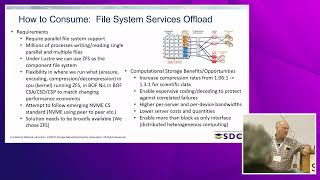
HPC Scientific Simulation and Computational Storage for Large-Scale Data Management
Explore how Los Alamos revolutionizes scientific data management using NVME Computational Storage, featuring proof-of-concept applications and industry partnerships for large-scale data solutions.

Storage Virtualization and Hardware-agnostic Acceleration Using IPDK and xPU
Discover how IPDK enables vendor-agnostic storage virtualization and hardware acceleration, allowing standard drivers to access remote storage at scale while leveraging SmartNIC/DPU/IPU/xPU capabilities.

DPU as a Storage Initiator for Bare Metal Performance and Virtualization
Discover how DPU-based Storage Initiators enhance NVMe/TCP performance, enabling bare-metal speeds for virtualized applications while providing encryption, compression, and seamless integration with orchestration systems.
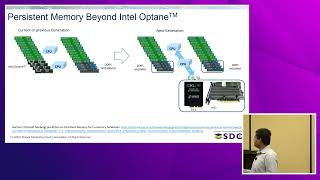
Future of Persistent Memory Form Factors and Architectures with CXL
Explore the convergence of storage and memory technologies through CXL protocols, focusing on form factors, management interfaces, and the future of persistent memory architectures.
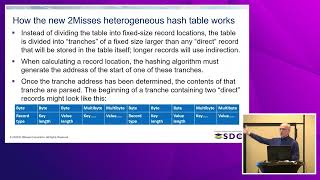
Challenges and Opportunities in Hash Table Optimization for Persistent Memory
Dive into optimizing hash tables for persistent memory, exploring design constraints, performance implications, and new programming paradigms for efficient database operations.

HDD Computational Storage Performance Analysis and Benchmarking - From System Tests to IPC
Dive into computational storage benchmarking techniques, exploring IPC analysis, SIMD programming, and inline assembler for optimizing genomics research performance on HDD systems.

Disaggregated NVMe/TCP Storage Using an Infrastructure Processing Unit (IPU)
Explore end-to-end Software Defined Storage solutions using Infrastructure Processing Units, focusing on NVMe/TCP integration, Kubernetes CSI plugins, and orchestration frameworks for cloud data centers.

Hardware Accelerated ZFS Using Computational Storage - SDC 2022
Discover how to accelerate ZFS performance using computational storage devices and DPUs, exploring hardware-software integration techniques that boost storage system efficiency by 10-30x.
Introducing CXL 3.0 - Expanded Capabilities for Scale and Resource Optimization
Explore the next-gen CXL 3.0 technology's enhanced capabilities, including doubled bandwidth, improved memory pooling, multi-level switching, and advanced coherency features for high-performance computing workloads.