Apache Pulsar - A Cloud-Native Alternative to Kafka for Event-Driven Applications
Discover how Apache Pulsar serves as a scalable messaging platform, offering unified data streaming, multi-tenancy, and seamless integration with container environments - all while providing an alternative to traditional message brokers.
Running Data Applications on Google Kubernetes Engine (GKE) - From Stateless to Stateful Workloads
Discover how Kubernetes has evolved to effectively manage stateful applications, from databases and big data to machine learning workloads on Google Kubernetes Engine.
Open Formats: The Happy Accident Disrupting the Data Industry
Discover how open table formats like Apache Iceberg are revolutionizing data accessibility, breaking vendor lock-in, and enabling shared analytics across multiple query engines.
CICD Pipelines for dbt - Choosing Between DIY and Cloud Solutions
Explore the trade-offs between building custom CICD pipelines for dbt projects versus using dbt Cloud's built-in solutions, focusing on Slim CI and documentation deployment strategies.
Making AI Truly Open Source - Challenges and Solutions
Explore the complexities of truly open-source AI, examining transparency challenges, data attribution issues, and practical solutions for creating genuinely open AI systems.

LANL's Journey Toward Computational Storage - Exploring Data Reduction Techniques for Petabyte-Scale Simulations
Explore LANL's innovative approaches to handling massive simulation data through computational storage techniques, focusing on efficient data reduction and analytics optimization for petabyte-scale operations.
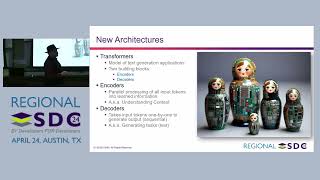
AI at the Intersection of Storage and Networking
Explore the technical implications of AI's rapid rise in storage and networking architectures, examining key challenges and future developments through an expert industry perspective.
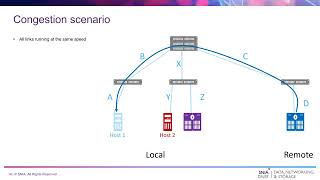
The Evolution of Congestion Management in Fibre Channel - Understanding Fabric Notifications and SAN Performance
Explore the latest advancements in Fibre Channel SAN performance through Fabric Notifications, covering implementation techniques, standards, and current solutions for optimal network management.
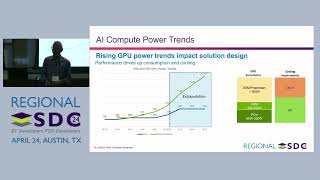
Technical Trends in AI Infrastructure for Developers - 2024
Explore the evolving landscape of AI infrastructure, from accelerators and storage to deployment models, focusing on technical trends and future solutions for developers working with AI workloads.
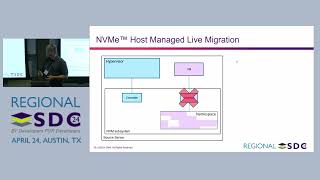
NVM Express Standardization of Controller Migration in Virtual Environments
Explore NVM Express® controller migration standardization, focusing on live VM transfers, namespace migration, and tracking memory modifications for seamless datacenter operations.
Introduction to Capacity Optimization Methods - February-March 2018
Discover essential capacity optimization techniques and methods for storage systems, focusing on efficiency improvements and data reduction strategies.
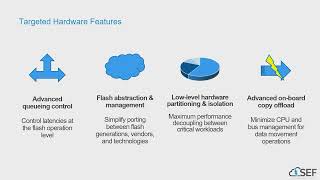
Software-Enabled Flash Capabilities and Demonstrations - Understanding Hardware Features and Implementation
Discover how Software-Enabled Flash™ technology revolutionizes flash memory usage through custom hardware, API integration, and advanced features like workload isolation and latency control for cloud applications.
Standardized Storage Telemetry for Secure Fleet Monitoring and Debug
Discover how standardized telemetry enables secure fleet monitoring and debugging while protecting data privacy, featuring new specifications for improved vendor-specific health monitoring capabilities.
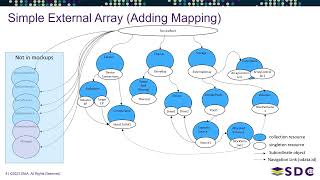
Comprehensive SNIA Swordfish Overview - 2023
Discover the comprehensive SNIA Swordfish® storage management interface, its RESTful hierarchies, ecosystem tools, and latest features including enhanced NVMe capabilities and metrics management.
Expanding Ceph's Capabilities with NVMe-oF - Technical Deep Dive
Dive into the integration of Ceph with NVMe-oF technology, exploring architectural decisions, implementation challenges, and practical applications for high-performance storage systems and data centers.
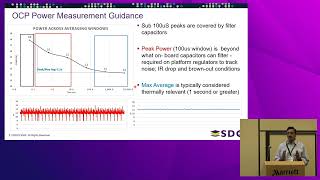
Gen6x4 SSD Power Management and Form Factor Considerations for 25W Systems
Explore power management strategies for Gen6 SSDs, focusing on thermal limits, burst capabilities, and form factor considerations within 25W constraints for enhanced storage performance.
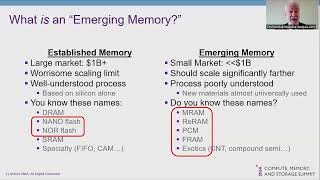
Memories Are Driving Big Architectural Changes in Computing Systems
Explore the rapid evolution of memory technologies and their impact on computing architecture, from CXL and HBM to emerging solutions like MRAM and Processing in Memory, shaping the future of AI and data processing.
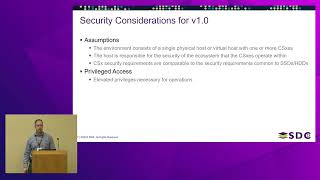
Standardizing Computational Storage - Latest Standards and Developments 2023
Explore the latest developments in Computational Storage standards, including SNIA and NVMe specifications, architecture models, programming interfaces, and terminology alignment between different standards organizations.
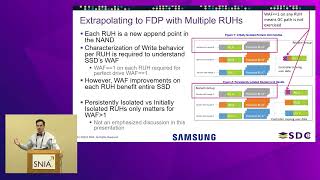
Achieving Write Amplification Factor of 1 in Flexible Data Placement SSDs
Dive into NVMe's Flexible Data Placement feature and learn how to achieve optimal Write Amplification Factor through various host workload implementations and NAND management strategies.
Flexible Data Placement Open Source Ecosystem - Implementation and Benefits
Dive into NVMe's Flexible Data Placement technology, exploring implementation strategies across Linux systems, QEMU emulation, and applications like Cachelib and RocksDB, with focus on integration and performance benefits.
Applying AI/ML Methodologies to Categorize Storage Workloads
Discover how AI/ML techniques analyze and synthesize complex storage workloads, enabling efficient testing and validation of enterprise storage systems through automated workload categorization and reproduction.