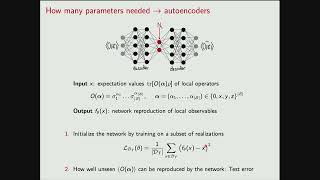
Reconstructing Complexity and Effective Hamiltonians
Explore effective Hamiltonians and complexity reconstruction in condensed matter physics, focusing on advanced theoretical concepts and applications.
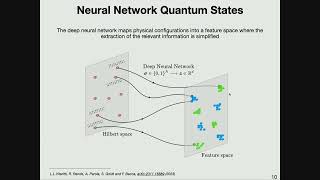
Fine Tuning Neural Network Quantum States
Explore advanced techniques for optimizing neural network representations of quantum states, enhancing accuracy and efficiency in computational physics simulations.
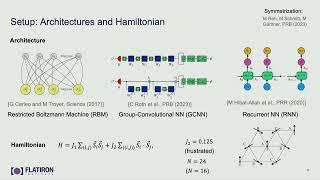
Investigating the Optimization Landscape of Neural-Network Quantum States
Explore optimization landscapes of neural-network quantum states, delving into advanced concepts and techniques for enhancing quantum system modeling and simulation.
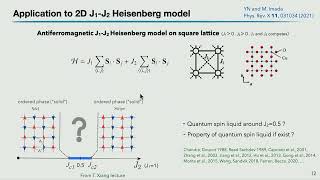
Quantum Many-Body Simulations Using Artificial Neural Networks
Explore quantum many-body simulations leveraging artificial neural networks, gaining insights into advanced computational techniques for complex quantum systems.
Simulation of Quantum Many-Body Systems with Neural Quantum States - Part 3
Explore advanced techniques for simulating quantum many-body systems using neural quantum states, focusing on cutting-edge methodologies and applications.
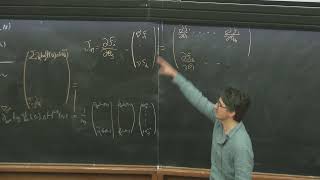
Simulation of Quantum Many-Body Systems with Neural Quantum States - Part 2
Explore advanced techniques for simulating quantum many-body systems using neural quantum states, focusing on cutting-edge methodologies and applications.
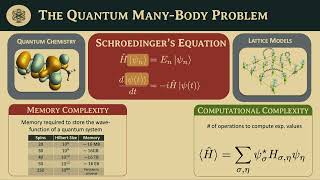
Simulation of Quantum Many-Body Systems with Neural Quantum States - Lecture 1
Explore neural quantum states for simulating complex quantum systems, focusing on many-body interactions and advanced computational techniques.
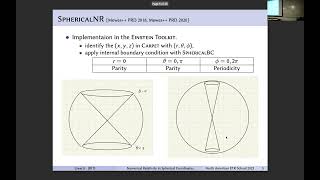
Numerical Relativity in Spherical Coordinates with SphericalN
Explore numerical relativity in spherical coordinates using SphericalN, covering advanced computational techniques for gravitational physics simulations.
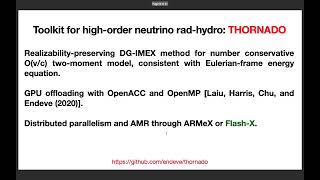
ExaStar: Multi-Physics Stellar Astrophysics Simulations at the Exascale
Explore cutting-edge multi-physics simulations for stellar astrophysics at exascale computing levels, focusing on the ExaStar project and its applications in computational relativity.

Dendro-GR: An Introduction to Adaptive Mesh Refinement in Numerical Relativity
Explore Dendro-GR, a cutting-edge tool for computational relativity and gravitation, presented by David Neilsen at the 2023 North American Einstein Toolkit School and Workshop.
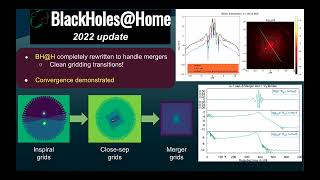
BlackHoles@Home - Citizen Science in Computational Relativity
Explore cutting-edge research on black holes through citizen science, contributing to gravitational wave detection and understanding cosmic phenomena.
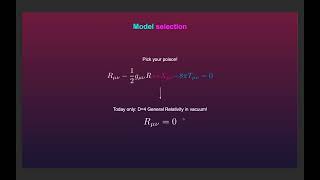
Introduction to Numerical Relativity
Explore advanced concepts in numerical relativity, focusing on computational techniques for modeling gravitational phenomena and spacetime dynamics.
Initial Data for the Numerical Evolutions of Compact Binaries
Explore numerical evolutions of compact binaries, focusing on initial data preparation for simulating gravitational wave sources in computational relativity.
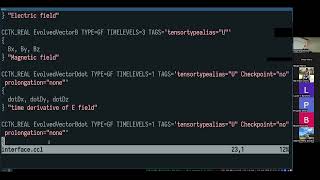
Tutorial on Writing a Physics Thorn - Einstein Toolkit
Learn to create a physics thorn in the Einstein Toolkit, exploring computational techniques for relativistic astrophysics and gravitational wave research.
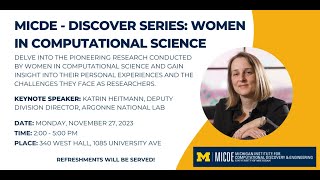
Exploring the Dark Universe - Challenges in Cosmology
Explore the Dark Universe with Dr. Katrin Heitmann, delving into cosmology's exciting phase, dark matter, dark energy, and challenges in data interpretation using supercomputer simulations.
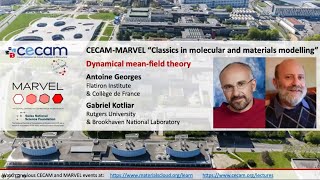
CECAM-MARVEL Classics: Molecular and Materials Modelling with Antoine Georges and Gabriel Kotliar
Explore pioneering methods in computational physics and chemistry with Antoine Georges and Gabriel Kotliar. Learn about quantum excitations, locality, and efficient impurity solvers in this in-depth presentation.
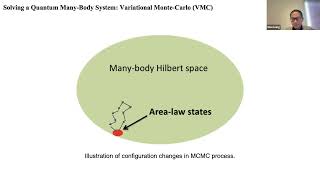
Backflow Corrections of Green Functions: Benchmarks on the Two-dimensional Fermi-Hubbard-type Model
Explore computational methods for solving the Fermi-Hubbard model, focusing on backflow corrections of Green functions to improve correlation capture in quantum many-body systems.
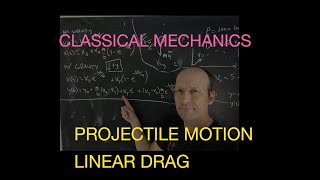
Classical Mechanics: 2D Projectile Motion with Linear Drag
Explore 2D projectile motion with linear drag, analyzing range and velocity for specific scenarios like a tiny ice ball launch. Includes Python code demonstration.
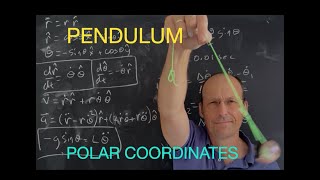
Classical Mechanics: Pendulum in Polar Coordinates - Python Modeling
Explore pendulum motion using polar coordinates and Newton's second law, with Python implementation for practical modeling.
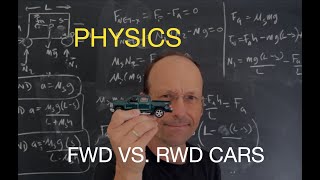
Physics: Front Wheel vs. Rear Wheel Drive Car Acceleration
Explore the physics behind front-wheel vs. rear-wheel drive car acceleration through calculations and Python code analysis.
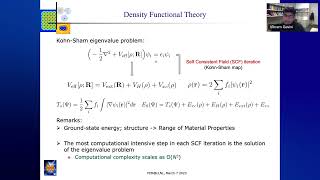
Fast, Accurate and Large-scale Ab-initio Calculations for Materials Modeling
Explore advanced computational methods for large-scale density functional theory calculations using adaptive finite-element discretization, enhancing materials modeling capabilities.