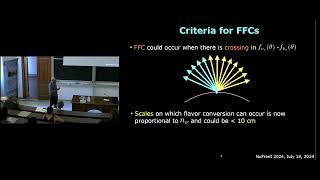
AI for Collective Neutrino Oscillations: From Detection of FFCs to Prediction of the Asymptotic
Explore AI applications in neutrino physics, focusing on collective oscillations, fast flavor conversions detection, and asymptotic prediction techniques.
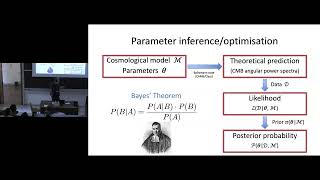
Efficient Cosmological Model Selection with Bayesian Optimization
Explore Bayesian optimization techniques for efficient cosmological model selection, enhancing understanding of the universe's structure and evolution.

Numerically Solving the Schrodinger Equation in Scilab - Harmonic Oscillator and Infinite Square Well
Learn to numerically solve the Schrödinger equation using Scilab, covering finite difference methods and applications to harmonic oscillator and infinite square well potentials.

Surprising Exam Advice from Top Olympiad Students - Physics Online
Top Olympiad students share unexpected advice: prioritize rest and sleep for exam success. Insights from Astro, Physics, and Computational Challenge participants on effective preparation strategies.
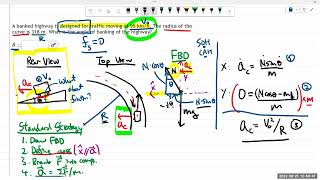
Physics 4A - OpenStax University Physics Problem Solving with SageMath - Chapter 6
Explore problem-solving in physics using SageMath, focusing on a specific challenge from OpenStax University Physics Vol 1, Chapter 6.
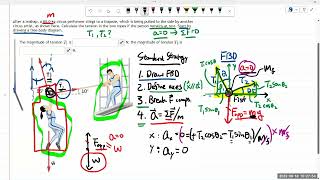
Physics 4A - OpenStax University Physics Problem 30 with SageMath - Lecture 2
Explore problem-solving in physics using SageMath, focusing on a specific challenge from OpenStax University Physics Vol 1, Chapter 6.
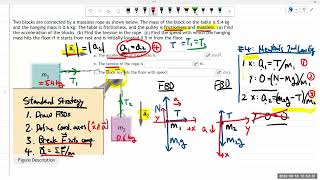
Physics 4A - OpenStax University Physics Problem 43 with SageMath - Chapter 6
Explore problem-solving in physics using SageMath software, focusing on a specific challenge from OpenStax University Physics Vol 1, Chapter 6.
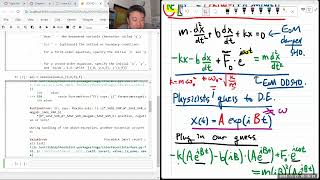
Physics 4A - Exploration of Driven and Damped SHO with Complex Exponentials and SageMath
Explore driven and damped simple harmonic oscillators using complex exponentials and SageMath, enhancing understanding of advanced physics concepts.
Quantum Monte Carlo Simulation of Skyrmion Superconductivity
Explore quantum Monte Carlo simulations of skyrmion superconductivity, uncovering novel insights into this fascinating quantum phenomenon and its potential applications.
Numerical Investigation of Vortex Formation in Bose-Einstein Condensates
Explore numerical modeling of vortex patterns in Bose-Einstein condensates using finite elements, focusing on mesh size requirements for accurate approximations of superfluid behavior.
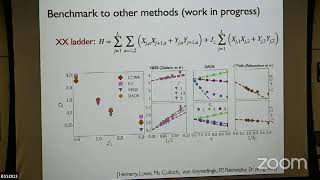
Numerical Methods and Quantum Many-Body Dynamics II - July 5
Explore advanced numerical techniques for quantum many-body dynamics with Frank Pollmann. Delve into cutting-edge methods for simulating complex quantum systems.
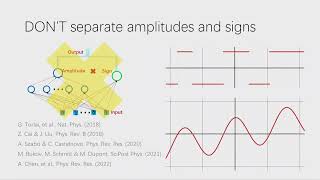
Empowering Deep Neural Quantum States Through Efficient Optimization
Explore efficient optimization techniques for deep neural quantum states, enhancing their power and performance in quantum systems modeling.
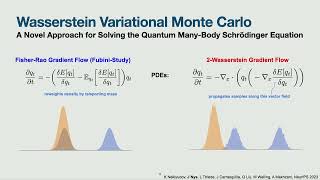
Ab-initio Variational Wave Functions for the Time-(In)dependent Many-electron Schrödinger Equation
Explore variational wave functions for many-electron Schrödinger equations, focusing on ab-initio methods and their applications in quantum mechanics.
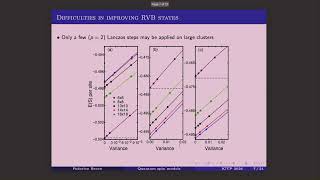
Transformer Wave Functions for Quantum Spin Models
Explore transformer wave functions for quantum spin models, delving into advanced concepts in condensed matter and statistical physics.
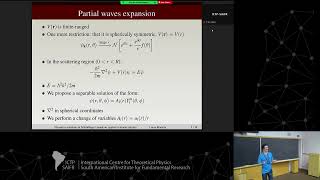
Numerical Solutions of Schrödinger's Equation Applied to Atomic Physics - Class 3
Explore numerical solutions of Schrödinger's equation in atomic physics, focusing on advanced techniques and applications in the field.
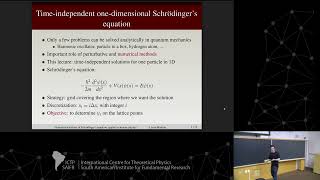
Numerical Solutions of Schrödinger's Equation Applied to Atomic Physics - Class 1
Explore numerical solutions of Schrödinger's equation in atomic physics, focusing on fundamental concepts and computational techniques.
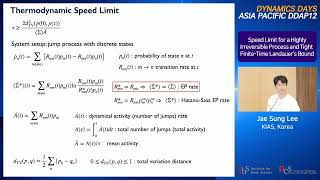
Speed Limit for a Highly Irreversible Process and Tight Finite-Time Landauer's Bound
Explore the thermodynamic costs of information erasure, including Landauer's bound and finite-time operations. Gain insights into classical speed limits and heat dissipation in high-speed irreversible computation.
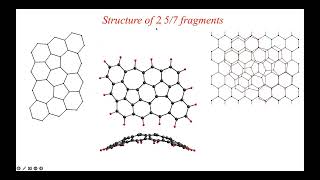
Towards Smart Algorithms of Structural Minimization of Low-Dimensional Lattices: Quantum Stability and Topology Conservation Theorem
Explore quantum stability and topology conservation in structural minimization of low-dimensional lattices through smart algorithms.
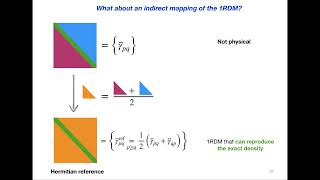
A Non-Hermitian Approach to the Representability Issue in Density-Matrix Embedding Theory
Explore non-hermitian approaches to representability in density-matrix embedding theory, enhancing understanding of quantum chemistry concepts and computational methods.

Computational Quantum Many-Body Physics: A Few Highlights
Explore computational approaches in quantum many-body physics, focusing on key highlights and advancements in the field.
Statistical Physics of Stochastic Gradient Descent
Explore statistical physics principles applied to stochastic gradient descent, uncovering insights into machine learning optimization techniques.