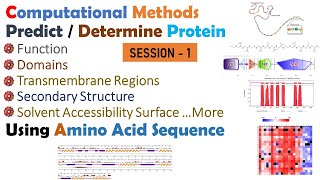
Bioinformatics Methods for Protein Function Identification - Domains and Transmembrane Regions
Explore protein sequence annotation using computational tools for properties, domains, transmembrane regions, and structural elements. Learn to analyze amino acid sequences effectively.
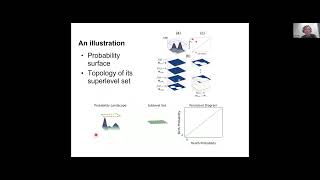
Non-Diffusive Vortexes at Transition State of Activated Process by Persistent Homology
Exploring non-diffusive dynamics in molecular transitions using persistent homology, revealing reactive vortexes and rotational fluxes at transition states of alanine-dipeptide isomerization.
Lab-in-the-Loop De Novo Antibody Design - What Are We Missing From Machine Learning?
Explore lab-in-the-loop de novo antibody design, focusing on computational aspects. Discover generative modeling, computational oracles, and active learning in molecular systems research.
Kubernetes and AI in Cancer Diagnosis and Treatment
Explore how distributed Kubernetes clusters and AI revolutionize cancer diagnosis, combining computational biology with cloud computing for faster, more precise treatments.
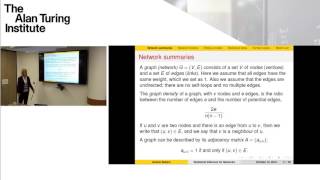
Statistical Inference for Networks - Professor Gesine Reinert, University of Oxford
Explore network analysis, from basic concepts to advanced statistical methods, covering degree distributions, clustering coefficients, and mathematical models for understanding complex interconnected systems.

Networks from Real Data - Algorithmic Information Dynamics
Explore algorithmic information dynamics and its applications in causality and living systems, from networks to cells, using computational approaches.
De Novo Protein Design Using Deep Learning and Musical Representations
Explore innovative protein design using deep learning and musical representations, bridging materials science and artificial intelligence for groundbreaking bioengineering applications.
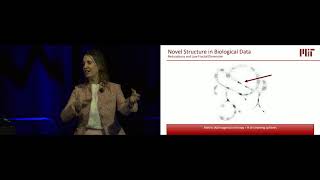
Biomedical Data Sharing and Analysis at Scale
Explore cutting-edge techniques for large-scale biomedical data sharing and analysis, addressing challenges and opportunities in this rapidly evolving field of computational biology and mathematics.
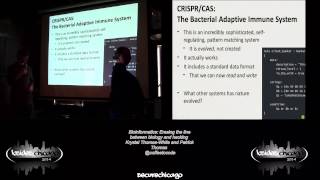
Bioinformatics - Erasing the Line Between Biology and Hacking
Explore the intersection of biology and hacking in bioinformatics, discovering how computational techniques are revolutionizing biological research and creating new security challenges.
Kaemika App - Simulating Reaction Networks and Digital Protocols
Explore integrated descriptions for automated scientific processes, extracting models and protocols for analysis and execution using the Kaemika app across multiple platforms.
Data-Driven Understanding of Human Disease: From Machine Learning Methods to Biological Discoveries
Data-driven disease understanding: machine learning methods for genomic analysis, integrating model organism data with human studies to uncover disease mechanisms and genetic architecture.
Language AI for RNA Virus and RNA Vaccine Design
Exploring unexpected connections between linguistics and biology, revealing efficient algorithms for mRNA vaccine design and COVID genome structure prediction with significant biological impacts.
Advances in Predictive Models for Single-cell and Regulatory Genomics
Explore cutting-edge predictive models for single-cell and regulatory genomics, enhancing understanding of cancer progression and potential treatment approaches.
From Genomes to Life: Computing Cell Phenotypes Using Biochemical Network Reconstruction
Explore computational approaches to predict cell phenotypes from genomic data using biochemical network reconstruction, advancing our understanding of cellular behavior and disease mechanisms.
Tumor Phylogeny Inference from Single-cell Datasets - Lecture 2
Explore tumor evolution through single-cell data analysis. Learn advanced techniques for inferring phylogenetic relationships and understanding cancer progression at the cellular level.
Computational Cancer Biology: An Expedition Towards Precision Oncology
Explore computational approaches in cancer research, from mathematical modeling to machine learning, aimed at understanding disease progression and developing precision treatments.
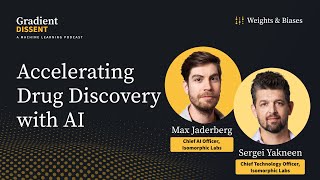
Accelerating Drug Discovery with AI - Insights from Isomorphic Labs
Explore AI's transformative role in drug discovery with Isomorphic Labs experts, discussing challenges, innovations, and future prospects in biotech and healthcare.
Cover Your Bases: Minimizing Sequencing Coverage in DNA Storage Systems
Explores minimizing DNA sequencing coverage in storage systems, focusing on error-correcting codes and retrieval algorithms to reduce costs and latency while optimizing information retrieval efficiency.
Toward Efficient Genomic Compression Using Channel Codes for Joint Alignment and Reconstruction
Explore innovative genomic compression techniques using channel codes for efficient alignment and reconstruction, advancing data storage and analysis in genomics research.
A Quest for Little Eureka Moments
Explore the intersection of poetry, science, and learning with Sara Garg as she shares insights on finding "little Eureka moments" and pursuing interdisciplinary passions.

Discrete Morse Graph Skeletonization and Application to Local Structures of scRNA-seq Data
Explores topological data analysis for extracting graph skeletons from high-dimensional data, with applications in analyzing local structures of scRNA-seq datasets across brain regions.