Cryptography and Kolmogorov Complexity - A Quick Tutorial
Explore the intersection of cryptography and Kolmogorov complexity, examining minimal complexity assumptions and their implications for secure communication systems.
Assumptions in Cryptography and Complexity Theory
Explore key assumptions in cryptography and complexity theory through an expert panel discussion, delving into minimal complexity requirements for cryptographic systems.
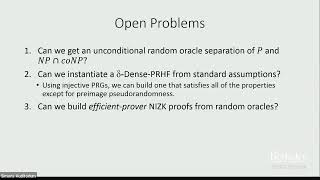
Hard Languages in NP ∩ coNP and NIZK Proofs from Unstructured Hardness
Explores unstructured hard languages in NP ∩ coNP, providing evidence for their existence and introducing a new NIZK proof construction, advancing understanding of computational complexity and cryptography.
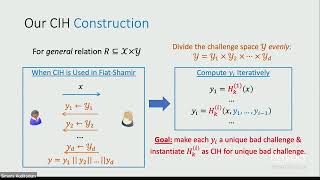
Correlation Intractability and SNARGs from Sub-exponential DDH
Explore groundbreaking constructions of SNARGs and correlation-intractable hash functions based on sub-exponential DDH, achieving poly-logarithmic proof sizes for Batch-NP and P.
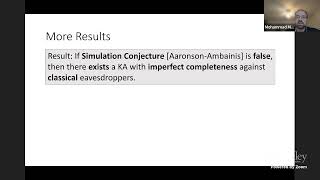
Black-Box Separations in Quantum Cryptography
Explores black-box separations in quantum cryptography, discussing efforts to extend classical results, related problems, and barriers for unconditional separations in the quantum setting.
Quantum Pseudorandomness in Algorithmica, and Its Implications to Cryptography and Complexity
Explore quantum pseudorandomness, its separation from one-way functions, and implications for cryptography and complexity theory. Discover potential for quantum cryptography without relying on traditional assumptions.

The Short Integer Solutions Problem and Cryptographic Applications
Explore the Short Integer Solutions Problem, its cryptographic applications, and connections to lattice-based algorithms, complexity, and security in this advanced mathematical lecture.
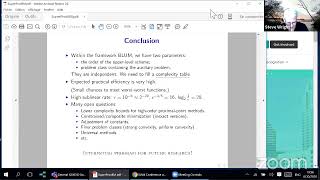
Inexact Accelerated High-order Proximal-point Methods in Convex Programming
New framework for accelerated methods in convex programming using approximations of high-order proximal points. Presents second-order method with O(k^(-4)) convergence rate, surpassing traditional complexity limits.
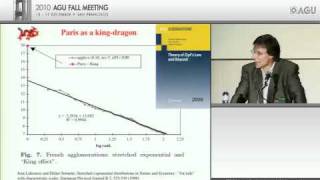
Dragon-Kings, Black-Swans and Prediction - Lorenz Lecture
Explore extreme events, their predictability, and impact on complex systems through statistical physics and nonlinear dynamics in this insightful lecture by D. Sornette.
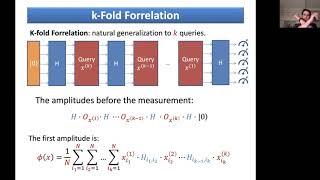
Towards Optimal Separations between Quantum and Randomized Query Complexities
Explore the intriguing gap between quantum and randomized query complexities, delving into cutting-edge research on optimal separations and their implications for computational theory.
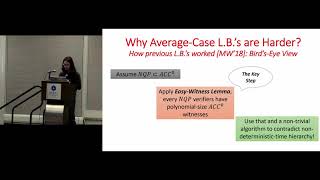
Non-deterministic Quasi-Polynomial Time is Average-case Hard for ACC Circuits
Explore the complexity theory concept of non-deterministic quasi-polynomial time and its average-case hardness for ACC circuits in this advanced computer science presentation.
A Quantum Query Complexity Trichotomy for Regular Languages
Explore quantum query complexity for regular languages, uncovering a trichotomy that advances understanding in computational theory and quantum algorithms.
Complexity and Coding Theory - Session 6A
Explore cutting-edge research in complexity and coding theory, delving into advanced mathematical concepts and their applications in computer science and information theory.

What Can Theoretical Computer Science Contribute to the Discussion of Consciousness
Explore the intersection of theoretical computer science and consciousness, examining potential insights and contributions to this complex philosophical debate.
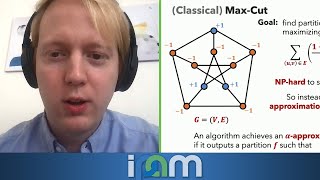
Unique Games Hardness of Quantum Max-Cut and Conjectured Vector-Valued Borell Inequality
Explore quantum max-cut problems, unique games hardness, and vector-valued Borell's inequality in this advanced theoretical computer science and mathematics talk by John Wright.
Exponential Separations Between Classical and Quantum Learners - IPAM at UCLA
Explore exponential advantages of quantum learning algorithms over classical ones, including new results from complex quantum systems and restricted quantum capabilities in training stages.
On the Complexity of Collision Resistant Hash Functions
Explore the intricacies and challenges of collision-resistant hash functions in cryptography, examining their complexity and implications for security systems.
Fine Grained Complexity
Explore fine-grained complexity theory, its applications in logic, and its role in query evaluation, offering insights into computational efficiency and algorithmic analysis.

The Complexity of Fermions in Quantum Information and Beyond
Exploring fermion simulation challenges in quantum computing, highlighting new data structures and complexity results for ground state problems in chemistry, physics, and computer science.

How Did Life Arise from Increasing Entropy?
Explores how life and evolution align with increasing entropy, discussing energy dissipation, complexity formation, and the potential physics behind life's origins in the universe.
Optimal Reads-From Consistency Checking for C11-Style Memory Models
Explore optimal consistency checking algorithms for C11-style memory models, improving efficiency in concurrency testing and model checking for various C/C++ variants.