Numbers, the Universe and Complexity Beyond Us - Data Structures Math Foundations 177
Explore the limits of mathematical notation, the philosophy of numbers, and the physical constraints of our universe in representing extremely large quantities and complex mathematical concepts.
Complexity of Log-Concave Poset Inequalities
Explore log-concave inequalities in mathematics, from elementary examples to complex cases like Stanley's inequality, and examine their intrinsic complexity using combinatorics, complexity theory, and geometry.
Border Subrank of Tensors
Exploration of tensor subrank and border subrank, including construction of maximal border subrank tensors and lower bound computation for the dimension of maximal border subrank tensor sets.
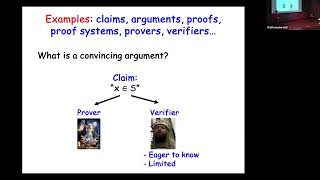
The Value of Errors in Proofs
Explore the significance of errors in mathematical proofs with Avi Wigderson, delving into their role in advancing quantum information and physics research.
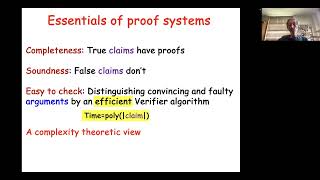
The Value of Errors in Proofs
Explore the significance of errors in mathematical proofs with Avi Wigderson. Gain insights into how mistakes contribute to advancing mathematical understanding and problem-solving techniques.
Nonmonotone Forward-Backward Splitting Method for Infinite-Dimensional Optimization Problems
Explore nonmonotone forward-backward splitting for nonsmooth composite problems in Hilbert spaces, covering convergence analysis, complexity, and numerical experiments.
Quantitative Ell-Adic Sheaf Theory
Explore quantitative bounds for étale cohomology groups and their applications in algebraic geometry. Learn about complexity measures for sheaves and how they interact with various functors.
Graph Connectivity Using Star Contraction
Explore edge connectivity in simple graphs using cut queries, introducing star contraction for efficient graph simplification and discussing randomized and quantum algorithms for connectivity determination.
Matrix Spaces and Graphs: Connections and Applications
Explore connections between matrix spaces and graphs, uncovering surprising equivalences and their applications in theoretical computer science, quantum information theory, and algebra.
Tensor Rank and Bias of Multilinear Forms Over Finite Fields
Explorez les liens entre le rang tensoriel et le biais des formes multilinéaires sur les corps finis dans cette conférence mathématique approfondie.
On the Subrank of Generic Tensors
Explorez les limites supérieures et inférieures du sous-rang des applications bilinéaires et tenseurs d'ordre supérieur génériques. Découvrez les mesures des multiplications indépendantes réductibles.
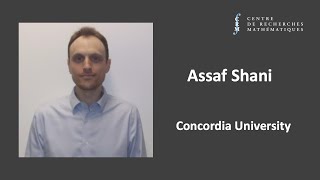
Classification Using Sets of Sets of Reals as Invariants
Explore Borel equivalence relations and Friedman-Stanley jumps in classification problems. Analyze complexity, optimal invariants, and structural dichotomies in mathematical classifications.
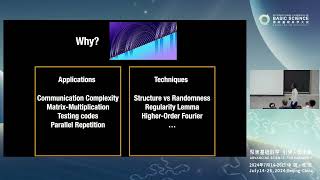
New Frontiers in Structure vs Randomness with Applications to Combinatorics, Complexity, and Algorithms
Explore new frontiers in structure vs randomness, delving into applications in combinatorics, complexity, and algorithms. Gain insights on Erdos-Turan problem and recent advancements in additive combinatorics.
Realizations of Equivalence Relations and Subshifts
Explore countable Borel equivalence relations, continuous actions on compact spaces, and subshifts. Investigate complexity and genericity of properties like hyperfiniteness in the space of subshifts.

Subgroup Tests and the Aldous-Lyons Conjecture
Explore the refutation of the Aldous-Lyons conjecture through novel interactive proof systems and subgroup tests, connecting complexity theory to probability theory and group theory.
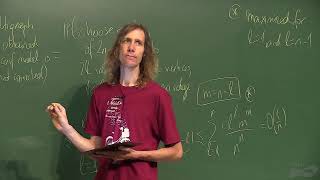
Discrete Random Models - Minicourse 03
Explore discrete random models in this advanced mathematics workshop. Gain insights into probabilistic techniques for analyzing complex network structures and random processes.
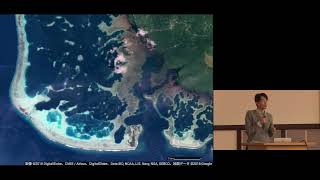
Complexity of Life History Adaptation in Marine Invertebrates
Explore the complexity of life history adaptation in marine invertebrates, examining environmental factors and evolutionary strategies through advanced research findings from the University of Tokyo.
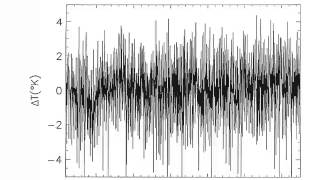
Complexity and Self-Organization in Earth Systems - Lorenz Lecture 2002
Explore self-organized complexity, predictability, and universal statistical distributions in natural systems through Donald L. Turcotte's insightful Lorenz Lecture at the 2002 AGU Fall Meeting.

Coding the Cosmos - Does Reality Emerge From Simple Computations?
Explore the possibility of a universal theory emerging from simple computations with Stephen Wolfram and Brian Greene. Delve into the intersection of computer science, physics, and cosmology in this thought-provoking discussion.
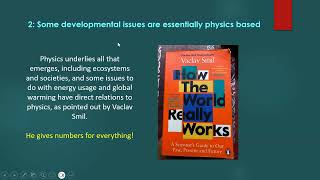
The Interactions of Physics, Environmental, and Developmental Issues - Taking Complexity Seriously
Explores complex interplay between physics, ecosystems, and societies, emphasizing the need for holistic approaches to sustainable development that consider adaptive hierarchical structures and non-linear mechanisms.

What on Earth Does Complexity Theory Have to Do with Gravity?
Explore the intriguing connection between complexity theory and gravity, delving into quantum PCP, area laws, and quantum gravity concepts.