BLASPhemy - Improving BLAS Handling in Enzyme.jl
Optimizing BLAS and Lapack routines for Enzyme.jl, improving performance and reliability in numerical computations and machine learning applications within the Julia ecosystem.
Efficient Parallel Functional Programming with Effects
Explore techniques for efficient parallel functional programming with unrestricted effects, improving performance while maintaining safety benefits through innovative memory management.
Rust on Morello - POCL'24
Explore Rust programming on the Morello architecture, focusing on memory safety and capability-based security features.

Rapid: Region-Based Pointer Disambiguation for Efficient Memory Optimization
Explore Rapid, a tool for efficient pointer disambiguation using region-based allocation. Learn about its performance benefits, low-overhead allocator, and improved dynamic checks for compiler optimizations.
Efficient OCaml Compilation with Flambda 2
Explore Flambda 2's IR and optimization pass for OCaml, focusing on inlining techniques and engineering constraints for efficient compilation of large codebases.
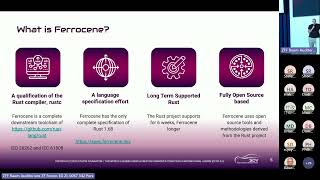
Ferrocene - Qualifying the Rust Compiler Using a Fully Open Source Tool Stack
Discover how to qualify the Rust compiler through Ferrocene's open source tooling, exploring key qualification processes and implementation strategies for safety-critical systems.
Modern DSL Compiler Architecture in OCaml - Experience with Catala
Explore state-of-the-art DSL implementation in OCaml, featuring concrete examples and insights from the Catala compiler for legal algorithms.

Graph IRs for Impure Higher-Order Languages: Making Aggressive Optimizations Affordable - OOPSLA 2023
Explore a novel graph IR for aggressive global optimizations in impure higher-order languages, combining reachability types and effect systems for precise dependency tracking and efficient code optimization.

Optimization-Aware Compiler-Level Event Profiling
Explore a novel technique for quantifying compiler-internal events in optimized code, reducing profiling perturbation and enhancing dynamic analysis accuracy.
Flan: An Expressive and Efficient Datalog Compiler for Program Analysis
Explore Flan, a Datalog compiler embedded in Scala that combines expressiveness and performance for program analysis, offering powerful extensions and specialized code generation.
An Intrinsically Typed Compiler for Algebraic Effect Handlers
Explore type-preserving compilation for algebraic effect handlers, focusing on safety in continuation capture and resumption using stack polymorphism in an Agda-implemented compiler.
Indexed Streams - A Formal Intermediate Representation for Fused Contraction Programs
Explore a formal operational model for fused execution of contraction languages, covering sparse tensor and relational algebra. Learn about indexed streams and their compiler implementation.
SSA as Freyd Categories - Categorical Semantics for Compiler Design
Explore the connection between Static Single Assignment (SSA) and Freyd categories, examining their graphical syntax and applications in compiler design and optimization.
Compiler Support for Structured Data
Explore compiler techniques for efficiently handling structured data, enhancing performance and optimization in programming languages.
The Sparse Abstract Machine: A Model for Sparse Tensor Algebra on Dataflow Accelerators
Explore the Sparse Abstract Machine (SAM) for targeting sparse tensor algebra to spatial dataflow accelerators, including its streaming dataflow abstraction and compiler implementation.
Tiling for DMA-Based Hardware Accelerators
Explore a compiler pass using polyhedral analysis to optimize loop tiling for DMA-based hardware accelerators, addressing fixed-width transfer limitations.
Four Languages for Portability - SPARSE 2024
Explore four languages for achieving software portability across different platforms and architectures in this concise programming talk.
SpEQ: Translation of Sparse Codes Using Equivalences
Discover SpEQ, a strategy for detecting semantics in sparse codes and translating to high-performance libraries. Learn about its implementation, evaluation, and performance gains across various backends.
Program Reconditioning: Avoiding Undefined Behaviour When Finding and Reducing Compiler Bugs - PLDI 2023
Explore program reconditioning to avoid undefined behavior in compiler bug detection and reduction for GLSL and WGSL languages, enhancing differential testing and test-case simplification.
Semantic Encapsulation Using Linking Types
Explore semantic encapsulation with linking types to preserve language invariants when integrating foreign code, ensuring sound interoperability in multi-language systems.

Getting into the Flow: Towards Better Type Error Messages for Constraint-Based Type Inference
Explore innovative approaches to improve type error messages in constraint-based type inference systems, focusing on data flow and subtyping constraints to enhance programmer understanding.