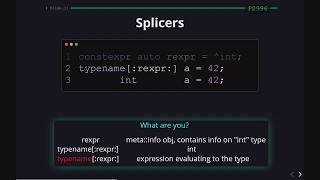
Reflection in C++26 - Welcome to the Metaverse
Explore C++26 reflection proposal, its utilities, practical applications, and potential for innovative libraries. Dive into the transformative power of reflection in codebases.

Navigating Strategies for Debugging WebAssembly
Explore effective strategies for debugging WebAssembly applications, including open-source tools and compile-time approaches, with insights into LLVM Intermediate Representation for improved development.

Safety, Security, and C/C++ Evolution - Keynote ACCU 2024
Explore C++ evolution, safety, and security with Herb Sutter. Gain insights on tool adaptation, language distinctions, and future improvements in C and C++ programming.
Role of Lexical Analyzer in Compiler Design
Explore the crucial role of lexical analyzers in compiler design, including token generation and processing. Learn how this component impacts the overall compilation process.
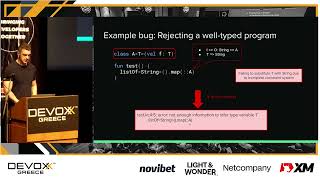
Well-typed Programs Can Go Wrong - Enhancing the Reliability of Type Checkers in Compilers
Explore how static typing bugs in compilers impact software development and learn about efforts to enhance type checker reliability through randomized testing.
Beyond Kubernetes: Exploring Lightweight Orchestration Systems for Edge Computing
Explore the future of container orchestration beyond Kubernetes, examining lightweight alternatives for edge computing and emerging workloads like Wasm, eBPF, and AI using Python-based DSLs.
Cross-Architecture Dynamic Migration Solution for Heterogeneous AI Acceleration Systems
Discover a unified solution for seamless application migration across diverse AI accelerators, enabling cross-architecture compilation and dynamic runtime adaptation without code modifications.
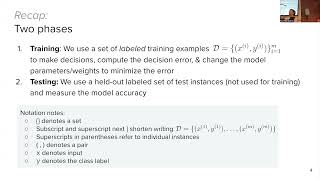
Tokenization and Morphology in Natural Language Processing
Master essential text processing concepts through tokenization and morphology analysis, exploring fundamental techniques for breaking down and understanding linguistic structures.

Distributed Random Access Merkledags - Exploring Registry Capabilities
Explore innovative uses of OCI registries, drawing parallels with computer architecture concepts to redefine distributed systems and introduce Distributed Random Access Merkledags.

AST Helper Classes for Operating System Development
Explore helper classes for representing Abstract Syntax Trees (AST) on the heap, enhancing your understanding of compiler design and memory management.
Challenges with Hardware-Software Co-design for Sparse Machine Learning on Dataflow Architectures
Explore challenges in hardware-software co-design for sparse machine learning, focusing on tensor algebra accelerators and real-world applications.
Facilitating the Bootstrapping of a New Instruction Set Architecture
Explore tools and verification mechanisms for developing new instruction set architectures, focusing on semi-automated approaches to streamline system software and simulator infrastructure creation.
Weak Memory Demands Model-based Compiler Testing
Explore compiler bugs arising from relaxed hardware memory models and their implications for testing, using an LLVM toolchain bug as a case study.
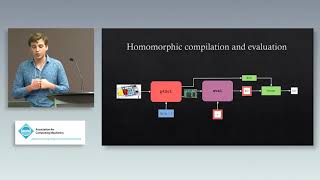
ALCHEMY - A Language and Compiler for Homomorphic Encryption Made Easy
Simplifying Fully Homomorphic Encryption with ALCHEMY: a modular system that compiles plaintext computations into homomorphic operations on ciphertexts, making FHE accessible without specialized knowledge.
Compilers - Jared Shumway
Explore compiler internals, optimization techniques, and security enhancements to improve code efficiency and write better programs.

Turing Lecture 2021 - Abstractions, Their Algorithms, and Their Compilers
Explore computational thinking through abstractions, algorithms, and compilers. Delve into compiler design, large dataset handling, and quantum computation, with insights from renowned computer scientists.

Designing Fast and Programmable Routers
Explore cutting-edge router design combining high performance and programmability. Learn about innovative primitives enabling line-rate programmable routers, including packet scheduling, stateful processing, and flow-based statistics measurement.
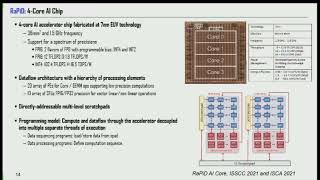
Mastering the Three Pillars of AI Acceleration: Algorithms, Hardware, and Software
Explore IBM Research's holistic approach to AI acceleration, covering low-precision DNN models, scalable hardware techniques, and efficient software methodologies for optimal performance.
Feedback Driven Optimization: Improving Program Performance Through Compilation
Explore Feedback Driven Optimization (FDO) techniques for code performance enhancement, including AutoFDO, its benefits, challenges, and real-world applications in embedded Linux systems.

Explaining Different Coroutine Flavors Using Scala Native
Explore coroutines in modern languages, their types, and implementation. Learn about stackless and stackfull variants, LLVM backend optimizations, and green threads in operating systems.
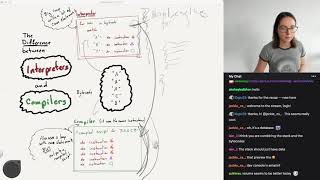
Implementing JavaScript in Two Places: Baseline Interpreter and Compiler - Part 5
Explore SpiderMonkey's JS implementation, focusing on the transition from interpreter to baseline interpreter and the distinctions between interpreters and compilers.