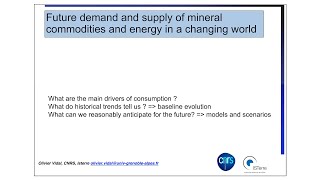
Future Demand and Supply of Mineral Commodities and Energy in a Changing World
Explore the dynamic model linking metal demand with production capacity, considering GDP, population, and energy scenarios to understand resource-energy-emissions coupling.
How to Raise the Net Zero Conversation
Explore climate change as a political issue and the need for broader debate on "third way" climate solutions with Professor Myles Allen, Director of Oxford Net Zero initiative.
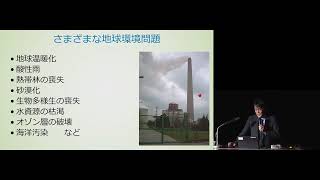
窒素の環境問題 - 化学肥料がもたらす恩恵と脅威
Explore the dual impact of nitrogen fertilizers on society and environment, from their revolutionary role in food production to current environmental challenges and sustainable solutions.
Comprendre le Monde de Demain - Enjeux Écologiques et Énergétiques
Explorez les enjeux écologiques et énergétiques avec humour et réflexion. Découvrez les perspectives d'un étudiant en finance sur les défis mondiaux urgents pour mieux comprendre notre avenir.
Sustainability Through Accountability in a CNCF Ecosystem
Explore sustainable cloud computing through carbon footprint tracking in multi-tenant services. Learn to combine CNCF projects for energy consumption estimation in storage systems, benefiting users and developers.
How Open Source Collaboration Is Transforming the Power Systems Sector
Experts discuss how open source collaboration is revolutionizing the power systems sector, addressing challenges in decarbonization, renewable energy integration, and grid modernization for a sustainable future.

Faster, Greener, and Happier: Why Quarkus Should Be Your Next Tech Stack
Discover Quarkus: a fast, efficient Java framework for cloud-native development. Learn its advantages in speed, memory usage, and sustainability, with live demos and practical insights.
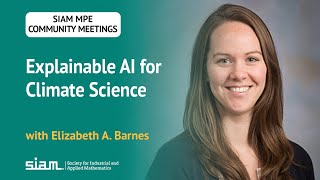
Explainable AI for Climate Science - Opening the Black Box to Reveal Planet Earth
Discover how explainable AI techniques can revolutionize climate science research, from weather prediction to understanding human impacts on Earth's systems through advanced machine learning applications.
Building Green and Low-Carbon Telecom Cloud Native Infrastructure for Sustainability
Discover how to build sustainable telecom cloud data centers through intelligent management, power optimization, and resource efficiency for reduced carbon footprint and energy savings.
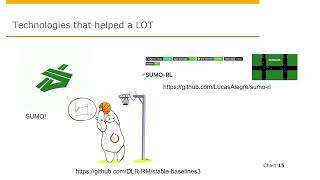
Challenges in Reward Design for Reinforcement Learning-based Traffic Signal Control - An Investigation Using CO2 Emission Objective
Explore the complexities of reward design in reinforcement learning for traffic signal control, focusing on CO2 emission reduction through Deep Q-Network implementation and reward optimization strategies.
Estimating Oxygen in the Southern Ocean Using Argo Temperature and Salinity - Donata Giglio
Explore innovative techniques for estimating oxygen levels in the Southern Ocean using Argo float data. Learn how temperature and salinity measurements contribute to understanding ocean biogeochemistry and climate change impacts.
Using AI to Facilitate Environmental Justice - The Need for Ethical & Responsible AI
Explores the application of AI in environmental justice, emphasizing ethical considerations and responsible practices for weather and climate research. Discusses potential impacts and challenges in this emerging field.
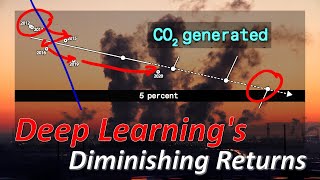
How Far Can We Scale Up? Deep Learning's Diminishing Returns
Explores the limits of scaling up deep learning, discussing computational costs, CO2 emissions, and potential solutions to overcome diminishing returns in AI model performance.

Navigating the AI Council's AI Roadmap
Experts discuss AI's role in UK society, addressing climate change, resilience, mental health, diversity, and skills development while exploring strategies to build public trust and make actionable impact.

Machine Learning and the Earth David Hall
Explore machine learning's potential in addressing urgent global challenges like climate change, with insights on strategies, risks, and implications for various fields.
Be the Change Our Planet Seeks: How You Can Contribute to Running Environment-Friendly Workloads on Kubernetes
Discover sustainable software engineering principles for Kubernetes workloads and learn actionable steps to reduce carbon footprint in your projects, contributing to a greener tech industry.
Evaluating the Energy Footprint of GitOps Architectures - A Benchmark Analysis
Explore the energy consumption and CO2 emissions of GitOps architectures through benchmark analysis, providing insights for eco-friendly decision-making in cloud-native environments.
Solving for Climate: Chasing Hurricanes Through Computational Modeling
Computational modeling of hurricanes and natural hazards, exploring their response to atmospheric dynamics and climate change impacts on economic and social outcomes.
Explainable AI for the Geosciences
Explore machine learning interpretation techniques in geoscience, focusing on climate science applications and their potential for scientific discovery and increased trust in AI outputs.
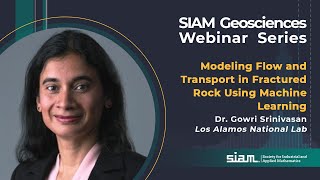
Modeling Flow and Transport in Fractured Rock Using Machine Learning
Integrating computational physics, machine learning, and graph theory to model flow and transport in fractured rock systems, offering a paradigm shift from high-fidelity models to efficient coarse-scale graphs.
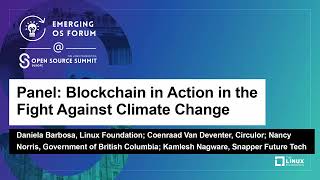
Blockchain in Action: Fighting Climate Change Through Traceability and Transparency
Exploring blockchain's impact on climate change through real-world applications in traceability, sustainability, and cross-industry collaboration for a greener future.