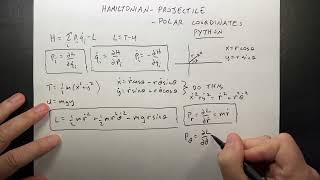
Hamiltonian Mechanics for Projectile Motion in Polar Coordinates
Explore Hamiltonian mechanics for projectile motion using polar coordinates, with Python code implementation for practical understanding.
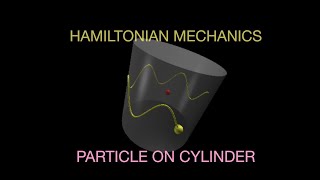
Hamiltonian: Particle on a Frictionless Cylinder with a Force
Explore particle motion on a frictionless cylinder under external force using Hamilton's equations and Python simulation.
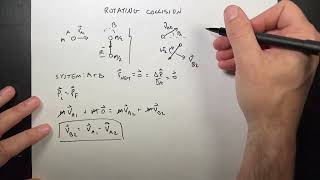
Collision Between a Mass and a Rod: Conservation of Momentum and Angular Momentum
Analyze collisions between masses and rods using conservation of momentum and angular momentum principles. Develop problem-solving skills in physics.

Physics Practice: 4 Atwood Machine Problems
Solve four challenging Atwood machine problems to enhance your understanding of physics principles and problem-solving skills.
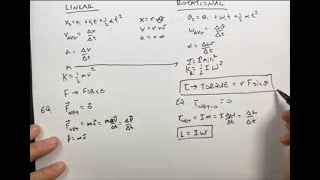
College Physics Chapter 8 Summary - Torque and Angular Momentum
Explore rotational dynamics, including kinetic energy, moment of inertia, torque, and angular momentum principles in physics.
The Eigenvalue Problem: An Example with Rigid Body Rotations and Python
Explore rigid body rotations using Python, solving the eigenvalue problem to find principal axes and animating results with Web VPython.
Python Physics: Object Falling to Earth and Gravitational Potential Energy
Model an object falling to Earth, exploring gravitational potential energy and the relationship between work done by changing gravitational force and kinetic energy change.
Physics Problem: Work Energy and Height of a Ball Launcher
Solve a physics problem involving work, energy, and projectile motion for a spring-loaded ball launcher, applying key concepts to real-world scenarios.
Physics Problem: Energy and a Jumping Basketball Player
Learn to solve a physics problem involving energy conservation and force calculations for a jumping basketball player.
Physics Summary Chapter 8: Linear Momentum and Collisions
Explore linear momentum, collisions, and related principles in physics. Understand key concepts like impulse, conservation of momentum, and types of collisions for a solid foundation in mechanics.
Physics 4A - Chapter 7 Overview
Explore fundamental concepts of physics in Chapter 7, covering key principles and their applications in real-world scenarios.

Can AI Solve Physics Problems? ChatGPT Takes on Physics Challenges
Explore ChatGPT's ability to tackle physics problems, from projectile motion to quantum mechanics. Witness AI's potential and limitations in comprehending and solving complex scientific questions.
Symplectic Ak Singularities and Schrödinger Operators
Explore finite dimensional integrability in mathematical physics, focusing on symplectic Ak singularities and Schrödinger operators.
Geometric Reduction of Spin Trigonometric RS Systems
Explore finite dimensional integrability in mathematical physics through geometric reduction of spin trigonometric RS systems.

Gibbs State Preparation for Commuting Hamiltonian - Mapping to Classical Gibbs Sampling
Explore quantum Gibbs state preparation through mapping commuting Hamiltonians to classical systems, focusing on efficient sampling methods and applications in quantum computing.
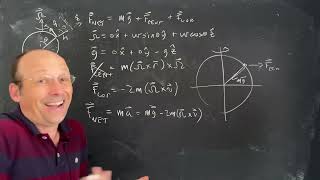
Free Fall with the Coriolis Force - Classical Mechanics Physics Problem
Explore the mathematical analysis of free-falling objects affected by the Coriolis force, including numerical calculations and Python implementation for real-world applications.
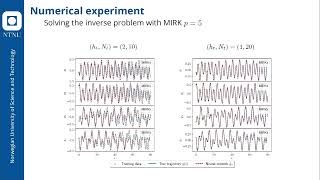
Learning Hamiltonian Systems with Mono-Implicit Runge-Kutta Methods
Explore advanced numerical methods for simulating Hamiltonian systems using Mono Implicit Runge-Kutta techniques, enhancing accuracy and efficiency in scientific computations.
Non-linear Electrodynamics Derived from Kaluza-Klein 5-Dimensional Gravity
Explore non-linear electrodynamics derived from Kaluza-Klein theory, examining unique Maxwell equation generalizations and potential static solutions as electron models.
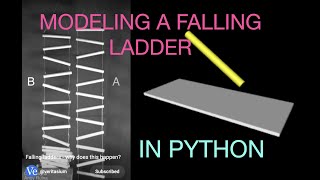
Modeling a Bouncing Stick with Python - Veritasium Falling Ladder Problem
Model a falling and bouncing stick using Python, inspired by Veritasium's falling ladder problem. Explore physics simulations and coding techniques.
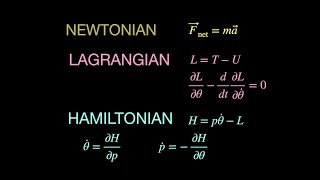
Newtonian, Lagrangian, and Hamiltonian Methods for Simple Pendulum Motion
Explore three methods for deriving pendulum equations of motion: Newtonian, Lagrangian, and Hamiltonian. Compare approaches and visualize results using Python.
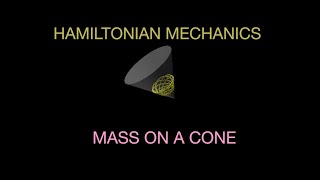
Hamiltonian Mechanics: Mass on a Cone with Gravity
Explore Hamiltonian mechanics through a mass-on-cone problem, using Python to model and analyze the motion in a gravitational field.