Generalised Integrated Information Theories
Exploring generalizations of Integrated Information Theory to address technical issues and extend applicability beyond classical systems, using category theory and process theories.
Towards a Category-Theoretic Framework for Phenomenal Holism
Exploring phenomenal holism through category theory, examining color experiences across the visual field and addressing theoretical concerns about inverted qualia and experience-substrate relationships.

Turing Award Recipient Dana S. Scott - Reflections on Logic and Computer Science - Part 4
Explore Dana S Scott's contributions to computer science, including his work on LCF, Scott Domains, and Category Theory Type Theory, in this insightful interview segment.
Sequence Alignment - Hidden Markov Models, Category Theory and All That Jazz by Soumyashant Nayak
Explore sequence alignment methods, from traditional algorithms to modern pseudo-alignment techniques, with insights on hidden Markov models and applications in RNA-Seq data analysis and evolutionary genetics.
The Directional Transform
Explore the directional transform in topological data analysis, its applications in understanding complex structures, and its potential for enhancing machine learning models and data shape quantification.
Introduction to Perverse Sheaves
Dive into the fundamental concepts and theoretical foundations of perverse sheaves with expert mathematician Mark Goresky, exploring advanced mathematical structures and their applications.
Derived Categories of Sheaves on Schemes and Prestacks - Talk 14
Delve into advanced sheaf theory concepts, exploring six-functor formalism, derived categories, and D-modules through an in-depth examination of prestacks and scheme applications.
Higher Category Theory: DG Categories and Homological Algebra Applications - Talk 13
Dive into higher category theory fundamentals, exploring DG categories and their applications in homological algebra through expert insights and practical examples.
Compact Generation of D-modules on BunG - Talk 15
Delve into advanced mathematical concepts of D-modules on Bun_G, exploring compact generation, DG categories, and applications in algebraic geometry through detailed theoretical analysis.
Geometric Contractiveness of the Harder-Narasimhan Stratification in BunG - Talk 10
Delve into the geometric contractiveness of Harder-Narasimhan stratification and its implications for D-modules on BunG, exploring behavior at infinity and quasi-compact properties.
Functor of Points and Descent - Talk 2
Delve into advanced algebraic geometry concepts, exploring schemes, stacks, and topology through the lens of functor points and descent theory in this mathematical seminar.
BunG and Higgs Bundles - Moduli Stacks and Geometric Langlands - Talk 4
Delve into advanced mathematical concepts of moduli stacks, exploring tangent/cotangent stacks, Higgs bundles, and their role in Geometric Langlands through expert analysis of BunG framework.
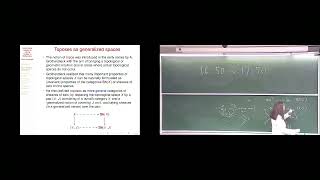
Grothendieck Toposes as Unifying Bridges in Mathematics - Lecture 2
Delve into Grothendieck toposes and their role as mathematical bridges, exploring how these structures enable the transfer of ideas between theories and lead to new discoveries in classical domains.
Reasoning About Conscious Experience With Axiomatic and Graphical Mathematics
Explore mathematical approaches to modeling consciousness using category theory and graphical calculus, examining key aspects like subjective experience and phenomenal unity.
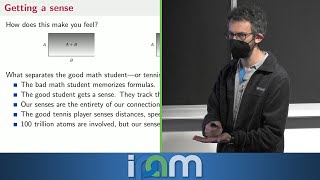
Sense-Making - Accounting for Intelligibility - IPAM at UCLA
Exploring mathematical accounting systems for collective intelligence, focusing on sense-making as a key component in understanding and articulating the phenomenon of intelligence.

Categories - The Mathematics of Connection - IPAM at UCLA
Explore the mathematics of connection through category theory, focusing on open systems, their interfaces, and composition. Learn how this approach applies to various fields and collective intelligence.
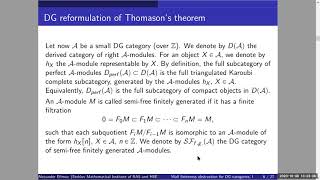
Wall Finiteness Obstruction for DG Categories I
Explore Wall finiteness obstruction theorem for DG categories, its applications to phantom DG categories, and implications for algebraic geometry, including results on Barlow surface and stratified varieties.
Wall Finiteness Obstruction for DG Categories II
Exploration of Wall finiteness obstruction theorem for DG categories, including applications to phantom DG categories and derived categories of algebraic varieties. Discusses extensions to algebras over DG operads.
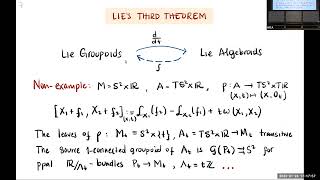
Frontiers in Mathematics Lecture Series - Research Talk
Explore Lie theory, groupoids, and algebroids in this advanced mathematics seminar. Discover local integration techniques and their implications for non-integrable Lie algebroids.
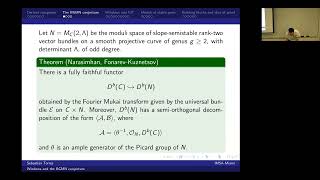
Windows and the BGMN Conjecture
Explore the BGMN Conjecture in algebraic geometry using moduli spaces, derived categories, and GIT wall crossing. Uncover insights into vector bundles and symmetric powers of curves.
Windows and Geometric Invariant Theory
Explore windows theory in algebraic geometry, its applications to GIT constructions, and its impact on derived categories and stability conditions in various mathematical contexts.