It's All About Morphisms
Gentle introduction to Category Theory for OOP programmers exploring Functional Programming. Explains key concepts with diagrams, metaphors, and code examples, comparing to OOP and showing real-world applications.
Inside Every Calculus Is A Little Algebra Waiting To Get Out
Explore algebraic approaches to automatic differentiation and integration in calculus, with Kotlin code examples. Learn how synthetic differential geometry simplifies complex mathematical concepts.

Functional Programming from First Principles
Explore functional programming fundamentals, side effects, and the contrast with imperative programming. Delve into concepts like monoids, category theory, and monads in this insightful talk by Erik Meijer.
An Invitation to Noncommutative Algebra
Explore noncommutative algebra through symmetry, representation theory, and uncertainty principles. Discover finite and infinite dimensional solutions, formal deformations, and category theory applications.
Expert Talk - Functional Programming
Explore functional programming with experts Russ Olsen and Christian Romney. Learn its nature, advantages, misconceptions, and practical applications in software development.
Approaching the Yoneda Lemma
Explore the Yoneda lemma in category theory through algebraic results, bridging intuitive ideas with precise formulations. Gain insights into representability and studying diverse concepts in familiar forms.
A Categorical Formulation of Predictive Processing and Active Inference
Categorical formulation of Predictive Processing and Active Inference using string diagrams, clarifying key concepts and enabling comparison with Integrated Information Theory.
Mathematical Phenomenology, from Subjectivity to Objectivity Through Mathematical Invariants
Explore mathematical phenomenology's role in consciousness studies, examining how objectivity emerges from subjectivity using category theory and mathematical invariants.
Consciousness - Coherence of Modalities
Explores a coherence-based theory of consciousness, proposing structured nets and dynamic mappings as key elements. Discusses data structures, neural codes, and links to mathematical concepts.
Why Algebraic Data Types Are Important
Explore type theory, category theory, and logic in functional programming, focusing on algebraic data types and their role in enhancing code reliability and expressiveness.
Functional Programming in C++
Explore functional programming techniques in C++, including recursive algebraic data types, curried functions, purity, generic programming, and category theory for more general, concise, and composable code.
Functional Geometry - Producing Pure Spaces
Explore geometric synthesis using category theory and functional programming. Learn to model complex spatial configurations with C++14, combining Geometric Algebra and FP paradigms for dimensional fluency.
A Pragmatic Introduction to Category Theory
Explore the fundamentals of Category Theory and its practical applications in functional programming, with a focus on Scala implementations and real-world examples.
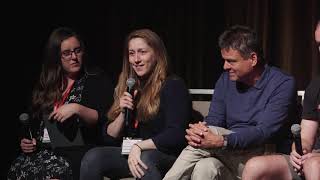
Teaching Scala - A Roundtable Discussion
Roundtable discussion on effective Scala teaching strategies, covering academic and industry perspectives, addressing challenges, and exploring methods to make the language more accessible to newcomers.
Faster JavaScript with Category Theory
Explore how category theory can revolutionize jQuery architecture, leading to faster DOM manipulation and improved JavaScript performance.
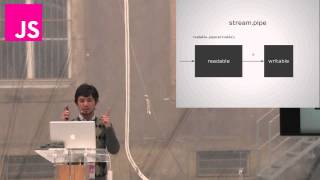
The Circuit as a Point-Free General Model of Computation
Explore circuit-based programming to create simpler, more maintainable applications by modeling them as interconnected processes, inspired by category theory and functional reactive programming.
Computing Meaning from Conceptual Structures in Integrated Information Theory
Explores computing compositional meaning in Integrated Information Theory using category theory and distributional semantics, addressing the role of meaning in conscious experience.
How Would We Know What an Astrocyte Knows? - Understanding Neural Computation Beyond Neurons
Explore how astrocytes compute using calcium patterns and neurotransmitters, challenging traditional neuron-centric views of cognition and proposing new frameworks for understanding consciousness across diverse systems.
Space of Possible Minds - The Landscape of Consciousness
Explore the vast landscape of consciousness across biological species, artificial minds, and theoretical entities through mathematical frameworks and philosophical perspectives.
SSA as Freyd Categories - Categorical Semantics for Compiler Design
Explore the connection between Static Single Assignment (SSA) and Freyd categories, examining their graphical syntax and applications in compiler design and optimization.
Functor Zoo - Exploring Functional Programming Concepts
Explore various functor types in Python, from basic to advanced, including covariant, contravariant, applicative, and profunctors. Gain insights into functional programming concepts and their practical applications.