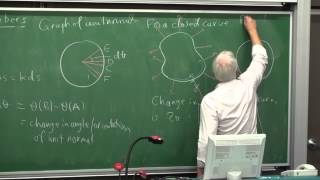
Curvature, Turning Numbers and Winding Numbers - Differential Geometry
Explore curvature, turning numbers, and winding numbers in planar curves. Learn about irrational numbers and transcendental functions from an applied perspective using rational turn angles.
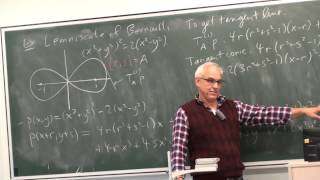
The Differential Calculus for Curves - Differential Geometry
Exploring advanced differential calculus for algebraic curves, including tangent lines, conics, and point classification. Extends to 3D surfaces, offering a comprehensive view of curve analysis.
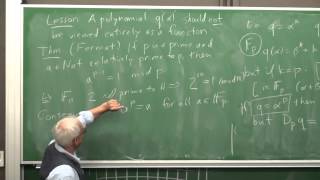
Differential Geometry With Finite Fields - Differential Geometry
Exploring differential geometry in finite fields, introducing arithmetic in prime fields, polynomial operations, and tangent conics to cubics. Highlights unique patterns and combinatorial structures in finite calculus.
Infinitesimal Calculus with Finite Fields - Famous Math Problems
Explore infinitesimal calculus in finite fields through the semi-cubical parabola over F_7, challenging traditional real number analysis and emphasizing polynumbers and de Casteljau Bezier curves.
An Algebraic Infinitesimal Approach to Product and Chain Rules - N J Wildberger
Algebraic approach to calculus using dual complex numbers and bi-polynumbers, introducing the Derivative theorem and deriving Product and Chain Rules without limits or real numbers.
Dual Complex Numbers and Leibniz's Differentiation Rules - Famous Math Problems
Explore algebraic infinitesimals, dual complex numbers, and Leibniz's differentiation rules in this advanced mathematics lecture, extending calculus to general and finite fields.
How to Develop a Proper Theory of Infinitesimals I - Famous Math Problems
Explore the history and development of infinitesimals in mathematics, from Archimedes to modern approaches, with a focus on the Dihedron algebra and dual complex numbers.
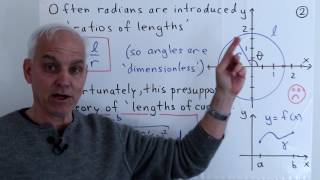
Understanding Uniform Motion - Are Radians Really Necessary? - WildTrig
Explores the concept of radians, questioning their necessity in uniform motion and examining the distinction between pure and applied mathematics in this context.
Problems With the Calculus - Math History - NJ Wildberger
Exploring historical controversies in calculus, including debates on derivatives, integrals, and curves, highlighting critiques from notable figures and ongoing mathematical challenges.
The Integral of X^n - Famous Math Problems
Explores the integral of x^n, its historical development, and challenges in modern analysis. Proposes a new 'Algebraic Calculus' approach, addressing issues with continuum, infinite processes, and area theory.
Archimedes' Squaring of a Parabola - Famous Math Problems
Explore Archimedes' ingenious solution to calculating the area of a parabolic section, a foundational problem in calculus, through geometric insights and elegant proofs.
Omar Khayyam and the Binomial Theorem - Famous Math Problems
Explore the history and applications of the Binomial Theorem, from Omar Khayyam to Pascal's triangle, with insights into its expansion, coefficients, and relevance in modern mathematics.
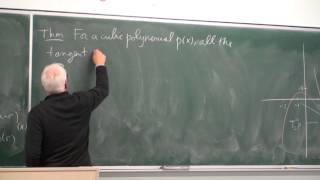
Tangent Conics and Tangent Quadrics - Differential Geometry
Exploring advanced calculus concepts through algebraic methods, focusing on tangent conics and quadrics. Offers a fresh perspective on polynomial approximations and their geometric applications.
Classical Curves - Differential Geometry
Explore classical curves in differential geometry, from conics to advanced constructions. Learn techniques for generating new curves and their applications in various fields.
Factorial Asymptotics, Stirling's Formula - Lecture 3b of CS Theory Toolkit
Explore factorial asymptotics and Stirling's Formula in this graduate-level lecture, covering mathematical techniques for theoretical computer science research.
Probability 1
Explore key concepts in probability theory, including events, conditioning, chain rule, and independence, with practical examples and problem-solving techniques.
Equations of Lines and Planes in 3D - Wild Linear Algebra A - NJ Wildberger
Explore parametric and Cartesian equations of lines and planes in 3D space, including novel concepts like describing all 2D lines as a Möbius band and using determinants for 3D analysis.
More Applications of 2x2 Matrices - Wild Linear Algebra A
Explores advanced applications of 2x2 matrices in linear algebra, covering rotations, reflections, composition of transformations, and connections to calculus, with a focus on linear approximations and derivatives.
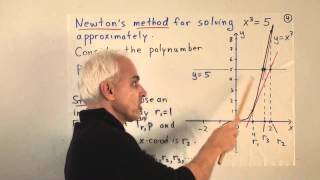
Newton's Method for Approximating Cube Roots - Real Numbers and Limits Math Foundations
Newton's method for approximating cube roots: explore cubes, cube roots, and techniques to find approximate solutions. Learn about Taylor expansion, tangent lines, and advanced methods like the weighted Babylonian and quadratic Newton approaches.
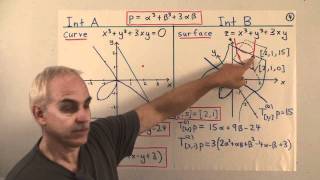
Calculus on a Cubic - The Folium of Descartes - Arithmetic and Geometry Math Foundations
Explore the Folium of Descartes through algebraic calculus, examining its parametrization, Taylor expansions, tangents, and unique properties in both 2D and 3D space.
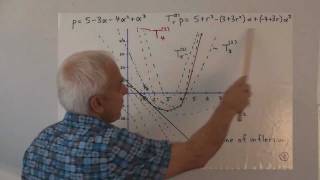
Cubics and the Prettiest Theorem in Calculus - Arithmetic and Geometry Math Foundations
Explore cubic polynomials, their calculus, and tangent conics. Learn about Etienne Ghys' theorem, considered one of the most beautiful in calculus, with an elegant proof provided.