
Kokkos: Getting Lucky By Design - Performance Portability and API Design Principles
Explore Kokkos programming model's design principles for performance portability across diverse HPC platforms. Learn how API design and community development contribute to widespread adoption.
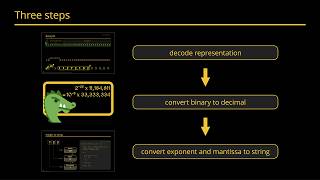
Floating-Point to String Conversion in C++: Exploring Algorithms and Performance
Explore algorithms for converting floating-point numbers to strings in C++, including Dragon, Grisu, Errol, Ryu, and Dragonbox. Gain insights into performance and implementation details.

Testability and C++ API Design
Explore approaches for designing APIs that enhance code testability and usability in test drivers. Learn techniques, simplified examples from popular libraries, and how to write generalized mocks for C++ development.

Introduction to Rust: Ownership, Borrowing, and Advanced Concepts - Part 2
Explore advanced Rust concepts including ownership, borrowing, smart pointers, pattern matching, and exception handling for enhanced programming skills.

C++ Fundamentals: Algorithms
Explore C++ algorithms' power in boosting productivity, reducing bugs, and improving maintainability. Learn why they're essential for every C++ developer and a prime example of extensible design.

Who Needs C++ Unit Tests Anyway? - Modernizing Legacy Code with 0% Code Coverage - 2024
Explore practical strategies for confidently modernizing large legacy C++ codebases without existing tests. Learn actionable approaches to understand, future-proof, and update code to new language standards.
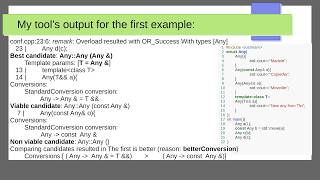
C++ Overload Inspector - A Tool for Analyzing and Profiling Overloaded Function Calls
Explore a tool for analyzing and profiling overloaded function calls in C++. Learn about fundamental overloading rules, tricky examples, and how to optimize compilation time using the open-source inspector.

Arduino C++ vs MicroPython Comparison - Which Language is Best?
Compare Arduino C++ and MicroPython for microcontroller programming. Explore strengths, weaknesses, and use cases of each language to determine the best fit for your projects.
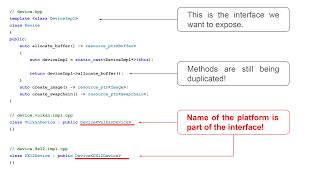
C++ Abstraction Patterns for Cross Platform Development - Lecture
Explore C++ abstraction patterns for cross-platform development. Learn effective techniques, analyze case studies, and gain insights for writing maintainable, performant code across multiple platforms.

Tetris Clone Code Review
Dive into a code review of a Tetris clone, exploring implementation techniques and offering insights to enhance your game development skills.
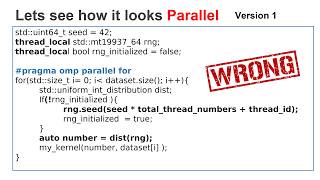
Guide to Random Number Generation in C++ - C++Now 2024
Explore modern alternatives to Mersenne Twister for random number generation in C++. Learn when and why to use newer techniques for improved performance and quality.
Game Programming: Collision Detection and AABB - Lecture 8
Explore collision detection in game programming, focusing on AABB techniques. Learn to implement and resolve collisions for realistic gameplay mechanics.
Game Programming: Introduction to Shaders - Lecture 21
Explore game shader fundamentals, including rendering techniques, visual effects, and performance optimization for enhanced graphics in game development.
Movement in Video Game AI - Lecture 4
Explore movement techniques in video games, including pathfinding, steering behaviors, and obstacle avoidance for realistic AI-controlled characters.
Grid Representations in Video Game AI - Lecture 5
Explore grid representations in video game AI, covering localization, optimization, pathfinding, and hierarchical structures for efficient game world modeling and navigation.
Grid Algorithms in Video Game AI - Lecture 7
Explore grid algorithms for game AI, including connectivity, BFS, vector fields, and distance maps. Learn techniques for efficient pathfinding and spatial analysis in video games.

Making C++ Fun, Safe, and Accessible
Explore strategies to make C++ more enjoyable, secure, and approachable for a wider audience. Learn how to overcome common challenges and misconceptions about the language.

The Singleton Pattern - Anti-Pattern or Solution?
Explore the Singleton pattern in C++: pros, cons, and proper implementation techniques for global aspects. Learn to overcome disadvantages and ensure testability in software design.

Safety in C++: All the Safeties - Lecture
Explore C++ safety concepts, their relation to correctness and security, and learn strategies for writing better code. Gain insights from Sean Parent's expertise in software architecture and development.
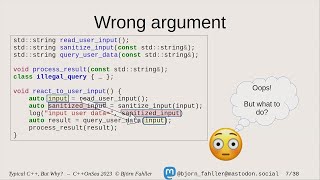
Typical C++ - Leveraging the Type System for Better Code
Explore how leveraging C++'s type system strengths improves code quality, prevents errors, enhances readability, and reduces risks during modifications.
How to Build C++ Interfaces That Are Hard to Use Incorrectly - Lecture
Discover techniques for designing C++ interfaces that prevent misuse, leveraging the type system to catch errors at compile-time and enhance code safety and reliability.