Taming Lambdas' Uniqueness in C++ - Techniques and Workarounds
Explore techniques to overcome lambda expression limitations in C++, including creating multiple lambdas of the same type and using them with standard containers while maintaining readability and performance.
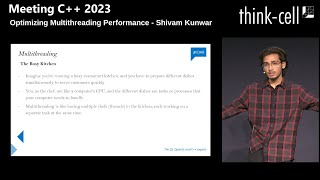
Optimizing Multithreading Performance - False Sharing and Hardware Destructive Interference
Explore false sharing and hardware destructive interference to optimize multithreaded performance. Learn strategies to mitigate cache-related bottlenecks and improve efficiency in C++ applications.
Minimal Logging Framework in C++20
Develop a minimal, optimized C++20 logging framework from scratch, exploring performance enhancements and efficient data collection techniques for large-scale systems.
C++ Common Knowledge - Exploring Core Language Fundamentals
Explore essential C++ concepts like one-definition rule, deterministic object destruction, lookup rules, and initialization. Deepen your understanding of core language features for well-rounded programming expertise.
Typical C++ But Why - Leveraging the Type System for Better Code - Meeting C++ 2023
Explore how leveraging C++'s type system strengths enhances code quality, prevents errors, improves readability, and reduces risks during code modifications.
Throwing Tools at Ranges - Performance Analysis of C++ Styles
Explore runtime performance and memory usage of ranges code vs. non-ranges code using various analysis tools. Compare C-style C++, C++17, and C++23/ranges to understand modernization effects on performance.
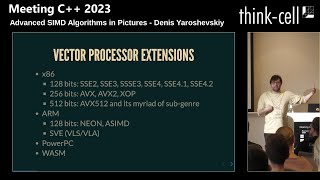
Advanced SIMD Algorithms in Pictures
Explore non-trivial SIMD algorithms like strcmp, set_intersect, and sort through visual explanations. Demystify vectorized algorithms for those with basic CS knowledge.
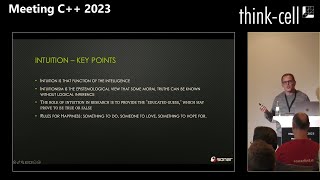
Tooling Intuition - Improving Development with Compiler and Static Analysis Tools
Explore compiler outputs, static analysis, and cross-platform best practices to enhance C++ development. Build intuition for interpreting and leveraging advanced tooling features effectively.
Design Patterns: The Most Common Misconceptions
Uncover common misconceptions about design patterns in software development. Gain clarity on Factory, Builder, Bridge, Strategy, Visitor, and Decorator patterns for improved communication and architecture.
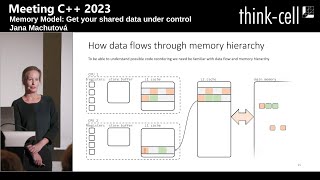
Memory Model: Get Your Shared Data Under Control
Explore C++ memory model, shared data synchronization, and effective use of mutexes and atomics through illustrative examples. Master multi-thread programming techniques.

TDD for Microcontrollers - Applying Test-Driven Development to Embedded Systems
Learn effective TDD techniques for microcontroller projects, including dual-target approach and open loop tests. Discover how to apply TDD to hardware-dependent code and improve embedded development workflows.

Playing Video Games One Frame at a Time
Explore game automation techniques using C++, from built-in tool support to code injection. Learn to enhance gameplay and overcome challenges through programming.
Applied Modern C++ - The Problem of Messages Versioning in API
Explore an elegant Modern C++ solution for versioning API messages, enabling seamless upgrades/downgrades between client and server communications.
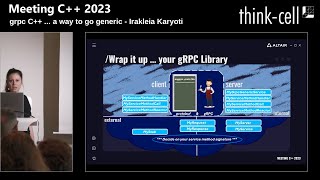
gRPC C++ - A Way to Go Generic
Explore gRPC C++ implementation for modernizing legacy codebases, abstracting details, and decoupling services. Learn effective strategies for transitioning to service-oriented architectures.

What Is a Range in C++ - Understanding C++20 Range Concepts
Explore C++20's range concepts, including views, common ranges, and borrowed ranges. Gain insights into their limitations and performance implications for advanced C++ programming.
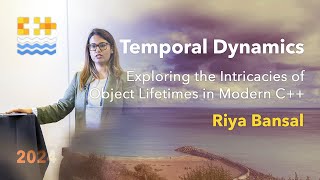
Temporal Dynamics - Exploring the Intricacies of Object Lifetimes in Modern C++ - 2024
Explore advanced C++ object lifetime management techniques. Master special member functions, move semantics, and RAII for efficient, resilient systems. Elevate your programming skills with temporal dynamics expertise.

A Whirlwind Tour of Rust - Systems Programming for the Modern Developer
Explore Rust's innovative approach to systems programming, offering C/C++-level performance with enhanced safety features. Learn language fundamentals and modern development tools.
The Role of C++ in the Python Ecosystem - The Case of the Qt Framework
Explore the complexities of integrating C++ into Python, focusing on Qt framework. Gain insights into build systems, packaging, API compatibility, and developing Python applications with Qt.
Gamedev Through the Eyes of a Backend Engineer
Explore gamedev's unique world: structures, tools, and quirks from a backend engineer's perspective. Gain insights into game engines, version control, Steam's role, and gameplay testing.
Game Programming: Collision Detection and Resolution - Lecture 8
Explore collision detection and resolution in game programming, focusing on bounding shapes, AABB techniques, and practical examples like Super Mario Bros.

Fun with Flags - C++ Type-safe Bitwise Operations
Explore type-safe bitwise operations in C++ using Boost.Flags library. Learn to enhance flag-like integer types with zero-overhead solutions for improved type safety and functionality.