
The Effect of Network Connectivity on Population Neural Dynamics
Explore how network connectivity shapes population neural dynamics, focusing on low-dimensional manifolds and their role in neural computation and cortical function.
Inferring and Characterizing Neuronal Connectivity with Deep Geometry and Topology
Exploring novel geometric and topological methods to decode neural connectivity rules in C. elegans, revealing insights into embryonic development and nervous system architecture.

Visual Processing During Navigation
Explore visual processing mechanisms in navigation, focusing on neural pathways and computational models for spatial orientation and movement through environments.
Architectural Constraints on Recurrent Network Dynamics
Explore how network architecture influences and constrains dynamics in recurrent neural networks, focusing on threshold-linear models and their implications for understanding connectomes in neural computation.
The Cost of Brain State Transitions
Explore the energetic costs of brain state transitions and their implications for connectome analysis in this insightful presentation on cutting-edge neuroscience research.

Earth and Mars - One Wet, One Dry - Why the Difference?
Explore the divergent paths of Earth and Mars, from their similar beginnings to their vastly different present states, uncovering the factors behind their contrasting evolutions.
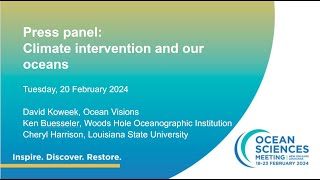
Climate Interventions and Our Oceans - Ask Us Anything
Experts discuss ocean-based climate interventions, including carbon dioxide removal strategies, exploring potential benefits, risks, and regulatory considerations for future oceanic impacts.
Setting the PACE: Scientists Investigate Oceans with New NASA Satellite
Scientists discuss PACE satellite's potential to revolutionize ocean ecosystem monitoring, from studying plankton to identifying harmful algal blooms, using advanced space-based measurements of ocean color.

Discovering the Hidden Secrets of the Ocean - New Era of Ocean Exploration
Explore the ocean's hidden secrets with cutting-edge technology, uncovering new ecosystems, mapping the seafloor, and livestreaming deep-sea discoveries. Learn about innovative marine research and its global impact.

Malaria Vaccines: Progress and Challenges - Interview with Faith Osier
Explore the latest developments in malaria vaccine research with immunologist Faith Osier in this insightful interview by NPR's Regina G. Barber at the AAAS Annual Meeting.
Brain-Machine Interfaces in Medical Therapy
Explore the revolutionary potential of brain-machine interfaces in medical therapy, combining IT, machine learning, and nanotechnology to enhance our understanding of the brain and reduce human suffering.
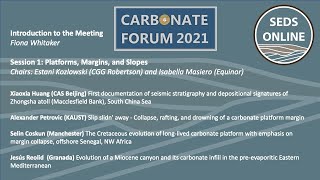
Carbonate Platforms, Margins, and Slopes - Session 1
Exploration of carbonate platforms, margins, and slopes through case studies in South China Sea, Red Sea, Senegal, and Mediterranean, focusing on seismic stratigraphy, depositional signatures, and platform evolution.
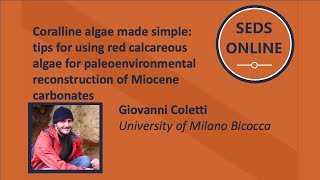
Coralline Algae: Strategies for Palaeoenvironmental Reconstruction in the Miocene
Explore strategies for using coralline algae in palaeoenvironmental reconstructions, focusing on the Miocene epoch and overcoming taxonomic challenges in shallow water limestone studies.

The Ichnology of Carbonate Drifts
Explore bioturbation in carbonate drifts to uncover detailed palaeoenvironmental conditions, enhancing understanding of past oceanic and ecological settings.
Salt on Mars - Astrobiological Tombs?
Explore the potential of salt minerals on Mars to host microorganisms and organic compounds, and learn about their role in the search for extraterrestrial life during Mars sample return missions.
Advent of the Anthropocene Epoch - Quantifying Drivers and Impacts Since 1950 CE
Explores the Anthropocene epoch's onset around 1950, examining human energy consumption, population growth, and their profound impacts on Earth's systems and stratigraphic record.
Limestones: An Essential User Guide to Sediments That Dissolve, Precipitate and Grow
Explore limestone formation, importance, and applications in climate studies and sustainable solutions. Learn about carbonate sedimentology's role in understanding Earth's history and future environmental challenges.

Locomotion Ecology in the Fossil Bird Ichthyornis
Explore 3D shape analysis of fossil bird sternums to uncover flight evolution. Groundbreaking research compares ancient Ichthyornis to modern birds, revealing insights into avian flight origins.

The Evolution of Grasslands - What Plant Fossils Reveal About a Major Ecosystem Change
Explore the evolution and spread of grasslands over 30 million years through microscopic plant fossils, revealing insights into this major ecological transformation.

Beasts Before Us - The Untold Story of Mammal Evolution
Explore mammal evolution from 300 million years ago, uncovering new fossil discoveries and technological insights that reveal the fascinating journey of synapsids to modern mammals.
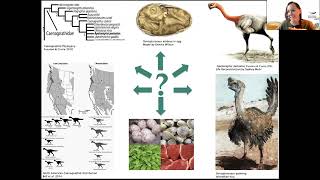
Oviraptorosaurs – The Growth and Hidden Diversity of North America’s Mysterious Bird-like Dinosaurs
Explore Oviraptorosaur growth and diversity through bone histology. Learn how microscopic analysis reveals dinosaur age, development, and species variation in this fascinating paleontological study.