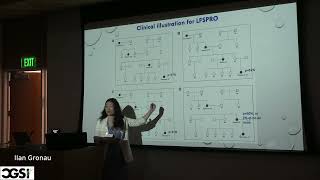
Statistical Methods for Cancer Risk Prediction Models - CGSI 2023
Explore statistical methods for cancer risk prediction models, focusing on Bayesian approaches and applications to Li-Fraumeni syndrome and personalized risk assessment for cancer survivors.
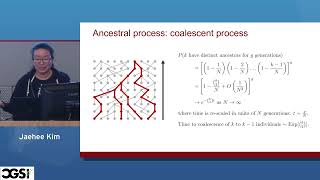
Bayesian Inference of Dependent Population Dynamics in Coalescent Models
Explore Bayesian inference techniques for analyzing dependent population dynamics in coalescent models, focusing on applications in genomics and evolutionary biology.

Investigating Crimes Using Julia
Explore forensic science using Julia, applying math and science concepts to solve crime puzzles. Learn to utilize Julia packages for data analysis, visualization, and complex problem-solving in criminal investigations.
Mathematical Analysis of Models for Living Tissues and Free Boundary Problems - Tutorial Part 1
Explore mathematical models for living tissues and free boundary problems with Professor Perthame, delving into advanced analysis techniques and applications in biological systems.
Mathematical Analysis of Models for Living Tissues and Free Boundary Problems - Tutorial Part 2
Explore mathematical models for living tissues and free boundary problems with Professor Benoît Perthame. Gain insights into advanced analytical techniques for biological systems.
PDEs for Neural Assemblies - Analysis, Simulations, and Behavior
Explore PDEs for neural assemblies, analyzing their behavior through simulations and mathematical techniques with Professor Benoît Perthame from Sorbonne University.
From Mosquitoes to ChatGPT - The Birth and Strange Life of the Random Walk
Explore the fascinating history and diverse applications of random walks, from mosquito control to AI, and their impact on modern technology and scientific understanding.
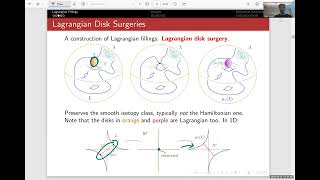
Introduction to Lagrangian Fillings of Legendrian Links - Part 1
Explore Lagrangian fillings of Legendrian links, their construction, and techniques to distinguish Hamiltonian isotopy classes. Delve into the connection with cluster algebras and key proof elements.

On the Spread of an Infection in a Host Population Distributed on Z - Lecture
Explore mathematical models of infection spread in host populations distributed on Z, focusing on stochastic processes in evolutionary biology.
Poincaré Duality Fibrations and Graph Complexes
Explore Poincaré duality fibrations and graph complexes in advanced mathematics. Gain insights from Alexander Berglund's conference talk at CIRM's thematic meeting on higher algebra, geometry, and topology.
Mathematics for Data-Driven Modeling - The Science of Crystal Balls
Explore data-driven modeling techniques that bypass traditional equation-based approaches, enabling direct analysis and prediction from observations in various scientific fields.
Solving PDEs in Domains with Complex Evolving Morphology - Rothschild Lecture
Explore mathematical challenges in solving PDEs on evolving domains, focusing on biological applications. Learn abstract frameworks, well-posedness theory, and numerical methods for complex geometries.
Data-Driven Modelling of Collective Cell Motility - Kirk Lecture
Explore data-driven modeling techniques for collective cell motility with Prof. Ruth Baker. Gain insights into interdisciplinary approaches in animal ecology and cell biology.
A Mathematical Toolkit for Pandemics
Explore mathematical tools for understanding and managing pandemics with Prof. Julia Gog. Gain insights into modeling, data analysis, and decision-making strategies for infectious disease outbreaks.
Data to Differential Equations: Discovering Mathematical Models for Biological Systems
Explore data-driven techniques for discovering governing equations in complex biological systems, focusing on PDEs and innovative mathematical methods for modeling phenomena like arterial flow and tissue fracture.
Understanding Complex Biological Systems: A Journey into Computational Topology
Explore computational topology's role in decoding complex biological systems. Learn how algorithms interpret data from molecular biology, genetics, and medicine, offering unique insights into disease progression and protein structures.
Group Dynamics in Phototaxis
Explore mathematical approaches to modeling group dynamics in phototaxis, including discrete, kinetic, and PDE-based methods for studying bacterial movement towards light.
A Simple Go-or-Grow Model of Aerotaxis Along a Self-Generated Gradient
Explore a minimal model of cell colony expansion driven by aerotaxis, examining division, directional movement, and diffusion in response to oxygen gradients.
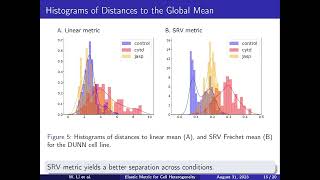
Using a Riemannian Elastic Metric for Statistical Analysis of Tumor Cell Shape Heterogeneity
Analyze tumor cell shape heterogeneity using Riemannian elastic metrics for advanced statistical insights in cancer research.
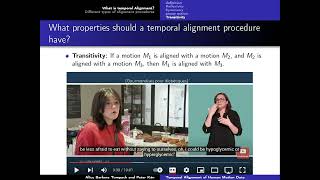
Temporal Alignment of Human Motion Data - A Geometric Point of View
Explore geometric approaches to temporally align human motion data, focusing on innovative techniques and their applications in motion analysis.
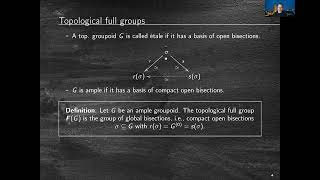
Ample Groupoids, Topological Full Groups, Algebraic K-Theory Spectra and Infinite Loop Spaces
Explore ample groupoids, topological full groups, and their connections to algebraic K-theory spectra and infinite loop spaces in this advanced mathematics seminar.