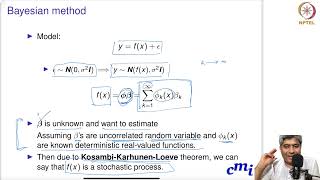
Gaussian Process Regression
Explore non-linear regression techniques, focusing on Gaussian Process Regression, basis functions, and systems. Gain insights into GP priors for advanced statistical modeling.
Combined Stochastic Models for Cancer Patient Trajectories
Integrating diverse clinical data into a unified stochastic model for cancer patient trajectories, combining tumor growth, metastasis, and survival data using Julia for simulation and Bayesian inference.
Variational Inference for Fun and Profit
Discover the fundamentals of variational inference in statistical analysis, exploring Bayesian techniques, SuSiE PCA methodology, and practical applications in computational genomics and regression modeling.
A Deep Computational Phenomenology of MPE as Metacognitive Free Energy Optimization
Explore the computational modeling of minimal phenomenal experience through Bayesian mechanics and free energy principles, examining belief dynamics and metacognitive processes.
Machine-Brain Intelligence in Brain-Computer Interfaces - Understanding Neural Networks and Human Learning
Explore the symbiotic relationship between neural networks and brain-computer interfaces, discovering how machine and human learning combine to extend neural control to external devices.
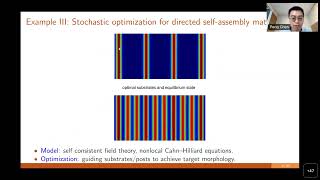
Derivative-Informed Neural Operators for Solving PDE-Governed Optimization Problems
Explore novel machine learning for solving optimization problems with PDEs, featuring derivative-informed neural operators for efficient, scalable solutions in high-dimensional parameter spaces.
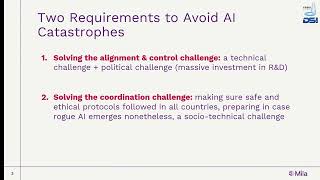
How Could We Design Aligned and Provably Safe AI?
Explore AI safety with Dr. Yoshua Bengio, focusing on run-time risk evaluation and Bayesian approaches to mitigate potential harm from advanced AI systems.
Better Photos - Leveraging Product Insights to Optimize Machine Learning Models
Explore advanced analytical techniques for optimizing photo selection in dating apps. Learn about statistical considerations, product insights, and impact on engagement and revenue metrics.
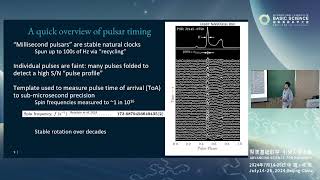
The Parkes Pulsar Timing Array Third Data Release: Overview and Search for an Isotropic Gravitational-wave Background
Explore the Parkes Pulsar Timing Array's latest data release, focusing on gravitational wave detection techniques and results from isotropic stochastic background searches.
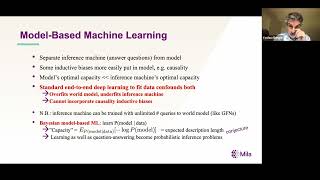
Large Neural Nets for Amortized Probabilistic Inference in Highly Multimodal Distributions
Explore amortized probabilistic inference using large neural networks for complex distributions. Learn about GFlowNets and their potential to improve AI systems with Bayesian and causal understanding.
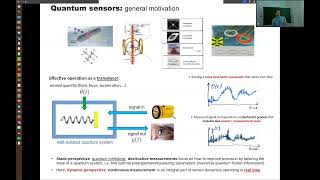
Quantum Sensors Operated in Real Time
Explore quantum sensors' real-time applications, from gravitational-wave detection to brain magnetic field tracking. Learn about enhancing sensitivity through non-classical correlations and measurement-based feedback techniques.
Merging Rate of Opinions via Optimal Transport on Random Measures
Explore optimal transport on random measures to analyze opinion merging rates, focusing on Bayesian statistics applications in mathematical research.
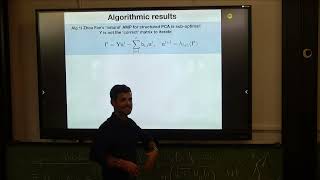
Bayesian Limits in Structured PCA and How to Reach Them - Workshop on Spin Glasses
Explore Bayesian limits in structured PCA and techniques to achieve them, presented by J. Barbier from ICTP Trieste.

The Role of Machine Learning in Facilitating Fusion Energy Research
Explore machine learning applications in fusion energy research, including turbulence simulation speed-ups and predicting rare events. Gain insights into ML's potential to accelerate progress towards clean, abundant fusion energy.
Fast and Accurate Probabilistic Time Series Classification
Explore fast and accurate probabilistic time series classification using MINIROCKET technology, achieving near-state-of-the-art performance with significantly reduced computational costs compared to existing methods.
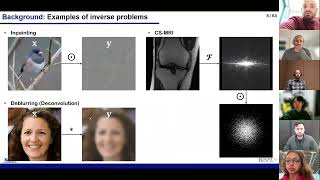
Diffusion Models for Inverse Problems
Explore advanced techniques for solving inverse problems using diffusion models, focusing on posterior sampling and manifold constraints.
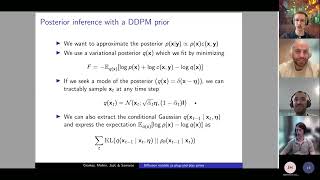
Diffusion Models as Plug-and-Play Priors
Explore diffusion models as versatile priors for various tasks, enhancing image processing and generation capabilities.
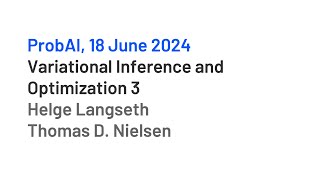
Variational Inference and Optimization - Lecture 3
Explore advanced variational inference and optimization techniques for probabilistic AI, focusing on cutting-edge methods and practical applications.
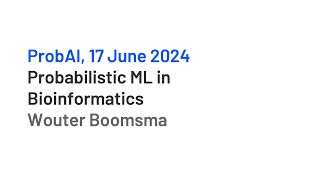
Probabilistic Machine Learning in Bioinformatics
Explore probabilistic machine learning applications in bioinformatics, focusing on cutting-edge techniques and their impact on biological data analysis.

What's New with Turing.jl and Its Ecosystem
Explore updates to Turing.jl, a probabilistic programming framework in Julia for Bayesian inference, and its expanding ecosystem of modular packages for enhanced usability and extensibility.

Discriminative Classification with Incomplete Data - Lecture
Explore advanced discriminative classification techniques for structured data with missing information, focusing on maximum entropy principles and large margin methods for robust decision-making.