Deep Learning in Bioinformatics - Recent Advancement
Explore recent advancements in deep learning for bioinformatics, covering BTINET, autoencoders, and deep belief networks. Gain insights into cutting-edge applications in genomics, drug discovery, and disease prediction.

Deep Learning to Discover Coordinates for Dynamics - Autoencoders & Physics Informed Machine Learning
Explore deep learning techniques for discovering effective coordinate systems in dynamical systems, enabling simpler models and physical law discovery. Focus on autoencoders and physics-informed machine learning.
Machine Learning for Fluid Dynamics - Patterns
Explore machine learning applications in fluid dynamics, focusing on pattern extraction and coherent structure identification in high-dimensional systems.
Machine Learning for Fluid Mechanics
Overview of machine learning applications in fluid mechanics, exploring historical context, pattern recognition, reduced-order modeling, and flow control, with insights on AI's impact on this data-rich field.
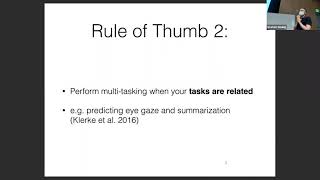
CMU Advanced NLP: Pre-training Methods
Explore advanced NLP concepts including multi-task learning, sentence embeddings, BERT variants, and language modeling objectives. Gain insights into cutting-edge techniques for natural language processing.
All Things VQGAN - AutoEncoder with Latent Space and Reconstruction Error - Part 1
Explore AutoEncoders, latent space, and reconstruction error in VQGAN. Learn key concepts and their applications in AI, with practical examples and in-depth explanations.

BigGAN and Other Generative Models
Explore BigGAN and BigBiGAN generative models, their functionality in RunwayML, and learn about image reconstruction techniques in this informative video on advanced AI-powered image generation.

Approaches to Fraud Detection - Autoencoder and Isolation Forest - Fraud Detection Using ML
Learn fraud detection techniques using KNIME, including random forest, autoencoder, and isolation forest. Explore methods for both labeled and unlabeled data, with practical demonstrations and insights on implementation.
Anomaly Detection with Autoencoder
Learn to detect anomalies using autoencoders in high energy physics data analysis. Explore advanced machine learning techniques for uncovering rare events and potential new physics.
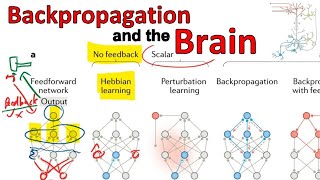
Backpropagation and the Brain
Explore a biologically plausible variant of backpropagation and its potential role in brain learning, discussing feedback connections and error signal approximation in cortical networks.

From LV-EBM to Target Prop to Autoencoder
Explore various autoencoder types, from target propagation to variational autoencoders, understanding their mechanisms, applications, and differences in deep learning and neural network architectures.

Unsupervised Learning - Autoencoding the Targets
Explore unsupervised learning and generative models, covering topics like latent space interpolation, style transfer, super resolution, and autoencoders. Gain insights into advanced machine learning concepts and techniques.
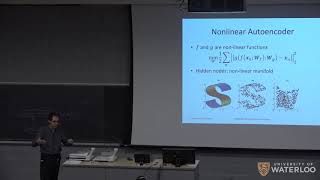
Autoencoders
Explore autoencoders, from basic concepts to advanced applications, covering compression, PCA, deep architectures, sparse representations, and denoising techniques.
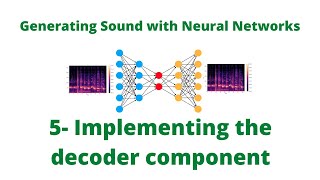
How to Implement Autoencoders in Python and Keras - The Decoder
Learn to implement the decoder component of autoencoders using Python, TensorFlow, and Keras. Covers building methods, layers, and architecture for generating sound with neural networks.
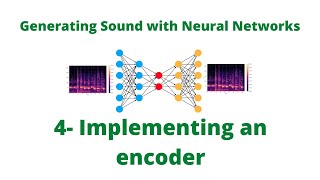
How to Implement Autoencoders in Python and Keras - The Encoder
Learn to implement autoencoders in Python and Keras, focusing on building the encoder component. Covers autoencoder class construction, convolutional layers, bottleneck creation, and practical implementation.

Autoencoders Explained Easily
Intuitive explanation of autoencoders, covering key concepts like representation learning and latent space, with applications in data generation, denoising, and anomaly detection.
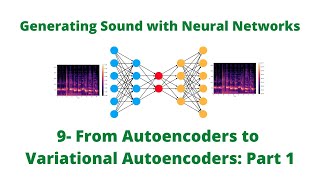
From Autoencoders to Variational Autoencoders - Improving the Encoder
Explore the transformation from autoencoders to variational autoencoders, focusing on improved encoding using multivariate normal distributions for enhanced generative capabilities in AI and sound processing.
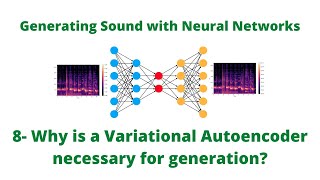
Generation with AutoEncoders - Results and Limitations
Explore image generation using autoencoders, analyze latent space representations, and understand limitations in generative tasks. Learn why variational autoencoders are necessary for improved generation.
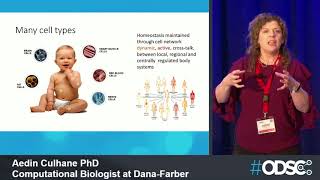
Unsupervised Feature Learning with Matrix Decomposition - Aedin Culhane, PhD | ODSC East 2018
Explore unsupervised learning techniques for high-dimensional data analysis, focusing on matrix factorization methods and their applications in oncology and precision medicine.

Deep Generative Modeling
Explore deep generative modeling, including autoencoders, VAEs, GANs, and diffusion models. Learn about latent variables, training techniques, and recent advances in generative AI.
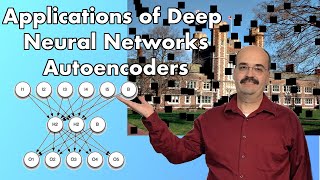
Deep Neural Network Autoencoders in TensorFlow and Keras - Part 1
Learn to create and implement autoencoders in Keras and TensorFlow, including denoising autoencoders, for deep neural network applications in image processing and function approximation.