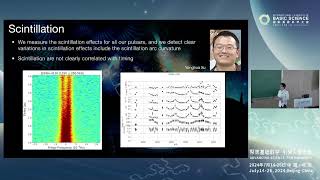
Searching for Gravitational Wave Background with Chinese Pulsar Timing Array Data Release I
Explore gravitational wave detection using Chinese Pulsar Timing Array data. Learn about millisecond pulsar observations, data analysis techniques, and key findings in the search for nanohertz gravitational wave backgrounds.
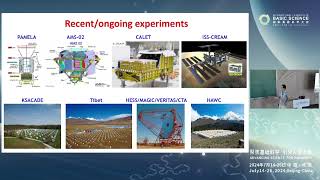
Measurement and Implication of Diffuse Gamma-Ray Emission from the Galactic Plane at Ultra-High Energies
Explore ultra-high energy gamma-ray emissions from the Galactic plane using LHAASO data, examining spectral characteristics and implications for cosmic ray propagation models.
Testing Gravity Theories with Radio Pulsar Timing
Explore radio pulsar timing techniques and their application in testing alternative gravity theories using binary pulsars.
A Universe To Be Decided: Towards Specialized Foundation Models for Advancing Astronomy
Explore specialized foundation models in astronomy, including AstroLLaMa-1 and AstroLLaVA, to enhance scientific inquiry and democratize access to astronomical knowledge.
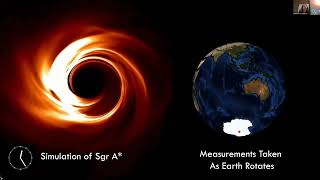
Moving Beyond the First Portrait of Our Milky Way's Black Hole by Leveraging Underlying Structure
Explore computational imaging techniques used to capture black hole images and leverage data structure to extract evolving details of the Milky Way's supermassive black hole.
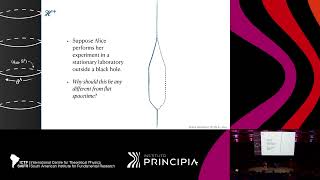
Black Holes and Cosmological Horizons Decohere Quantum Superstitions
Explore how black holes and cosmological horizons impact quantum superpositions, delving into the intersection of gravity and quantum mechanics.
On the Energy and Helicity of Inflexional Magnetic Braids
Explore energy and helicity in inflexional magnetic braids, examining their properties and implications for astronomical phenomena.
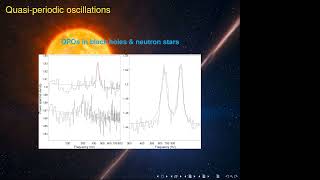
High-Frequency Quasi-Periodic Oscillations and Oscillations of Accretion Disks
Explore high-frequency variability in X-ray light curves of accreting black holes and neutron stars, focusing on orbital motion and oscillations of thin accretion disks, their linear modes, and nonlinear interactions.
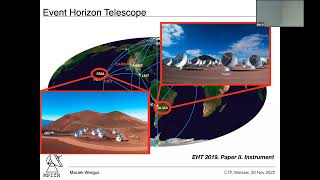
First Image of the Black Hole Shadow in the Galactic Center - Sagittarius A*
Explore groundbreaking images of Sagittarius A*, the Milky Way's central supermassive black hole, captured by the Event Horizon Telescope. Delve into data analysis, theoretical interpretations, and implications for black hole physics.
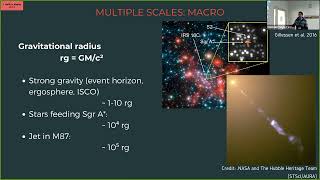
Simulating the Multi-Scale Environment of Supermassive Black Holes
Explore simulation techniques for modeling supermassive black holes, focusing on incorporating large-scale environmental data into event horizon simulations to enhance EHT observations.
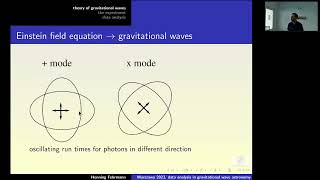
Data Analysis in Gravitational Wave Research
Explore data analysis methods for detecting gravitational waves from various cosmic sources, including mergers and continuous waves, with insights into the Atlas data analysis facility.
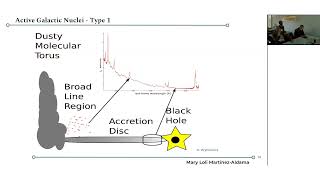
UV Quasar Main Sequence - Exploring the Eigenvector 1 Sequence in Active Galactic Nuclei
Explore the UV Eigenvector 1 sequence in quasars, examining spectral properties and their correlation with Eddington ratio to identify AGN subpopulations and physical differences.
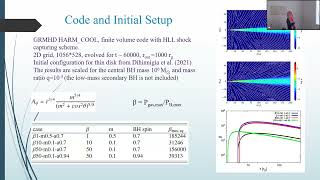
Gas-Rich Environment Effect on Low-Frequency Gravitational Waves from Supermassive Black Hole Binaries
Explore how gas-rich environments impact low-frequency gravitational waves from supermassive black hole binaries, focusing on LISA's potential to detect these effects and inform AGN accretion disk physics.
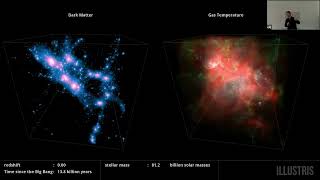
Exploring the Local Group with Constrained Simulations
Explore the Local Group using constrained simulations to study low-mass galaxies, including ultra-diffuse galaxies, and their implications for dark matter and galaxy evolution.
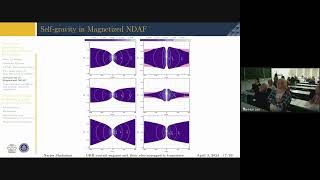
GRB Central Engines and Electromagnetic Transients
Explore gamma-ray burst central engines, focusing on hyper-accretion disks around black holes. Examine self-gravity, magnetic fields, and instabilities in neutrino-dominated accretion flows and their role in X-ray flares and prompt emissions.
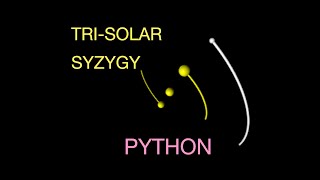
Modeling the Tri-Solar Syzygy with Python
Explore Python modeling of the Tri-Solar Syzygy from "The 3 Body Problem," simulating stable orbits and planetary positions in a three-star system.
What We Know and Don't Know About Searching for Alien Life
Explore the search for alien life with astrophysicist Dr. Adam Frank, covering key concepts, challenges, and recent developments in astrobiology and SETI research.
The First North-South Agreement: The Armagh-Dunsink-Harvard (ADH) Telescope 1947
Explore the historic Armagh-Dunsink-Harvard telescope project, its political significance, and impact on space research through expert insights from renowned historians and astronomers.
Darkness Falls: Cosmological Tension Rises - Old and New Dark Energy Mysteries
Explore cosmological tensions and dark energy mysteries with Dr Yasaman Yazdi in this intriguing Samhain agus Science 2023 presentation.
Galaxy of Horrors - Troubling Tales from Worlds Beyond Our Own
Explore chilling tales of distant worlds and cosmic horrors in this Halloween-themed astronomical journey beyond our solar system.
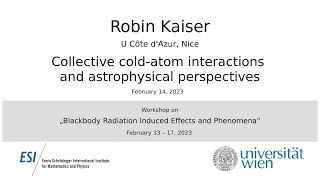
Collective Cold-Atom Interactions and Astrophysical Perspectives
Explore collective cold-atom interactions and their astrophysical applications through experiments on light scattering, random lasing, and long-range forces in atomic vapors.