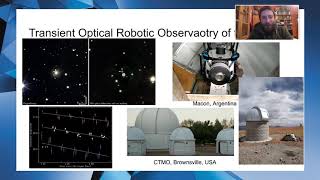
Using Deep Learning to Hunt Optical Counterparts to Gravitational Wave Events
Exploring deep learning applications in astrophysics to detect optical counterparts of gravitational waves, enhancing our understanding of cosmic events and advancing telescope scheduling techniques.

Unveiling the Universe with Python
Explore how Python and Monte Carlo simulations unveil the mysteries of the Universe, from analyzing cosmic microwave background data to revealing the surprising dominance of dark matter and energy.
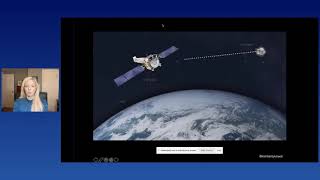
Our Universe through Sight, Sound & Touch
Explore the cosmos through innovative sensory experiences: listen to stellar explosions, walk through the Milky Way in VR, and feel vibrations of stellar nurseries. Transform 2D data into immersive, multi-dimensional encounters with our universe.
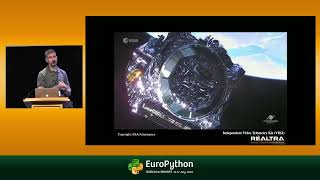
Python's Role in Unlocking the Secrets of the Universe with the James Webb Space Telescope
Explore how Python powers data processing for the James Webb Space Telescope, enabling groundbreaking discoveries about the Universe's origins, star formation, and exoplanets.
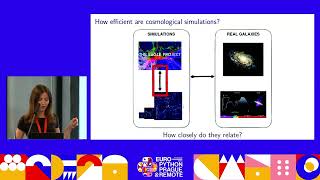
How Well Do We Understand Our Universe? Let's Python It Out!
Explore cosmic evolution using Python and machine learning to model the Universe's history, train AI on simulations, and apply findings to real galaxies, shedding light on their cosmic past.
Uncovering the Universe - Latest News from the LHC
Explore groundbreaking discoveries from the Large Hadron Collider, including insights on antimatter, dark matter, and the Higgs particle. Learn how this powerful machine recreates post-Big Bang conditions.

Mysteries of Matter at the LHC
Explore the Higgs Boson discovery, LHC's future plans, and unsolved mysteries in particle physics. Learn about dark matter, gravity's weakness, and ATLAS experiment's role in advancing our understanding of the universe.

Dark Matter's Not Enough
Explore the cosmos beyond dark matter and energy with Andrew Pontzen, delving into the predictability of our rule-governed universe and the potential for even stranger phenomena.

What a Wonderful World
Award-winning writer Marcus Chown explores fascinating scientific phenomena, from rocket-fueled babies to invisible Universe matter, in an engaging and accessible talk that explains the world's wonders in just one hour.
Gravity and Orbital Mechanics - Physics 101 / AP Physics 1 Review with Dianna Cowern
Explore gravity and orbital mechanics, covering gravitational force, orbital velocity, and Einstein's theories. Includes practical exercises and real-world applications like the ISS orbit.

Your Body Was Forged in the Spectacular Death of Stars
Explore the cosmic origins of life as an astrophysicist reveals how supernovas forged elements essential to our existence, connecting us all to the spectacular birth and death of stars.

Shedding Light on Dark Matter
Explore dark matter and dark energy with physicist Patricia Burchat, uncovering their immense influence on the universe despite being undetectable through direct measurement.

Shedding Light on Dark Matter
Explore the mysterious world of dark matter and dark energy, comprising 96% of the universe, through cutting-edge physics and innovative detection methods.

The Sound the Universe Makes
Explore the unexpected sonic landscape of space as physicist Janna Levin reveals the universe's soundtrack, from black holes' percussive effects to dramatic cosmic events, in this mind-expanding journey through outer space.

What's Inside a Star?
Explore the fascinating world of spectroscopy and its role in understanding stars' composition and behavior. Gain insights into the search for potentially habitable planets beyond our solar system.
Physical Limits to Cognition - How I Learned to Stop Worrying and Love Black Hole Thermodynamics
Explore the intersection of information theory, cognitive science, and black hole thermodynamics to understand fundamental limits of physically-embodied computational systems and cognitive processes.
Probing Reionization of the Universe Using Signal from Hydrogen
Explore the fascinating process of cosmic reionization and how scientists study the early universe through hydrogen signals in this engaging astronomy presentation.
Beyond the Visible Universe - Discovering Wonders in Radio and X-rays
Explore the mysteries of space through radio and X-ray astronomy, uncovering celestial phenomena beyond human vision and discovering how scientists observe the invisible cosmos.
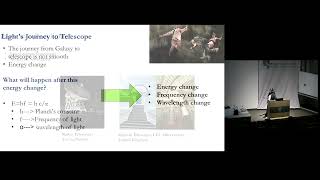
Mysteries of Redshift: Unlocking the Secrets of the Expanding Universe
Explore redshift's role in understanding cosmic expansion, the Big Bang theory, and the universe's structure. Discover how this phenomenon reveals celestial objects' age, distance, and composition.
Introduction to Radio Astronomy
Explore the fundamentals of radio astronomy, including electromagnetic spectrum and its significance in astronomical research. Learn course structure and logistics.
Cosmic Map Making - Exploring Similarities Between Cosmic and Everyday Maps
Explore cosmic map making's intricacies and surprising similarities to everyday maps with Prof. Adrian Liu, uncovering the Universe's history and the birth of first-generation stars and galaxies.