
Aspects of Black Holes Perturbation Theory - Lecture 2
Explore advanced concepts in black hole perturbation theory, focusing on mathematical techniques and physical implications for gravitational wave analysis and astrophysical phenomena.

Aspects of Black Holes Perturbation Theory - Lecture 1
Explore black hole perturbation theory, delving into advanced concepts and mathematical frameworks for understanding gravitational phenomena and spacetime dynamics.

The View from Earth - 400 Years of Astronomical Adventure
Embark on a 400-year journey through astronomical discoveries, exploring Earth's perspective on the cosmos and our evolving understanding of the universe.
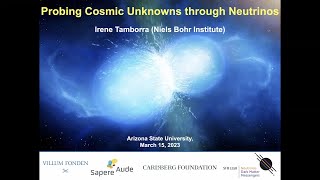
Probing the Cosmic Unknowns Through Neutrinos
Explore cosmic mysteries through neutrinos, their role in stellar dynamics, element formation, and powerful cosmic events. Discover recent developments and exciting detection prospects in multi-messenger astronomy.
Fundamental Physics with Nuclei: Exploring Standard Model Tests and Beyond
Explore lepton-number violation, neutrino mass hierarchy, and dark matter through nuclear physics. Gain insights into Standard Model tests and beyond using advanced computational methods.
Strong Interaction Matter in the Universe
Explore quantum chromodynamics, hadron formation, and nuclei in the universe. Discover advances in understanding dense matter in neutron stars and high-temperature phenomena in compact object mergers.
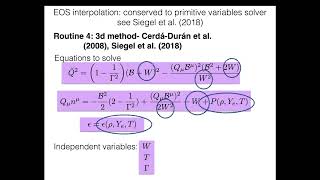
HARM3D and NUC: Numerical Simulations in Relativistic Astrophysics
Explore HARM3D and NUC in relativistic astrophysics, focusing on computational techniques for modeling extreme cosmic events and gravitational phenomena.
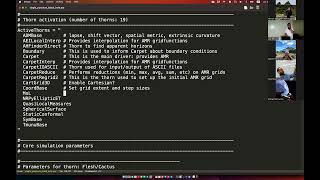
Tutorial on Simulation Analysis
Explore advanced techniques for analyzing gravitational wave simulations, focusing on data interpretation and visualization in computational relativity research.
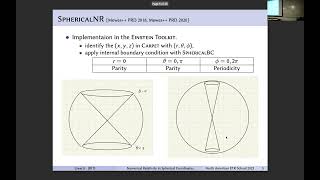
Numerical Relativity in Spherical Coordinates with SphericalN
Explore numerical relativity in spherical coordinates using SphericalN, covering advanced computational techniques for gravitational physics simulations.
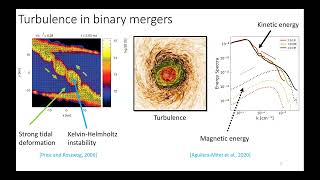
Modeling the Kelvin-Helmholtz Instability in BNS Mergers
Explore advanced modeling techniques for Kelvin-Helmholtz instability in binary neutron star mergers, enhancing understanding of gravitational wave sources and astrophysical phenomena.
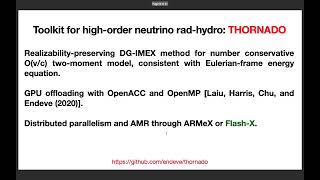
ExaStar: Multi-Physics Stellar Astrophysics Simulations at the Exascale
Explore cutting-edge multi-physics simulations for stellar astrophysics at exascale computing levels, focusing on the ExaStar project and its applications in computational relativity.
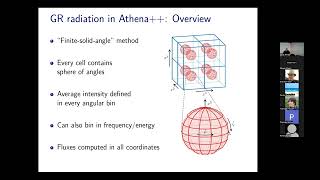
Radiation Transport in Athena++ - 2023 North American Einstein Toolkit School
Explore radiation transport in Athena++, focusing on computational methods for modeling energy transfer in astrophysical simulations.
Harm3D: Highly Accurate Relativistic MHD in 3D
Explore highly accurate relativistic magnetohydrodynamics in 3D with Harm3D, a cutting-edge computational tool for astrophysical simulations.
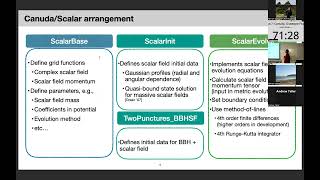
Canuda Tutorial
Explore gravitational wave analysis using the Canuda toolkit in this comprehensive tutorial from the 2023 North American Einstein Toolkit School and Workshop.
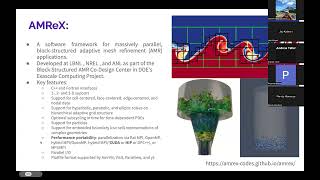
AsterX and GPU Simulations in Computational Relativity - Tutorial
Explore AsterX and GPU simulations for computational relativity and gravitation, enhancing understanding of advanced numerical techniques in astrophysics.
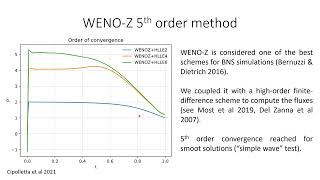
The Spritz Code for Computational Relativity and Gravitation
Explore the Spritz code for computational relativity and gravitation with expert Bruno Giacomazzo. Gain insights into advanced numerical techniques for simulating astrophysical phenomena.
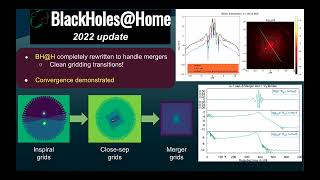
BlackHoles@Home - Citizen Science in Computational Relativity
Explore cutting-edge research on black holes through citizen science, contributing to gravitational wave detection and understanding cosmic phenomena.
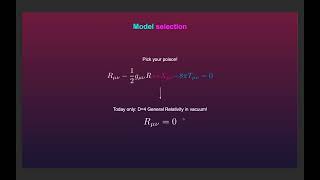
Introduction to Numerical Relativity
Explore advanced concepts in numerical relativity, focusing on computational techniques for modeling gravitational phenomena and spacetime dynamics.
Initial Data for the Numerical Evolutions of Compact Binaries
Explore numerical evolutions of compact binaries, focusing on initial data preparation for simulating gravitational wave sources in computational relativity.
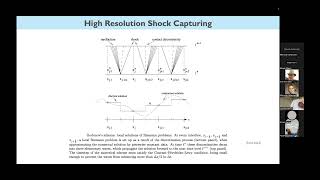
Introduction to General Relativistic Magnetohydrodynamics (GRMHD)
Explore General Relativistic Magnetohydrodynamics (GRMHD) fundamentals and applications in astrophysical simulations, focusing on compact objects and their environments.
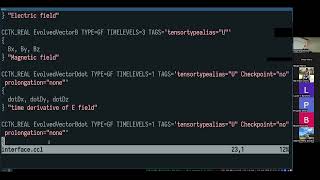
Tutorial on Writing a Physics Thorn - Einstein Toolkit
Learn to create a physics thorn in the Einstein Toolkit, exploring computational techniques for relativistic astrophysics and gravitational wave research.