Introduction to Numerical Relativity - Part 1
Explore Einstein's Field Equations through computational methods, covering 3+1 formulation, initial data, evolution, gauge choice, and extracting gauge-invariant quantities for astrophysical simulations.
Introduction to Numerical Relativity - Part 2
Explore computational methods for solving Einstein's Field Equations, covering 3+1 formulation, initial data, evolution, gauge choice, and extracting gauge-invariant quantities in astrophysical simulations.
The Nonlinear Stability of Slowly Rotating Kerr Black Holes
Explore nonlinear stability of slowly rotating Kerr black holes through joint research findings, delving into advanced astrophysical concepts and mathematical models.
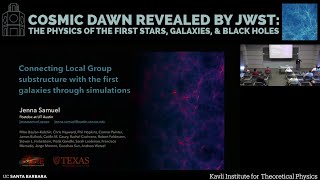
Connecting Local Group Substructure with the First Galaxies Through Simulations
Exploring connections between Local Group substructure and early galaxies using simulations, bridging near-field and deep-field observations to understand cosmic dawn.
New Insight into Early Massive Stars from Local Metal-Poor Dwarf Galaxies
Explore insights on early massive stars through local metal-poor dwarf galaxies. Discover connections between near-field observations and cosmic dawn, enhancing our understanding of the universe's early stages.
The Interplay of Feedback and Star Formation in Dense Compact Star Clusters
Explores the relationship between stellar feedback and star formation in dense compact star clusters, discussing implications for early galaxy formation and cosmic dawn observations from JWST.
The GARDEN Survey - Exploring Galaxy Evolution in the Early Universe
Exploring cosmic dawn with JWST: Insights on first stars, galaxies, and black holes. Conference talk discusses GARDEN Survey findings and implications for understanding early universe evolution.
A New Era for Emission-line Probes of Star-forming Galaxies back to Cosmic Dawn
Explore cosmic dawn with JWST: Discover first stars, galaxies, and black holes. Discuss key questions on early universe evolution, connecting near-field and deep-field observations.
Radiative Signatures of Growing Massive Black Holes in the Early Universe
Explore radiative signatures of early universe massive black holes. Discover insights on cosmic dawn, first stars, and galaxies through JWST observations and theoretical models.
Insights into Black Hole Growth in the Early Universe with JWST
Explore early universe black hole growth using JWST data. Gain insights into cosmic dawn, first stars, and galaxy formation. Join experts discussing latest discoveries and theoretical models in astrophysics.

Dark Matters: Have We Really Failed to Identify Most of the Cosmos?
Explore dark matter's mysteries with physicist Katherine Freese and Brian Greene. Delve into its history, evidence, potential candidates, dark stars, and the concept of a dark big bang in this enlightening discussion.

Einstein's Quantum Gravity Insights - Did He Unknowingly Solve Physics' Biggest Problem?
Explore quantum gravity insights from Google's quantum computer with Brian Greene and researchers, discussing Einstein's papers, wormholes, and the future of quantum computation.

NASA's Next Big Thing: The Nancy Grace Roman Space Telescope
Explore NASA's Nancy Grace Roman Space Telescope: its groundbreaking capabilities, scientific goals, and potential to revolutionize our understanding of dark energy, exoplanets, and the universe.

Year Two in Review - Groundbreaking Science Discoveries by JWST
Explore groundbreaking discoveries by the James Webb Space Telescope in its second year, from revolutionary findings to unexpected revelations across astronomy, with insights on future investigations.
Don't Go for Broke - The Key Physics of the Universe's First Billion Years
Explore the crucial physics of the universe's early stages, focusing on the first billion years, with insights from UC Santa Cruz expert Brant Robertson in this engaging Kavli Institute talk.
Pressure-Regulated Feedback-Modulated Star Formation Model: A Plausible Explanation for High-z Galaxies
Explore a novel star formation model explaining high-z galaxy abundance observed by JWST and its implications for cosmic reionization in this insightful astrophysics talk by Sultan Hassan.
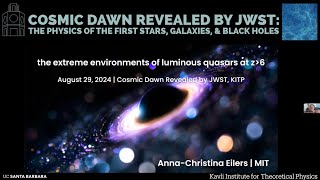
The Extreme Environments of Luminous Quasars at z~6
Explore luminous quasars at z~6 and their extreme environments. Discover insights into cosmic dawn, early black holes, and galaxy formation through cutting-edge JWST observations and theoretical models.
The Insane Power of a Hypernova - Second Only to the Big Bang
Explore the mind-blowing power of hypernovas, their formation, and potential cosmic threats. Discover how these stellar explosions create intense gamma-ray bursts that could impact Earth.
How Dark Energy May Be Hiding Inside Black Holes
Explore the intriguing connection between black holes and dark energy, examining new research that suggests supermassive black holes may be the source of this mysterious cosmic force.

How Scientists Created a Quantum Wormhole Simulation in a Lab
Explore the creation of a quantum holographic wormhole in a quantum computer, examining the connection between quantum entanglement and wormholes, and its implications for information transfer.

Black Holes Are Even Weirder Than You Thought - Exploring Their Formation and Mysteries
Explore the mind-bending physics of black holes, from their formation to their potential for harboring life, and discover why they're even stranger than you imagined.