Capturing a Supermassive Black Hole - 2021 Kavli Foundation Keynote Plenary
Explore groundbreaking research on supermassive black holes with Nobel laureate Andrea Ghez as she discusses her team's revolutionary observations at the center of our galaxy.
A 40-Year Journey in Astrophysics - 2021 Kavli Foundation Keynote Plenary
Explore Reinhard Genzel's 40-year scientific odyssey, culminating in groundbreaking discoveries about the supermassive black hole at our galaxy's center.
Fundamental Lessons from Black Hole Physics - 2021 Kavli Foundation Keynote Plenary
Explore fundamental lessons from black hole physics with Nobel laureate Roger Penrose, delving into groundbreaking concepts and their implications for our understanding of the universe.
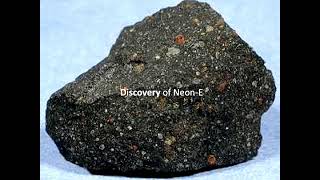
Adventures in Planetary Science 1960-2020 - Fred Whipple Lecture
Explore six decades of planetary science advancements, from early discoveries to recent breakthroughs. Gain insights into the field's evolution and its impact on our understanding of the cosmos.

James Webb Space Telescope and the Search for Earth-Like Exoplanets
Panel discussion exploring JWST's potential to revolutionize exoplanet research, featuring astrophysicists discussing the telescope's capabilities to discover Earth-like planets and search for signs of life beyond our solar system.
A Modern Way to Look for Aliens
Exploring innovative approaches to detect extraterrestrial intelligence, including indirect clues of technological development. Discusses efforts to establish SETI as a legitimate scientific discipline with academic infrastructure.
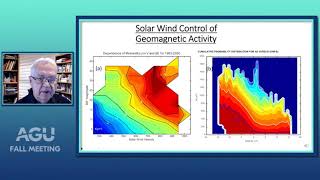
Solar Wind Coupling and Magnetospheric Substorms - James Van Allen Lecture
Explore solar wind coupling and magnetospheric substorms in this prestigious space science lecture, honoring James A. Van Allen's pioneering contributions to magnetospheric research.
Latest Science from NASA's Juno Mission to Jupiter
Discover the latest findings from NASA's Juno mission, including Jupiter's Great Blue Spot, polar cyclones, magnetosphere, and interior. Explore citizen scientists' contributions and hear Ganymede's magnetosphere sounds.
Pioneering Planetary Defense - What Comes Next After DART's Asteroid Impact
Experts discuss DART mission's asteroid impact, analyzing momentum transfer, ejecta, and implications for future planetary defense strategies against potentially hazardous asteroids.
Latest Science Results from NASA's Juno Mission to Jupiter
Explore the latest findings from NASA's Juno mission, including detailed observations of Jupiter's moons Ganymede and Europa, and new insights into the gas giant itself. Featuring captivating imagery and expert analysis.
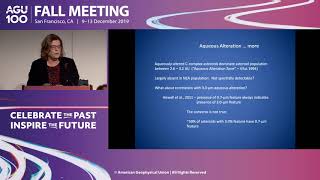
Fred Whipple Lecture on Planetary Science - AGU Fall Meeting 2019
Presentation of prestigious planetary science awards and lecture at AGU Fall Meeting 2019, honoring outstanding contributions and early career achievements in the field.
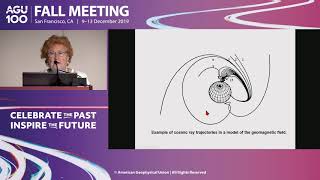
The 2019 Eugene Parker Lecture
Honoring solar astrophysicist Eugene N. Parker, this lecture at AGU Fall Meeting 2019 celebrates his contributions to the field and explores advancements in solar and space physics research.
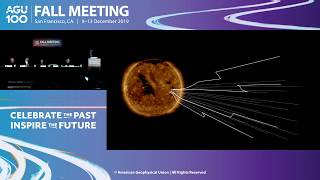
New Science from NASA's Parker Solar Probe Mission
Groundbreaking observations from Parker Solar Probe's closest-ever approach to the Sun, including measurements of coronal mass ejections and particle events, revealing new insights into solar phenomena affecting space technology.

Is Interstellar Travel Possible? - Challenges and Realities of Space Exploration
NASA scientist explores challenges and possibilities of interstellar travel, discussing latest exoplanet discoveries, promising missions, and technologies that may enable us to reach the stars.
When Galaxies Were Born - Exploring the Early Universe
Explore the birth of galaxies and early universe with Richard Ellis, delving into groundbreaking discoveries in modern cosmology and the quest to witness the dawn of starlight.

At the Limits of Astrophysics - Exploring Extreme Gravitational Phenomena
Explore the boundaries of astrophysics with Katy Clough, delving into supermassive black holes, wormholes, and warp drives, and how they fit into our current understanding of physics and Einstein's theory of general relativity.
Trailblazing Women Astronomers - Breaking Barriers in Modern Astronomy
Explore the journeys and contributions of pioneering women astronomers, breaking barriers and reshaping the field. Gain insights into scientific discoveries, role models, and the ongoing fight for gender equality in astronomy.
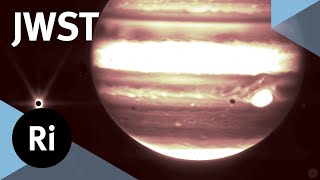
Solar System Science from the James Webb Space Telescope
Explore JWST's capabilities for solar system research, focusing on ice giants Uranus and Neptune, with NASA scientist Naomi Rowe-Gurney as she discusses new images and scientific potential.
Solving the Biggest Mysteries of the Universe - Multi-Messenger Astronomy
Explore multi-messenger astronomy and its role in unraveling cosmic mysteries, connecting the infinitely large and small, and advancing our understanding of the universe's biggest enigmas.

What's Eating the Universe? - Exploring Cosmological Enigmas
Award-winning physicist Paul Davies explores unexplained cosmic riddles, from ancient Greece to modern day, revealing cutting-edge research and potential solutions to the universe's greatest enigmas.
The Invisible Universe: From Supernovas to Black Holes
Explore the hidden cosmos beyond visible light, from ancient galaxies to black holes. Discover how astronomers use advanced technology to unveil the invisible universe and its fascinating phenomena.